
Club Costa Tropical · The Journal
Motril: from sugar to the port of the future
Motril (Granada) closes 2025 with a port record: 2.86 million tons, while its industry rises from the ashes of sugar toward logistics and solar energy. The last sugar mill: workers' memory of sugar. The city has turned its back for decades on its own industrial biography. But the chimney of the
Motril (Granada) closes 2025 with a port record: 2.86 million tons, while its industry rises from the ashes of sugar toward logistics and solar energy. The last sugar mill: workers' memory of sugar. The city has turned its back for decades on its own industrial biography. But the chimney of the Azucarera del Genil, a silent brick witness rising over the old town,
[[PHOTO:0]]
The Last Sugar Mill: Working-Class Memory of Sugar
[[PHOTO:1]]
The city has turned its back for decades on its own industrial biography. But the chimney of the Azucarera del Genil, a silent brick witness rising above the urban core, has become a reclaimed symbol. Declared a Bien de Interés Cultural (Asset of Cultural Interest), its silhouette is no longer a remnant of the past, but the anchor of a memory that refuses to dissolve into the concrete of new developments.
To understand the Motril of today—the one of record-breaking port activity and moving cranes—one must descend into the subsoil of its sweetest and, at the same time, most bitter history. Sugar production was no minor episode: in its peak years, the factory processed up to 40,000 tons annually, a volume that made the Motril plain one of the most significant agro-industrial hubs in the southern Iberian Peninsula. That activity generated more than 500 direct jobs, a figure that, translated into the demographics of the time, meant that practically every family in the town had a direct or indirect connection to the sugar mill.
The closure in 1984 was not a simple workforce adjustment. It was a social earthquake. The shutdown of the Azucarera del Genil and the Guadalfeo left a void that was not only economic but also symbolic. The noise of the machines, the smell of molasses that permeated the nearby streets, and the rhythm of the beet campaigns marked the vital calendar of the region. When the doors closed, that pulse stopped.
| Indicator | Years of full activity (1970-1980) | Impact after closure (1985-1990) | |:----------|:-----------------------------------:|:----------------------------------:| | Annual sugar production | Up to 40,000 tons | 0 tons | | Direct employment generated | More than 500 jobs | Total loss of jobs | | Associated beet cultivation area | Historical maximum in the plain | Drastic reduction and progressive abandonment | | Heritage status of the chimney | Unprotected | Declared BIC (in later years) |
The testimonies of those who lived through that era paint a landscape of extreme physical effort and working-class solidarity. Former workers recall the endless shifts during the milling campaign, when the factory operated at full capacity and shift changes followed one another without pause. There was no room for error: a breakdown in the line could mean the loss of tons of raw material and, with it, the livelihood of many families. Discipline was ironclad, but so was the pride of belonging to an industry that put Motril on the map.
That pride has now transformed into a civic and cultural movement that has driven the recovery of the factory's historical archive. Technical documents, blueprints, photographs of the work crews, and yellowed payroll records have been rescued from oblivion to reconstruct a history that textbooks had ignored. The working-class memory of sugar is not a closed chapter; it is living material that feeds exhibitions, heritage routes, and educational projects.
The chimney, which for years was considered an obstacle to urban development, is today the epicenter of that recovered narrative. Its preservation does not respond to empty nostalgia, but to the conviction that a territory that does not understand its industrial past can hardly project a future with its own identity. While the port breaks cargo records and containers pile up on the docks, the old factory reminds us that Motril's prosperity is not a new phenomenon, but a constant that has been mutating in form.
The transition from sugar to the port was not an agreed generational handover. It was a collective mourning that lasted years, with its phases of denial, anger, and finally acceptance. Those who lost their jobs in 1984 had to reinvent themselves in an economy that offered no immediate alternatives. Many emigrated; others found a place in the nascent service sector or in intensive greenhouse agriculture that was beginning to emerge. But none forgot the smell of molasses.
Today, when local development and sustainability are discussed, the lesson of sugar should serve as a warning. Dependence on a single productive sector proved to be a fragile strategy. Current diversification—with the port as the locomotive but with cultural tourism and organic agriculture as complements—is a mature response to that structural vulnerability.
The recovered archive is not a museum of curiosities. It is an analytical tool. Researchers who immerse themselves in its files find the keys to work organization, the power relations between management and unions, and the survival strategies of a community that knew how to withstand adversity. That documentation, now accessible, allows for a history of Motril to be written from below, from the perspective of those who built the wealth with their own hands.
The memory of sugar also has a landscape dimension. The remains of the old rails that connected the beet fields to the factory, the irrigation canals, and the warehouse structures form a dispersed industrial heritage that calls for comprehensive valorization. It is not about freezing time, but about integrating these elements into the contemporary urban discourse.
The contrast between the restored chimney and the port cranes is, in reality, a dialogue between two eras of prosperity. The first, based on the transformation of the land; the second, on connection with the world through the sea. Both share the same DNA: the adaptability of a city that has known how to read the signs of each era.
The former workers still alive to tell the tale are the custodians of a wisdom that is not taught in classrooms. Their stories, collected in the oral memory projects promoted by local associations, transmit values that transcend the merely labor-related: the dignity of work well done, the importance of community, and the certainty that progress cannot be built on amnesia.
While the port looks to the horizon with its record figures, the city must not forget that its other great infrastructure—the one that gave it its name and character for more than a century—also deserves a place in the narrative of the future. The sugar chimney is not an obstacle to progress; it is tangible proof that Motril knows how to rise, reinvent itself, and move forward without erasing its footprints.
From Sugarcane to Container: The Silent Conversion
[[PHOTO:2]]
The chimney of the Azucarera del Genil no longer spews smoke, but its shadow still stretches over Motril's industrial landscape. What for over a century was the economic heart of the region —sugar— has become a skeleton of converted warehouses where containers destined for Ceuta, Melilla, and North Africa are now stacked. The transformation has been neither noisy nor headline-grabbing, but it has completely reshaped the city's productive land.
The 1980s marked the beginning of the end of an era. The sugar mills, which at their peak employed more than 2,000 workers, closed one after another. Mechanization of agriculture, competition from sugar beet in Northern Europe, and the liberalization of the EU sugar market did the rest. Motril, which had lived off sweetness for generations, faced an industrial void that was difficult to fill.
The response did not come immediately. For nearly two decades, the land occupied by the factories remained in an administrative and urban planning limbo. Huge warehouses, designed to house milling machinery and steam boilers, sat empty while the city debated what to do with its past. Some were demolished; others simply waited.
The turning point came in 2005, when the port of Motril was established as an autonomous port authority. Administrative independence allowed for more agile management and its own commercial strategy, free from the oversight of Almería and Málaga. It was then that the old sugar warehouses, strategically located next to the port complex, began to awaken from their slumber.
| Indicator | 1980s (sugar) | 2025 (port logistics) | |-----------|-----------------|---------------------------| | Direct employment | 2,000 workers | 1,200 workers | | Active industrial area | 45,000 m² in mills | 38,000 m² in logistics warehouses | | Main activities | Milling, refining, distilling | Containers, bulk cargo, goods transit | | Anchor companies | 3 sugar mills | 12 logistics operators | | Productivity per worker | Low, seasonal (4-5 month campaign) | High, continuous (year-round) |
The employment figures do not lie: the city has gone from 2,000 workers tied to sugar to 1,200 in port logistics. The difference, however, is not merely quantitative. Sugar employment was seasonal, concentrated in the milling campaign that lasted barely five months a year, and depended on a harvest that fluctuated with rainfall and pests. Logistics employment, by contrast, operates 365 days a year, with rotating shifts and unceasing demand.
The conversion has been possible thanks to Motril's privileged location, just 40 nautical miles from the African coast. The warehouses that once held 50-kilo sacks of sugar now manage container transits with minimal waiting times. The old truck scales now weigh diverse cargo: from perishable goods bound for Northern European markets to construction materials for Morocco's coastal cities.
Not all industrial land has changed use. Some warehouses retain their original structure, with those sawtooth roofs that betray their factory origins. Others have been completely remodeled, losing any trace of their sugar past. The resulting mix creates a hybrid landscape, halfway between industrial archaeology and logistical modernity.
The process has not been without tensions. Unions at the time denounced the loss of jobs and the precariousness of working conditions in the logistics sector, where subcontracting and temporary contracts abound. Business owners, for their part, argue that the conversion prevented a total industrial vacuum and laid the foundations for the port's current growth.
The transformation of industrial land has also had a significant urban impact. The land occupied by the mills farthest from the port has been rezoned for residential and service use, giving rise to new neighborhoods that have nothing to do with the city's factory past. Only the most emblematic buildings, such as the chimney of the Azucarera del Genil, have been spared from the wrecking ball as heritage elements.
The balance sheet of this silent conversion is complex. On the one hand, the city has managed to maintain a productive fabric tied to the port, avoiding the economic collapse suffered by other Andalusian sugar towns such as Loja or Antequera. On the other, dependence on port traffic exposes Motril to fluctuations in international trade and competition from neighboring ports like Almería or Málaga.
The 2025 data confirm that the bet has paid off, at least for now. The 2,860,763 tons moved during the year represent an all-time record that validates the strategy of logistical specialization. But the question hanging in the air is whether this new economy will be as durable as sugar was, which sustained the city for over a century.
The old sugar warehouses, converted into container depots, are the symbol of a city that has known how to adapt without entirely renouncing its memory. Sugar is no longer produced in Motril, but the city still lives off what passes through its port. The conversion, silent and gradual, has ultimately imposed itself as the only viable path to economic survival.
The port that woke up: figures of a record
[[PHOTO:3]]
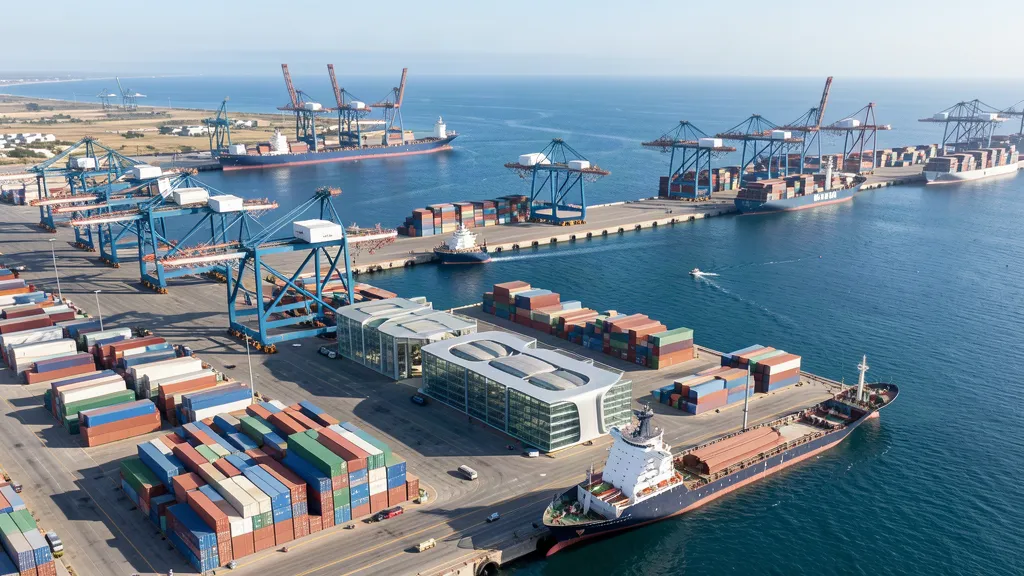
The figure has the force of a done deal: 2,860,763 tons. That is the amount of cargo moved by the port of Motril throughout 2025, a magnitude not seen on the Granada docks since 2006, when traffic reached its previous all-time high. The difference, of course, is that that record from nearly two decades ago was achieved in a context of widespread economic prosperity, while the current one has been reaped in a scenario of geopolitical tensions and reconfiguration of global maritime routes. The figure also represents a year-on-year growth of 8.4%, an acceleration that few ports of general interest to the State can boast in their year-end balance sheet.
What stands out most in the official records of the Port Authority is not only the absolute volume, but the composition of the growth. The number of ship calls has remained practically stable compared to previous years. There has been no avalanche of new vessels knocking on the port's door. What has happened is something quieter and, in the long run, more significant: the ships that were already coming now come bigger. The gross tonnage (GT) of vessels docking in Motril has doubled compared to the recent historical average. In other words, the port has ceased to be a minor cabotage port and has become a node capable of absorbing larger-scale traffic, with vessels of greater draft and cargo capacity.
| Indicator | Fiscal year 2024 | Fiscal year 2025 | Variation | |---|---|---|---| | Total cargo traffic (tons) | 2,638,600 (approx.) | 2,860,763 | +8.4% | | Previous historical record (2006) | — | 2,800,000 (approx.) | Surpassed | | Ship calls | Stable | Stable | No significant variation | | Gross tonnage (GT) of vessels | Baseline | Doubled | +100% |
The president of the Port Authority, José García Fuentes, has described the fiscal year as "historic," and he is not without reason if one looks at the evolution of recent years. The port of Motril has gone from being a nearly symbolic infrastructure, dependent on the ups and downs of the local agri-food sector, to consolidating itself as a logistics platform with an international outlook. General cargo, containers, and agri-food bulk goods have been the drivers of this takeoff, with special prominence given to horticultural products leaving the Granada and Almería plains bound for European markets.
The coincidence of the record with the twentieth anniversary of the port's constitution as an independent entity adds a symbolic layer to the numerical figure. Two decades after Motril assumed autonomous management of its port facilities, the balance could not be more eloquent: it has gone from a peripheral infrastructure to a strategic asset. Investment in drafts, in open yards, and in pending rail access — a subject still unresolved — has been transforming the appearance of docks that for decades lived in the shadow of the great Andalusian ports.
Partial data had already anticipated this trend. At the close of September, accumulated statistics showed a characteristic that the Port Authority's technicians emphasize with particular insistence: the relationship between the number of vessels and the tonnage moved evidenced that the strategy of attracting higher value-added traffic was working. It is not about moving more just for the sake of moving, but about moving better. And in that sense, the increase in vessel GT is the most reliable indicator that the port has made a qualitative leap in its positioning within the network of ports of general interest to the State.
The question floating in the port environment is whether this pace is sustainable. García Fuentes has spoken of "good progress," a prudent expression that does not hide the ambition to keep growing. The rail connection, the eternal pending subject, remains the bottleneck preventing Motril from developing its full potential as a link port between the Mediterranean and the interior of the peninsula. Until that infrastructure arrives, the port will continue to depend excessively on road transport to distribute its goods, a burden that raises logistics costs and limits competitiveness compared to other better-connected enclaves.
Even so, the 2025 figures show that the port has awakened from a long slumber. The comparison with 2006, the previous record year, is inevitable. Back then, the port moved a similar amount of tons, but in a radically different context: the real estate bubble had not yet burst, vehicle and construction material traffic was driving the docks, and the economic crisis that would devastate the country was just around the corner. That record deflated with the recession, and the port took years to recover its momentum. The question is whether the current upward cycle has more room to run or whether, as then, it is a circumstantial mirage.
Port officials are confident it is not. The diversification of traffic, the commitment to agri-food bulk goods, and the growing container activity offer a more solid foundation than dependence on a single sector. The port of Motril has learned the lesson of 2006: ephemeral records are useless if they are not built on a diversified productive structure. The 2,860,763 tons of 2025 are, in that sense, a starting point rather than a finish line. The infrastructure is ready, operators have responded, and foreign demand continues to grow. What is missing, as always, is for the administrations to follow through with the pending investments.
Meanwhile, the docks of Motril keep moving cargo. The ships, increasingly larger, dock and undock at a pace that has nothing to do with that of a decade ago. The port has ceased to be an appendage of the city and has become one of its main economic engines. The figures confirm it. The 2025 record is not a statistical accident, but the result of a sustained strategy over time that has finally managed to give Motril its own place on the Spanish port map.
Investment of 105 million: the master plan
[[PHOTO:4]]
The master plan that the Port Authority has on the table is not just another document stuck in a drawer. It represents 105 million euros committed for a horizon spanning 2025 to 2030, aiming to rewrite the logic of a port that for decades lived with its back to its own potential. The figure, broken down into three major fronts, aspires to turn the Motril dock into a logistics hub of the western Mediterranean, not merely a berthing point for bulk cargo traffic.
The first front, and the one concentrating the largest budget allocation, is the new container terminal. The bet is not a minor one: moving from a nearly testimonial operation to a capacity capable of absorbing the roll-on/roll-off traffic and containers that today escape toward Algeciras or Málaga. The terminal, which will occupy an expanded surface area over the current esplanade, will incorporate two rubber-tyred gantry cranes and a storage area with direct connection to the future rail access. Demand studies handle an optimistic projection: a 30% increase in total freight traffic by 2030, with a range placing annual movement at around 3.7 million tonnes.
The second front is the expansion of the cruise ship dock. Motril has watched with envy for years as Málaga took the large passenger ships that sail the Mediterranean. The planned work extends the current dock by 250 linear metres, allowing the simultaneous berthing of two large vessels. The dock will also gain a new maritime station capable of processing 1,500 passengers per hour, a qualitative leap seeking to position the city as a home port for the Alboran circuit. Cruise tourism, which moved barely 40,000 passengers in 2025, aims to double that figure within three years.
The third front, and perhaps the most strategic, is the improvement of rail access. The project contemplates connecting the port to the Mediterranean Corridor through a 12-kilometre branch line that would link with the conventional Granada-Motril line. Investment in this section exceeds 30 million euros and includes electrification of the stretch and the construction of a rail yard within the port premises. The logic is impeccable: without rail, the port will remain condemned to depending on road transport to move its goods, with the costs and emissions that entails.
| Action | Investment (million €) | Timeline | Expected impact | |--------|----------------------|----------|-----------------| | Container terminal | 45 | 2025-2028 | +30% freight traffic | | Cruise dock expansion | 25 | 2026-2029 | 80,000 passengers/year | | Rail access | 30 | 2027-2030 | Mediterranean Corridor connection | | Other improvements (paving, lighting, digitalisation) | 5 | 2025-2027 | Facility modernisation | | Total | 105 | 2025-2030 | 500 direct jobs |
Financing is no minor issue. The Port Authority manages a mixed scheme combining its own funds, from profits accumulated in recent financial years, with the State ports financing mechanism and possible public-private collaboration for the container terminal. The expected profitability of the operation is supported by a demand study that anticipates reaching the break-even point in the fifth year of operation of the new facilities.
The employment impact is the other pillar of the project. The 500 direct jobs expected to be generated is no small figure for a region with an unemployment rate that has historically doubled the Andalusian average. Added to those positions are the induced ones: transport, stevedoring, shipping agencies, hospitality and auxiliary services. The Port Authority's own calculations estimate that each direct job at the port generates another three in the surrounding area, which would raise the total impact to nearly 2,000 jobs across the entire Costa Tropical.
The timelines are ambitious but not unrealistic. The container terminal has technical approval and the environmental processing is already underway. The cruise dock expansion depends on final approval of the port space utilisation plan, expected by mid-2026. The rail access is the most complex: it requires coordination with Adif and the Junta de Andalucía, and the environmental impact statement for the route could delay the start of works until 2027.
Competition does not wait. The port of Algeciras has announced a new container terminal for 2027, and Málaga continues expanding its cruise offering with an eye on the Asian market. Motril plays the card of proximity to the Granada metropolitan area, to the eastern Costa del Sol and to a hinterland that includes the provinces of Jaén and Almería. The rail connection, if it materialises within the planned timelines, would turn the port into the natural outlet for agricultural production from the Granada plain and Almería's marble toward North African and eastern Mediterranean markets.
The master plan also has an environmental dimension that is not cosmetic. The installation of a shore-side electricity supply system for berthed vessels, known as shore connection, will reduce emissions from ships' auxiliary engines during their stay in port. The digitalisation of access points and intelligent management of freight flows complete a package seeking to certify the port as sustainable infrastructure before the European Union, an increasingly demanding requirement for accessing cohesion funds.
The city watches the plan with contained expectation. The people of Motril have seen too many projects announced with great fanfare that then remained at the mock-up stage. But this time there are substantial differences: feasibility studies are done, financing has a defined scheme, and maritime traffic demand in the western Mediterranean continues to grow. The question is not whether the port will grow, but whether Motril will know how to take advantage of that growth to weave a productive fabric that goes beyond stevedoring and transport.
Solar Energy: The New Gold of the Vega
[[PHOTO:5]]
The Motril plain keeps an open-air secret. Where the green of sugarcane once rippled, a dark and shiny mantle of photovoltaic panels now stretches, converting light into electricity. The transformation has not been silent, but it has been steady. The lands that fed the local sugar industry for centuries, those that sustained generations of farmers and kept the chimney of the Azucarera del Genil alive, now house one of the largest concentrations of solar energy in the province of Granada.
The numbers speak clearly. In the municipality of Motril, the photovoltaic plants already installed and operational add up to 150 megawatts of power. To put that figure in perspective, it is enough to recall that the old sugar factory, in its years of greatest splendor, generated electricity for its own consumption and fed a surplus to the grid that barely exceeded 5 megawatts. The difference is not merely quantitative: it is structural. Sugarcane offered four harvests a year, conditioned by the agricultural cycle, rainfall, and seasonal labor. The sun, on the other hand, does not understand agricultural calendars. It offers its energy for 365 days, with a regularity that no harvest could ever guarantee.
| Concept | Sugarcane (golden era) | Solar energy (2025) | |---|---|---| | Annual production cycle | 4 harvests | 365 days | | Installed capacity | ~5 MW (factory self-consumption) | 150 MW (plants in the municipality) | | Climate dependence | Rainfall, frost, pests | Solar radiation (predictable) | | Labor per hectare | High, seasonal | Low, technical maintenance | | Income generation | Subject to sugar prices | Subject to electricity market, with long-term contracts |
The installation of these panels has followed a logic of land use that has not been without debate. The plots chosen were, for the most part, parcels that had lost their agricultural profitability after the definitive closure of the sugar industry in 2006. The land, salinized by years of intensive irrigation and exhausted by successive monocultures, no longer offered viable alternatives. Landowners found in leasing for solar plants a stable source of income, far superior to what they obtained from marginal dryland crops or abandoned plots.
The port of Motril has become fully involved in this energy equation. The local energy community currently being developed includes the direct participation of the Port Authority, which sees in solar energy a double opportunity. On the one hand, reducing the carbon footprint of port operations, an increasingly demanding requirement for maintaining trade routes with northern European ports, where environmental regulations are strict. On the other, the possibility of offering docked ships clean electricity for their auxiliary services, eliminating the need to burn diesel fuel while they remain in port.
The first steps of this energy community have already been taken. The panels installed on the roofs of port warehouses and on parking lot canopies generate electricity that is consumed directly in the port's facilities. The surplus is fed into the grid, and the profits are distributed among the community members, which include small businesses in the port area and residents of nearby neighborhoods. The model replicates, with the logical differences, the cooperativism that characterized the old sugar societies, where farmers pooled their harvests to keep the factory alive.
The comparison between sugar and solar energy is not just a journalistic metaphor. It has practical consequences for the territory. Sugarcane occupied, in its best era, more than 4,000 hectares in the region. Current photovoltaic plants occupy a fraction of that surface area but generate comparable economic value. Productivity per hectare has multiplied: a hectare of solar panels in Motril annually produces the energy equivalent to the consumption of about 150 Spanish households, while a hectare of sugarcane yielded, at best, the sugar needed to sweeten the annual consumption of about 2,000 people. The comparison is imperfect, but it illustrates the paradigm shift.
Critics of this transformation rightly point to the loss of a cultural landscape that defined the identity of the region. Sugarcane was not just a crop: it was a way of life, an aesthetic, a collective memory. Solar panels, with their industrial aesthetic and dark blue monochrome, evoke none of that. But economic reality is stubborn. Beet sugar produced in northern Europe, with millions in subsidies, made sugarcane cultivation unviable on the Granada coast. The land needed a new function, and solar energy has filled that void with an efficiency that the market has validated.
The local energy community project adds an additional layer of interest. It is not just about producing electricity, but about democratizing its consumption. Motril residents who join the community will be able to access reduced rates, with estimated savings of up to 30% on their electricity bills. For a municipality with an unemployment rate that has historically exceeded the Andalusian average, that saving represents tangible relief for household economies. Solar energy, which in its early days was seen as a business for large corporations, is becoming a tool for social cohesion.
Generation data supports the optimism. The Motril area enjoys an average of 3,200 hours of sunshine per year, one of the highest in continental Europe. Each installed kilowatt in the municipality produces an average of 1,700 kilowatt-hours per year, well above the national average. That comparative advantage makes the Motril plain a strategic enclave for renewable generation, with growth potential already contemplated in urban planning. New installations will have to coexist with the remains of the sugar heritage, but that coexistence, far from being an obstacle, can become a tourist attraction: the chimney of the Azucarera del Genil, a silent witness to the past, now stands surrounded by panels that look to the future.
The transition has not been without tensions. Farmers who still cultivate vegetables on the most fertile plots of the plain fear that solar expansion will devour land of high agronomic value. The authorities have responded with regulations that limit new plants to degraded or low-productivity soils, preserving active irrigated areas. The balance is delicate, but so far it has been maintained. The Motril plain has not died: it has been transformed, and in that transformation it has found a new reason to exist.
From Sugar to Lithium: The Chemical Conversion
[[PHOTO:6]]
The sweet smell that for over a century permeated the warehouses of the Motril industrial estate has been replaced by another—more technical, more metallic. Where the old sugar mills housed steam boilers and cane conveyor belts, today biofuel production lines are assembled and lithium derivatives are processed for electric vehicle batteries. The conversion has not been a market accident, but a surgical operation on the city's industrial fabric.
The most visible operation is led by a chemical plant that has invested 40 million euros in the comprehensive rehabilitation of two warehouses that belonged to the Azucarera del Guadalfeo sugar complex. The company, dedicated to the production of second-generation biodiesel from used oils and agricultural waste, has generated 200 direct jobs—a figure that gains perspective when compared with the 350 jobs the sugar industry sustained in its best years, but which are now distributed across very different profiles: process engineers, laboratory technicians, chemical logistics specialists.
Lithium, for its part, has found in Motril a strategic point for its intermediate transformation. A second company, with mixed Spanish-German capital, has installed in another of the rehabilitated warehouses a lithium carbonate refining line that supplies European battery cell manufacturers. The raw material arrives by ship from Chile and Argentina, is processed in Motril, and leaves again through the port bound for assembly plants in Germany and France. The circuit is an example of circular economy applied to logistics: the port not only moves tonnage, it also adds value.
| Indicator | Historic Sugar Mill (1970-2005) | New Chemical Industry (2025) | |---|---|---| | Cumulative investment | 12 million euros (estimate) | 40 million euros | | Direct employment | 350 workers | 200 workers | | Area occupied | 45,000 m² | 38,000 m² | | Main product | Cane sugar | Biofuels and lithium derivatives | | Production destination | Domestic market | Export (70% of volume) | | Energy consumption | Coal and fuel oil | Solar photovoltaic and biomass |
The connection with the port is not decorative. 70% of the production from these new plants leaves through Motril's docks, which has forced the Port Authority to commission a new liquid bulk storage system with a capacity of 12,000 cubic meters. This infrastructure, inaugurated in the last quarter of 2025, has been key to shipping companies including Motril in their regular chemical product routes, a segment previously dominated by the ports of Algeciras and Valencia.
The chemical conversion has had an unexpected side effect: the recovery of industrial heritage. The warehouses that today house the new plants preserve their original wrought iron and exposed brick structure, protected by the municipal catalog. The new tenants have had to adapt their processes to the historic volumes, which has generated unique architectural solutions, such as the installation of stainless steel tanks that coexist with the old brick chimneys, now converted into passive ventilation elements.
The local business fabric has reacted quickly. Three auxiliary companies from Motril have signed supply contracts with the new plants: one for pump and valve maintenance, another for internal transport of hazardous goods, and a third specializing in laboratory analysis. These are small companies, with between 10 and 25 workers, that have found in chemistry a stable niche after years of dependence on the service sector.
Training has been the bottleneck. The arrival of these industries required technical profiles that the region could not offer in sufficient quantity. The Motril City Council, in collaboration with the Junta de Andalucía, has launched a dual vocational training program that has already certified 45 operators in chemical substance handling and process control. The second cohort, with 60 students, is currently underway. The employment insertion data are telling: 92% of graduates from the first cohort work in the new plants or their auxiliary companies.
The impact on the industrial estate's turnover is measurable. The chemical companies installed in the old sugar warehouses invoiced a total of 85 million euros in 2025, a figure representing 18% of Motril's total industrial fabric. The projection for 2026, according to the companies' own forecasts, points to exceeding 100 million, provided European demand for biofuels holds and the lithium supply chain does not suffer new geopolitical tensions.
The conversion has not been without tensions. Residents of the San Agustín neighborhood, adjacent to the industrial estate, expressed their concerns at the time about the potential environmental risks of the new activities. The companies' response has been transparency: real-time air quality monitoring stations, publicly accessible, and a monitoring committee with neighborhood participation that meets quarterly. The 2025 data show no exceedance of safety thresholds—an argument that has gradually dispelled initial reluctance.
Lithium and biofuels have restored to Motril a condition that seemed lost: that of an industrial city with international projection. Sugar cane is no longer cultivated in the plain, but its industrial heritage has found an unexpected successor in clean chemistry. The warehouses that once processed cane now process Europe's energy future, and the port, which once shipped sacks of sugar to northern markets, today dispatches containers of refined lithium carbonate to the continent's battery factories.
The port as a logistics hub for North Africa
[[PHOTO:7]]
The Strait of Gibraltar is no longer the only point of commercial friction between two continents. On the map of western Mediterranean shipping routes, Motril has ceased to be an alternative and has become a choice. The figure that proves it: 1.2 million tons of goods moved with North Africa during 2025, a flow growing at an annual rate of 12% and already representing more than 40% of the port's total traffic.
Geography works in favor of the Granada dock. From its piers, the distance to Nador is barely 98 nautical miles; to Tánger Med, 135. Algeciras, the giant of the Strait, needs to cover 45 more miles to reach the same Moroccan destination. Málaga, for its part, starts with a 30-mile disadvantage. In a business where fuel accounts for 40% of the operating cost of a ro-ro vessel, every mile saved translates into a competitive advantage that shipowners have already begun to calculate.
| Route | Distance (nautical miles) | Average transit (hours) | 2025 goods (tons) | |------|---------------------------|----------------------|----------------------------| | Motril – Nador | 98 | 5.5 | 680,000 | | Motril – Tánger Med | 135 | 8 | 420,000 | | Algeciras – Tánger Med | 45 | 2.5 | 3,200,000 | | Málaga – Melilla | 110 | 6 | 350,000 |
The table reveals a paradox: Algeciras continues to dominate in absolute volume, but its chronic saturation —collapsed land access, berthing waits exceeding 12 hours on peak days— is pushing logistics operators to seek secondary ports with idle capacity and direct connections. Motril offers both.
The regular ferry and ro-ro lines operating from the Granada coast have gone from two to five weekly connections with Morocco in the last two years. The shipping company Balearia maintains a constant rotation with Nador, while Armas Trasmediterránea has reinforced its service to Alhucemas and Melilla. Passenger traffic also follows suit: 245,000 travelers in 2025, 18% more than the previous year, many of them cross-border workers and families from the Moroccan diaspora settled in eastern Andalusia.
The twinning agreement signed with the port of Nador in 2023 is yielding concrete results. The container terminal of the Moroccan city, managed by the Marsa Maroc group, has established a coordinated calls protocol that allows vessels to unload in Motril and pick up return cargo without idle time. The agreement also includes joint training of stevedores and the harmonization of customs management computer systems, a decisive step in reducing clearance times from 48 to 12 hours.
Tánger Med, the port that has turned Morocco into a global logistics platform, is also looking toward Motril. The relationship is not one of competition but of complementarity. While the Moroccan port channels the major international transshipment flows —the megaships crossing the Mediterranean bound for Europe and America— Motril absorbs the regional goods traffic that needs to reach inland Spain without passing through the Strait bottleneck. Moroccan horticultural products —tomatoes, peppers, citrus fruits— entering through the Granada dock are distributed directly toward the Levante and central Spain via the A-7 motorway and the rail corridor connecting with Granada and, from there, with the rest of the national network.
The commitment to North Africa is not limited to Morocco. Algeria, a market of 45 million consumers with growing demand for food products and construction materials, has reactivated its imports through Motril after the hiatus of the 2022 diplomatic crisis. 2025 data shows 120,000 tons moved with Algerian ports such as Orán and Mostaganem, a modest figure but one that grows quarter after quarter. The Macael marble sector, in neighboring Almería, uses this route to export natural stone to Algerian construction projects, while Granada's cement plants find an expanding market on the African coast.
Motril's competitive advantage over its Andalusian rivals rests on three pillars. The first is distance: the shortest between the Peninsula and North Africa for most Moroccan and Algerian ports. The second is the absence of congestion: while Algeciras operates at 95% of its capacity, Motril barely reaches 60%, guaranteeing immediate berthing times and maneuvers without waiting. The third is land connectivity: the A-44 motorway links directly with the Granada-Madrid axis, and the port has a logistics activities zone of 200,000 square meters with rail access already planned.
Moroccan businessmen have noticed this change. The Hispano-Moroccan Chamber of Commerce has recorded a 30% increase in 2025 in requests for information about facilities in the area of influence of the port of Motril. The nearby industrial estate, with land available at prices significantly lower than those on the Málaga or Cádiz coast, has become the natural destination for logistics and distribution companies seeking a gateway to the European market without the costs of the Strait.
The Granada port has understood that its future lies not in competing with the major transshipment ports, but in specializing in proximity traffic with the Maghreb. A strategy that has already borne fruit: goods traffic with Africa now represents 42% of the total moved, when a decade ago it barely reached 15%. According to reports from the Port Authority, the trend points to this proportion continuing to grow in the coming years, driven by Algeria's economic recovery and Morocco's consolidation as an industrial hub.
The connection with North Africa is not just a matter of figures. It is also a commitment to regional stability. The port of Motril has become a meeting point between two shores that share history, geography and, increasingly, economic interests. The cooperation agreements with Nador and Tánger Med are not mere institutional protocols; they are the expression of a commercial reality growing at a pace that not even the operators themselves expected. The Granada dock, born to export sugar from the plain, has found in North Africa its new raison d'être.
Subtropical agriculture: from mango to container
[[PHOTO:8]]
The land here does not rest. While the port moves containers and the chimney of the old sugar mill has become a museum, the slopes descending from the Sierra de Lújar to the Mediterranean produce something that cannot be seen from the ship: 200,000 tonnes of avocado, mango, and cherimoya every year. The Costa Tropical has found its true reconversion in subtropical farming, and the port of Motril, its natural outlet.
The figure is not a statistical whim. Behind those 200,000 tonnes lies a silent transformation that began three decades ago, when local farmers discovered that the microclimate of this coastal strip — the only one in continental Europe with average temperatures above 18 degrees — allowed them to grow fruits that until then had only arrived from America or Southeast Asia. Today, data from the Oficina Comarcal Agraria (OCA) confirm that production has consolidated as the leading economic engine of the region's agricultural interior, far surpassing traditional rain-fed crops.
Exports have found an unexpected ally in the port of Motril. Traffic in fruit and vegetable products has grown by 15% during 2025, according to records from the Port Authority. The refrigerated containers leaving the Motril dock carry the Osteen variety of mango — the most widely cultivated in the area — to Amsterdam, Hamburg, or Dubai. Hass avocado, for its part, finds in the Andalusian port a real alternative to the congested access points of Algeciras or Valencia. Logistics has responded: regular lines with direct connections to northern European ports have reduced transit times to less than 48 hours.
| Product | Annual production (tonnes) | Main destination | Export growth 2025 | |----------|------------------------------|-------------------|------------------------------| | Avocado | 95,000 | European Union | +18% | | Mango | 70,000 | Northern Europe | +12% | | Cherimoya | 35,000 | Domestic market | +8% | | Total | 200,000 | — | +15% |
The OCA, based in Motril, advises farmers from 17 municipalities in the region. Its work goes beyond mere aid management: it coordinates biological control programmes, supervises trial plots, and acts as an intermediary between producers and the authorities. The office has detected a recurring problem this year: pests — especially the fruit fly and thrips — have caused estimated losses of 8% of the mango harvest. Added to this are the effects of an increasingly erratic climate, with episodes of torrential rain that have damaged irrigation systems on the most exposed farms.
Farmers have called on the Junta de Andalucía for a package of specific aid to compensate for these losses. The request, channelled through agricultural organisations, includes declaring the most affected holdings a disaster zone and extending agricultural insurance to cover damage from extreme weather events. The administrative response, for now, has been limited to commitments to study the matter. Meanwhile, local cooperatives have chosen to diversify: some have begun experimenting with drought-resistant varieties, such as the Bacon avocado or the Keitt mango, which require less water and tolerate extreme temperatures better.
The port has responded to this demand with specific investments. The container terminal has expanded its capacity for reefer container plug-in points — those that maintain the cold chain — by 30% over the past year. The docks of Motril can now accommodate up to 400 refrigerated containers simultaneously, a figure that doubles the capacity of just five years ago. The connection with the Mercamotril logistics centre, located less than two kilometres from the port, allows fruit to go from tree to ship in less than 24 hours.
The relationship between the countryside and the port has become so close that agricultural cooperatives have begun signing multi-year agreements with the shipping lines operating in Motril. These contracts guarantee space on vessels during harvest peaks — from September to January for avocado, from August to October for mango — and ensure stable rates in a market where freight can fluctuate by up to 20% depending on demand. The formula has worked: 40% of the region's subtropical production now leaves through the port of Motril, compared to 25% three years ago.
One challenge remains: cherimoya, the most traditional of the three crops, still depends excessively on the domestic market. Its fragility — the fruit does not withstand long journeys well — limits its export to the closest European markets, such as France or Italy. The OCA is working on improving cold-storage preservation protocols, hoping to open new trade routes towards Eastern Europe. Trials conducted this year with controlled atmospheres have succeeded in extending the shelf life of cherimoya by up to 15 days, an advance that could change the rules of the game for this crop.
Meanwhile, the port's machinery does not stop. Green containers with the local cooperatives' logo are stacked alongside the grey ones of international shipping lines. Each one contains the story of a transformation: that of a region that knew how to swap sugar cane for mango, and that is now learning to turn mango into foreign currency. The land continues to bear fruit, but it is no longer content with feeding local markets: it wants to conquer the world, container by container.
The Industrial Legacy: Heritage That Sells Tourism
[[PHOTO:9]]
The chimney of the Nuestra Señora del Pilar factory no longer spews smoke, but it remains the vertex from which Motril's new tourism map is ordered. At its base, the processing hall—that enormous skeleton of brick and iron that for a century turned sugarcane into sugar—has ceased to be an eyesore and has become the region's main cultural attraction. The figure handled by the Municipal Tourism Board best summarizes the paradigm shift: 50,000 visitors passed through its doors during 2025. That is no small number for a city desperately seeking to de-seasonalize its offering beyond sun and beach.
The building, restored after a multi-million-euro investment that combined structural consolidation with the musealization of the original machinery, has not limited itself to hanging explanatory signs. The old turbines, cooking pans, and centrifuges—greased and in symbolic operation—have been integrated into an exhibition narrative that explains the industrial process without sacrificing the emotion of the authentic. The visitor does not contemplate a model; they walk the same polished concrete floor the workers walked, smell the same oil from the transmissions, hear the echo of a hall that once housed more than 600 workers during campaign shifts.
Working-class memory has here become an asset with market value. Guided tours, often led by retired former factory employees, add a layer of authenticity that no audiovisual can replicate. Their explanations of cooking times, anecdotes from harvest nights, or descriptions of working conditions in the 1950s generate an emotional connection that visitors appreciate and, above all, recommend. Word of mouth has worked: the museum has gone from being a local curiosity to occupying a prominent place in travel guides specializing in Andalusian industrial tourism.
But the project does not end within the museum's walls. The so-called 'Motril Industrial' Tourist Route has woven an itinerary connecting the three fundamental landmarks of the city's economic history: the sugar factory's chimney itself, the port, and the fertile plain. The route, which can be done on foot, by bicycle, or on a small tourist train operating on weekends, presents a narrative about the transformation of the landscape. It begins at the chimney viewpoint, where a metal walkway allows viewing the city from an unprecedented perspective, and descends toward the port, explaining how goods traffic has evolved from sugar to containers. It ends in the plain, where the visitor understands, on site, that the origin of all this wealth lies in the fertile soil and the water of the irrigation channels.
| Indicator | 2023 | 2024 | 2025 | Change 2024-2025 | |---|---|---|---|---| | Sugar museum visitors | 28,400 | 36,100 | 50,000 | +38.5% | | 'Motril Industrial' route users | 9,200 | 12,800 | 18,500 | +44.5% | | Hospitality jobs (annual average) | 1,240 | 1,310 | 1,415 | +8.0% | | Hotel overnight stays (thousands) | 214 | 226 | 249 | +10.2% | | Box office and guided tour revenue (€) | 142,000 | 189,000 | 268,000 | +41.8% |
Tourism employment data reinforces the thesis that industrial heritage is not an ornament but an economic engine. Motril's hospitality sector closed the year with an 8% increase in its workforce, growth that cannot be explained solely by the summer pull. Establishments have extended their hours outside peak season, brought in staff specialized in serving foreign visitors, and diversified their gastronomic offering to cater to a tourist profile demanding local products and experiences tied to the territory. The connection between the museum and restaurants is direct: 62% of visitors to the sugar complex consume at establishments in the historic center or the port, according to a survey conducted by the tourism department.
The bet on industrial memory as a draw also has a multiplying effect on the city's own identity perception. The people of Motril, who for decades saw the factory as a symbol of a glorious but surpassed past, have begun to revalue it as a mark of distinction. School visits have multiplied, educational centers have incorporated the route into their curricula, and neighborhood associations organize themed tours that recover the stories of the adjacent working-class districts. The factory has ceased to be a static monument and has become a living space hosting concerts, craft fairs, and producer markets throughout the year.
The success of the Motril formula has not gone unnoticed at the regional level. The Tourism Department of the Junta de Andalucía has included the project in its catalog of good practices in industrial tourism, and several Mediterranean basin cities with an industrial past have sent technicians to study the model. The key, according to municipal officials, has not been solely the restoration of the shell but the creation of a narrative connecting the workers' effort with the current prosperity of the port. That narrative, which avoids paternalism and empty nostalgia, is what is attracting a cultural tourist with high purchasing power and low environmental impact.
The fertile plain, that other great protagonist of the route, provides the landscape counterpoint. The paths between cherimoya and avocado crops, dotted with old farmhouses rehabilitated as rural accommodations, complete an offering that no longer depends exclusively on the sun. The visitor arriving in Motril looking for the beach finds a destination offering, within a ten-kilometer radius, a first-rate museum, a bustling commercial port, and an agricultural landscape unique in Europe. That diversity is precisely what is allowing the city to maintain hotel occupancy during autumn and winter weekends—an unprecedented phenomenon in the last decade.
The challenge now is to consolidate growth without losing authenticity. Tourist pressure on the historic center is beginning to be felt, and the City Council has approved an ordinance to regulate visits by large groups and protect residents' tranquility. Managing the flow of visitors to the museum, with mandatory advance booking for weekends, has maintained a quality experience without overcrowding the facilities. The figure of 50,000 annual visitors is considered the reasonable operational ceiling with current infrastructure, although an expansion of the exhibition space in the old sugar warehouses is already being studied to house a permanent collection of agricultural machinery.
Motril's industrial legacy has ceased to be a burden and has become an asset that generates employment, attracts visitors, and reinforces the self-esteem of a community that has known how to read its history without complexes. The chimney, which for decades was the symbol of an economy dependent on a single product, is now the emblem of a city that has diversified its future without renouncing its roots.
The Cruise Port: Luxury Tourism on the Coast
[[PHOTO:10]]
The horizon of Motril is no longer measured only in tons of cargo. Since the last fiscal year, the Granada harbor has incorporated a new variable into its port equation: the passenger who arrives with a camera, a credit card, and barely twelve hours to decide whether this coast deserves a second visit. The 2025 numbers paint a reality that until recently seemed reserved for higher-ranking ports: 45 cruise ships docked at its piers throughout the year, disembarking 60,000 passengers. That figure, which triples the 2023 records, has turned Motril into the third stop on the eastern Andalusian coastline, behind only Málaga and Almería, though with a growth rate that invites a revision of that hierarchy.
The profile of the cruiser who sets foot in the port of Motril has little to do with the sun-and-beach tourist who fills the beach bars of the Costa Tropical in August. We are talking about a traveler with an estimated average daily spend of 200 euros, who seeks not only a towel and sangria, but experiences that connect with the territory. Organized excursions from the port are divided between the Alpujarra, the sugar route, and the beaches of nearby Almuñécar, although local consumption data suggests that the real economic impact stays in the region: 12 million euros annually distributed among shops, hospitality, transport, and tourism services. That is no small figure for a city that has watched its traditional productive fabric—the sugar industry—fade away over recent decades.
The bet on this segment is neither coincidence nor improvisation. The Port Authority has allocated 30 million euros to the construction of a new pier specifically for megacruise ships, infrastructure that will allow berthing vessels of up to 300 meters in length—those that dominate the western Mediterranean routes. The work, progressing at a good pace, has been designed with environmental sustainability criteria that include shore-side electrical connection for vessels to eliminate emissions during port stays. A detail that the major shipping lines, increasingly pressured by European regulations, value when setting their itineraries.
The comparison with neighboring ports illustrates the moment Motril is experiencing. Málaga, the Andalusian giant of the sector, received more than 600,000 cruisers in 2025, but its port is saturated and shipping lines are seeking alternatives to decongest their routes. Almería, for its part, moved around 80,000 passengers, though with a more limited berthing offer. Motril occupies an intermediate position that, paradoxically, works in its favor: it offers proximity to unique destinations such as the Alpujarra or the Sierra Nevada National Park, without the crowds of the big ports. Tour operators know this, and bookings for 2026 point to a 40% growth in the number of calls.
| Indicator | Motril 2025 | Málaga 2025 | Almería 2025 | |-----------|------------|-------------|-------------| | Cruise ships | 45 | 280 | 32 | | Passengers | 60,000 | 620,000 | 80,000 | | Infrastructure investment | €30M | €45M | €12M | | Estimated economic impact | €12M | €120M | €16M | | Average spend per passenger | €200 | €190 | €195 | | Megacruise ships (>300 m) | 8 | 45 | 3 |
The arrival of these vessels poses, nevertheless, a logistical challenge that Motril has resolved with pragmatism. Access to the port from the urban center has been improved with a new shuttle bus line operating on call days, and the City Council has set up a local producers' market on the dock esplanade to channel direct passenger spending. Downtown merchants, who two years ago viewed the cruise tourism bet with skepticism, have noted a rebound in sales on docking days. The president of the local merchants' association summed it up in one sentence: "Before, we waited for cruisers like one waits for rain in August; now we count them like one counts oranges on the tree."
The sociodemographic profile of the cruiser who chooses Motril corresponds to a traveler between 55 and 75 years old, mostly from the United Kingdom, Germany, and the Nordic countries, with a medium-high income level. These are passengers who have already visited the great Mediterranean ports and seek more authentic experiences. The local gastronomic offering, with fish from the auction house and subtropical fruits as its flagships, has become an unexpected draw. Shipping lines have incorporated into their excursions visits to the old sugar factory, now a museum, and mango and avocado tastings on the farms of the fertile plain. Luxury tourism on this coast is not understood as ostentation, but as authenticity.
Seasonality remains the pending issue. The bulk of calls is concentrated between April and October, with a peak in May and September, when shipping lines schedule their transits between the Atlantic and the eastern Mediterranean. The winter months barely register one or two monthly calls, a pace the Port Authority is trying to correct by promoting Motril as a home port for cultural-themed cruises operating year-round. The city, with its rehabilitated sugar heritage and its monumental offering, has arguments to compete in that segment.
The new megacruise pier, scheduled for completion by the end of 2026, will not only expand berthing capacity but will also allow receiving the largest ships in the Mediterranean—those that until now sailed past toward Málaga or Valencia. The infrastructure includes a passenger terminal with capacity for 2,000 people per hour, equipped with security checks and customs that expedite disembarkations. The project has been co-financed with European ERDF funds, within the maritime transport decarbonization strategy.
The impact of this bet transcends the merely economic. The arrival of cruisers has forced the city to rethink its tourism offering, improve monument signage, train local guides, and coordinate museum and shop opening hours with call days. Motril, which for decades lived with its back to the sea, has discovered that the port is not just logistical infrastructure, but a gateway to the world. And the world—at least the part that travels by cruise—has begun knocking on that door with increasing frequency.
Cold chain logistics: state-of-the-art cold storage facilities and warehouses
[[PHOTO:11]]
The port of Motril has ceased to be a simple docking point and has become a giant open-air refrigerator. Or, more precisely, an indoor one. The Granada harbor basin and its adjacent industrial estate now house 150,000 cubic meters of cold storage facilities, a figure that positions it as the most important cold chain logistics platform in the south of the Iberian Peninsula. This is no exaggeration: it is the sum of the cold storage chambers built over the last five years, a deployment of concrete, sandwich panels, and compressors that has transformed the way this city understands its relationship with the port.
Accumulated investment exceeds 20 million euros, and direct employment associated with this infrastructure approaches 300 jobs. Figures that explain by themselves why freight traffic broke historical records in 2025: without this cold chain network, the 2.86 million tons moved would not have found a destination. The mango from the tropical coast, the avocado from Granada's hillsides, and the fish caught in the Alboran Sea need a journey without thermal breaks from the ship to the supermarket shelf.
| Concept | Data | |----------|------| | Total cold storage capacity | 150,000 m³ | | Accumulated investment | €20M | | Direct jobs generated | 300 | | Total port traffic 2025 | 2,860,763 t | | Year-on-year growth | +8.4% |
The cold chain operates like clockwork, but with an Andalusian accent. Reefer containers —those with their own refrigeration unit— arrive at port connected to the dock's electrical grid, preventing ships' diesel engines from continuing to run while unloading. That clean electricity maintains a constant temperature until the goods are transferred to the cold storage chambers in the industrial estate, where automated robots manage the location of each pallet. Technology doesn't understand siestas.
Agreements signed with European supermarket chains have been the definitive catalyst. Germany, France, and the Nordic countries demand subtropical produce year-round, and Motril has responded with infrastructure capable of guaranteeing complete traceability: from the tree on the farm in Salobreña to the distribution warehouse in Hamburg, every link is recorded. Temperature sensors send real-time data to a centralized platform, so any thermal deviation triggers an immediate alert.
The port has designed a system of cold loading docks that allows heavy-duty trucks to couple directly to the cold storage chambers, minimizing exposure time to open air. In July and August, when the thermometer exceeds 35 degrees on the Granada coast, this operation is crucial. An avocado that remains at ambient temperature for ten minutes loses quality; twenty minutes, and it may arrive rejected at the buyer's quality control. Precision is not a luxury: it is the difference between selling at €2.80 per kilo or being stuck with the batch.
Inshore fishing, that treasure unloaded every dawn at the fish market, has also found its place in these facilities. The blast freezing chambers, capable of lowering fish temperature to -40 degrees in less than four hours, have allowed Motril to compete in markets it previously couldn't reach. Anchovies, sardines, and Alboran octopus are frozen with a quality that technicians compare to freshly caught product, and from here they are distributed throughout the peninsula.
The industrial estate has grown in the wake of these facilities. State-of-the-art warehouses, built with high-efficiency insulating panels, stand alongside the old sugar factory buildings, in a contrast that sums up the city's economic transformation. Logistics operators have installed their cargo consolidation centers, and transport companies have expanded their fleets with latest-generation refrigerated vehicles. The ripple effect is visible in employment: the 300 direct jobs multiply by three when indirect positions are counted.
The commitment to sustainability is not mere sloganeering. The cold storage chambers use transcritical CO₂ refrigeration systems, a natural refrigerant gas that drastically reduces the impact on the ozone layer and the greenhouse effect. Solar panels installed on warehouse roofs generate part of the energy needed to keep the chambers at constant temperature, and the surplus is fed into the port's electrical grid. The result is a virtuous circuit that turns cold into an ally of the environment.
Seasonality, that old enemy of logistics, has ceased to be a problem. Previously, the cold storage chambers remained half-empty between November and February, when the mango and avocado campaign came to an end. Now, agreements with European chains have enabled diversification: citrus from the Granada plain in winter, berries from Huelva in spring, frozen fish year-round. Average occupancy of the facilities stands at around 85%, a figure that port managers consider optimal for ensuring profitability without saturating capacity.
Technicians speak of a multiplier effect that is difficult to quantify but easy to intuit. Each cubic meter of cold storage generates economic activity that goes far beyond simple warehousing: cargo handling, quality control, labeling, order preparation, document management. These are value-added services that have turned Motril into a reference logistics hub in the western Mediterranean, capable of competing with larger ports thanks to a specialization that others have failed to develop.
The question hanging in the air is whether this bet has a ceiling. Port officials are already working on expanding the facilities, with a project that would add another 40,000 cubic meters of cold storage capacity over the next three years. The demand exists: European supermarket chains are looking for stable suppliers, and Granada's tropical coast has the production and now the infrastructure to satisfy it. Cold, that great unknown of logistics, has become the silent engine driving the port of Motril's historical record.
The missing railway: the pending task
[[PHOTO:12]]
There is a photograph that sums up half a century of frustration: trucks forming a metal serpent at the gates of the port complex, waiting their turn to unload steel coils or pallets of watermelon. Each of those vehicles represents a missing link. While the port of Motril broke its historic record in 2025 with 2.86 million tons, the infrastructure that should channel that flow toward the interior of the peninsula remains a project on paper. The railway connection, that branch line so often announced and never built, continues to be the pending task that holds back the definitive takeoff of the Granada dock.
The diagnosis is not new. Since the 1990s, successive feasibility studies have agreed on the need to connect the Motril port with the conventional line linking Granada with Moreda and, from there, with the Mediterranean Corridor. The actual distance is modest: barely 40 kilometers of new track to connect with the existing network at Moreda station. But that figure hides a treacherous topography, with gradients that would require major engineering works, and a cost that frightens public budgets: around 500 million euros, according to the latest official estimates.
The year 2025 has brought a step forward that, for the most skeptical, is nothing more than another bureaucratic move. The Ministry of Transport has tendered the drafting of the project's informational study, a document that will define the exact route, technical alternatives, and environmental impact. It is the first formal step of a process that, in the best-case scenario, will still require several years of procedures, expropriations, and construction. The officials of the Port Authority, who have spent two decades demanding this infrastructure, receive the news with a prudence that betrays accumulated fatigue: they know that between the paper and the first train, another ten years may pass.
Meanwhile, the comparison with other Andalusian ports is uncomfortable. Algeciras, Huelva, and Seville have consolidated railway connections, albeit with varying degrees of efficiency. The port of Algeciras, the first in Spain in total traffic, moves more than 100 million tons each year and has rail access that, despite its limitations in gauge and electrification, allows a significant portion of its containers to be evacuated by train. Seville, with its historic connection to the Guadalquivir and its freight network, maintains a regular service linking to the center of the peninsula. Motril, however, continues to depend exclusively on road transport for 100% of its land movements.
The figures on potential impact are the most powerful argument of the project's supporters. According to studies handled by the Port Authority, the railway connection would remove some 200,000 trucks per year from the roads of Granada and Almería. That is no small figure: it is equivalent to more than 500 heavy vehicles daily that would stop circulating on the A-7 and A-44, with the consequent relief for road safety, asphalt maintenance, and CO₂ emissions. In a context of ecological transition and growing pressure on road transport, the environmental argument has become the project's best ally.
Historical demand supports these forecasts. The port of Motril has maintained over the last two decades a freight traffic that, despite the ups and downs of the economic crisis and the pandemic, has shown a clearly upward trend. Agri-food products from the Granada and Almería plains—vegetables, tropical fruits, olive oil—make up the largest share of exports, with preferred destinations in Northern European markets and, increasingly, Asia. Steel, fertilizers, and energy products complete a mix that, with the railway, could diversify toward container traffic, which today is practically negligible.
| Indicator | Motril (without railway) | Algeciras (with railway) | Seville (with railway) | |-----------|--------------------------|--------------------------|------------------------| | Total traffic 2025 (million tons) | 2.86 | 104.5 | 4.8 | | % of goods evacuated by train | 0% | 12% | 8% | | Daily trucks generated | 1,200 | 8,500 | 400 | | Connection to Mediterranean Corridor | No | Yes (mixed gauge) | Partial | | Planned railway investment | €500M | €400M (ongoing) | €150M (completed) |
The table above, prepared with data from the respective port authorities and the Ministry of Transport, highlights the gap separating Motril from its Andalusian competitors. It is not merely a matter of volume: the Granada port has shown it can grow even without a railway, thanks to its strategic position in the Western Mediterranean and the quality of its agricultural hinterland. But that growth has a ceiling, and the ceiling is called road capacity. The A-7, which structures the Granada coast, suffers recurrent congestion during the peak horticultural export months, between March and June. Transporters, who already work with very tight margins, see their waiting times lengthen and their costs soar.
The railway project would not only benefit the port. The connection to the Mediterranean Corridor would open the possibility of establishing passenger services between Motril and Granada, a historic demand from the municipalities of the tropical coast. The informational study to be drafted throughout 2026 will have to rule on this dual functionality, which undoubtedly complicates the technical design but multiplies the social return on investment. The city councils of Motril, Salobreña, and Almuñécar have shown unanimous support for this option, aware that the train could become a real alternative to the car for daily commutes to the capital.
Financing remains the big question mark. The estimated €500 million represents a considerable amount for a regional infrastructure, and recent experience shows that major Spanish railway projects tend to suffer cost overruns and delays. The Next Generation European funds, which have financed part of the modernization of the Mediterranean Corridor, could be a funding avenue, but the execution deadlines of these programs do not align with the slowness of administrative procedures. The alternative of a public-private partnership, with participation from the major shipping lines operating in Motril, has been mentioned in some forums, although without materializing.
While the informational study progresses, the port keeps growing. The 2.86 million tons of 2025 have shown that the Granada dock has its own strength, even without a railway. But every year that passes without a railway connection is a year of lost opportunities. The containers that today are diverted toward Algeciras or Valencia could have in Motril a gateway to the Mediterranean, if the appropriate infrastructure existed. The shipping lines operating on the Granada coast have repeatedly expressed their interest in increasing frequencies and capacities, conditioned on an improvement in land connections.
Motril's recent history is that of a city that has known how to reinvent itself. From sugar, which was its economic engine for over a century, it has moved to port logistics and tourism. But that transformation will not be complete while the railway remains an unfulfilled promise. The port of the future, the one local authorities sketch with ambitious figures, needs rails to connect it with Europe. Without them, the 2025 record risks becoming a ceiling, not a starting point.
The new generation: young people returning to the port
[[PHOTO:13]]
The generational handover is not announced with speeches; it is measured in enrollment numbers and payrolls. And in Motril, the 2025 figures paint a trend that had not been seen in decades: young people are coming back, and the port is the magnet.
The port's Dual Vocational Training School, specializing in logistics and renewable energy, has closed the academic year with 200 enrolled students. That is no ordinary figure: it represents twice as many students as in 2022, and the waiting list for next year already exceeds 60 applications. The student profile has changed. They are no longer just young people from Motril and surrounding towns; 30% of those enrolled are Motril natives who have returned specifically from Granada, Málaga, or Madrid to pursue these studies.
The reason for that return is not sentimental; it is practical. The 15 tech startups installed in the old sugar mill — the same one where three generations of Motril residents sweated through the harvest — have created an ecosystem that demands exactly what these programs teach: supply chain management, photovoltaic plant maintenance, port automation. The mill, which closed its doors in 2006 leaving 400 families out of work, today houses offices with views of the dock and raised floors through which fiber optic cables run.
Youth employment data confirm that something has shifted. The unemployment rate for those under 30 has fallen five points in the last fiscal year, down to 21.4%. It remains a high figure, but the trend is the most favorable since age-disaggregated statistics began being recorded in the region. And most significantly: 45% of new contracts signed in the port area during 2025 correspond to workers under 35.
| Indicator | 2022 | 2025 | Change | |-----------|------|------|--------| | Students in Dual VET (logistics and renewables) | 98 | 200 | +104% | | Startups in the old sugar mill | 4 | 15 | +275% | | Youth unemployment (<30) in Motril | 26.4% | 21.4% | -5 points | | Contracts <35 in port area | 28% | 45% | +17 points | | Motril natives returning after studying elsewhere | 12 | 47 | +292% |
The returnee figure deserves attention. The City Council, through the talent attraction office launched in 2024, has counted 47 young people who have returned to Motril after completing higher education or work experience elsewhere. These are not just any profiles: industrial engineers, renewable energy technicians, foreign trade specialists. The profile that a decade ago left for Madrid or abroad because there was nothing here now finds a concrete project in the port.
One of the cases circulating through the halls of the Port Authority is that of a 29-year-old engineer who worked at the port of Rotterdam and has accepted a position at the new refrigerated container terminal. The salary is 15% lower than what she earned in the Netherlands, but the cost of living on the Costa Tropical is incomparable. The equation works out in her favor, and the port gains a technical profile with experience at one of Europe's most efficient ports.
Dual training has been the lever. The model, which combines theoretical classes with paid work at companies within the port complex, has achieved what traditional programs failed to accomplish in two decades: 78% of students who complete the cycle obtain a contract within six months of graduation. Partner companies — logistics operators, stevedoring firms, electrical maintenance companies — have found in this pathway a pipeline of workers trained specifically for their needs, without having to retrain profiles.
The old sugar mill, a symbol of the region's industrial decline, has become the showcase of this transformation. The 15 startups operating in its renovated warehouses employ 130 people, of whom 62 are under 35. There are port management software companies, a cooperative developing floating solar panels for the port, and a biotechnology firm researching the use of algae for biofuels. They all share something: half of their founders are Motril natives who returned.
The connection between the sugar past and the energy future is not an easy metaphor. The mill's infrastructure — high-ceilinged warehouses, industrial flooring, rail access — has proven ideal for housing laboratories and prototyping workshops. And the city's industrial memory, that culture of hard work passed from parents to children over a century of harvests, has found a new channel in the culture of tech entrepreneurship.
The testimonies collected by the municipal employment office repeat a pattern: the decision to return was not easy, but the possibility of working in what you studied, in your own land, outweighed the fear of staying in an anonymous city. Some talk about the light, the sea, the proximity of Sierra Nevada. But everyone mentions something more concrete: the feeling that Motril, for the first time in decades, offers a professional horizon without needing to pack a suitcase.
The port, which for years was seen by young people as a place of passage — somewhere to work a few months and then leave — has become a destination. Social Security affiliation figures in the logistics-port sector show a 12% increase in the 25–34 age bracket. And companies in the complex, which traditionally complained about the difficulty of finding qualified staff, have begun receiving unsolicited CVs from young people studying in Granada city who see Motril as a real alternative.
Much remains to be done. The wage gap with the big cities still exists, and housing prices on the coast have begun to rise, pressured by tourist demand. But the shift in trend is undeniable: the generation that left is coming back, and those who stay no longer see the port as a toll booth on the way to somewhere else, but as a starting point.
Motril 2030: the green and digital port
[[PHOTO:14]]
Motril's horizon is no longer measured in tons moved, but in volts managed and data processed. While the docks close out 2025 with record figures, the heavy machinery of transformation works in silence beneath the asphalt of the port grounds. The bet is ambitious: a port that aspires to be carbon neutral before the end of the decade, and which has put on the table an investment of 25 million euros for the fiscal year that is just beginning alone.
The backbone of this metamorphosis is the electrification of the docks, what technicians call OPS (Onshore Power Supply). The system allows ships to connect to the shore-side electrical grid during their stay, shutting down their auxiliary engines. The noise and vibrations disappear; so do the emissions. The numbers speak for themselves: an average container ship consumes during a port call the equivalent of 300 Spanish households for a day. With OPS infrastructure, that energy stops being burned at sea and instead flows through cables. The project, which begins in 2025, contemplates the installation of the first substations at the commercial-use docks, with an initial capacity capable of supplying the largest vessels operating on the Morocco route.
The second pillar is green hydrogen. Motril does not want to be a spectator in the European energy race; it aims to be a testing ground. The Port Authority has reserved a plot adjacent to the port for the installation of a production and storage plant for this fuel, which will power cargo-handling machinery and, in a later phase, the ships themselves. Port machinery—gantry cranes, forklifts, tow tractors—is the first target. They are the facility's biggest diesel consumers, and their conversion to hydrogen would drastically reduce the environmental bill.
But the revolution is not only energy-related; it is also digital. The Smart Port project has begun deploying a network of IoT (Internet of Things) sensors throughout the facility. These devices, the size of a matchbox, measure in real time air quality, noise levels, the electrical consumption of each installation, and even the condition of the waters in the inner harbor. The data flows to a control center that processes it with artificial intelligence algorithms, capable of detecting anomalies before they become breakdowns or environmental penalties.
Digitalization also extends to operational management. The port single window system, which already streamlined administrative procedures, has been expanded with an arrival prediction module. Sensors installed in the Strait of Gibraltar and the Alboran Sea, connected to the maritime traffic system, now make it possible to anticipate the exact docking time with a margin of error under fifteen minutes. The result is a smoother logistics chain: trucks arrive when they should, cranes are prepared in advance, and waiting times are reduced to a minimum.
The stated goals are ambitious: reduce the port's carbon footprint by 50% by 2030, using 2020 levels as a baseline. To grasp the magnitude of the challenge, one only needs to look at the comparative table of emissions and consumption that the Port Authority itself has published in its latest sustainability report:
| Indicator | 2020 (baseline) | 2025 (year-end) | 2030 (target) | |-----------|-------------|---------------|-----------------| | CO₂ emissions (tons/year) | 12,400 | 9,850 | 6,200 | | Renewable electricity consumption (%) | 18% | 42% | 100% | | Ships with OPS connection (annual number) | 0 | 12 | 450 | | Machinery with alternative fuel (%) | 5% | 15% | 70% | | Active IoT sensors in the facility | 0 | 340 | 1,200 | | Average truck waiting time (min) | 45 | 28 | 15 |
The 2025 figures already show a clear trend. Emissions have fallen 20% compared to the 2020 baseline, despite cargo traffic growing 35% over the same period. Dock electrification, although still in the testing phase, has already allowed a dozen ships to make port calls with shore-side connection. And the alternative-fuel fleet—electric or hydrogen—already represents 15% of the total fleet.
The financing of this ambitious plan does not depend solely on state budgets. The Port Authority has managed to attract European funds from the Connecting Europe Facility program and the Recovery, Transformation and Resilience Plan, which cover approximately 60% of the total investment. The rest comes from the port's own revenues, which this year have reached historic highs thanks to increased activity.
The impact of this transformation goes beyond the purely environmental. The digitalization of operations is attracting technology companies that see the port as a real-world laboratory to test their developments. Two startups from Granada have already set up their offices in the old maritime station building, converted into a business incubator. One of them is working on an artificial vision system for automatic container inspection; the other, on a digital twin of the port that allows operations to be simulated before executing them.
The social dimension of the project is no less significant. Dock electrification and the reduction of truck traffic inside the facility have improved air quality in the neighboring neighborhoods. The fine particulate meters installed along the waterfront have recorded sustained improvement since the first measures were implemented. Residents of the Poniente area, the closest to the port, have noticed the difference: less noise, less smoke, and a breeze that once again smells of salt instead of diesel.
The road to 2030 is not without obstacles. The electrical connection of ships requires a high-voltage network that must be expanded in the coming years, with the consequent underground works within the facility. Green hydrogen, for its part, needs a market that is still to be built: local production is incipient and costs remain higher than those of fossil fuels. But the direction is set, and the first results demonstrate that the bet is not a pipe dream.
The port of Motril looks toward 2030 with a defined plan and committed resources. The transformation will not be noisy; it will be silent, measured in data and emission reductions. The docks that for decades lived off sugar and later off cargo traffic are now preparing for a third life: becoming a smart and clean logistics hub in the western Mediterranean. The revolution is not announced with speeches; it is measured in sensors, in volts, and in tons of CO₂ that are no longer emitted.
The identity that is not lost: from sugar to the future
[[PHOTO:15]]
When the last sugar mill closed its doors in the 1980s, Motril lost something more than a factory: it lost the heartbeat that had set its rhythm for more than a century. However, the memory of sugar has not faded among the cranes of the port and the logistics warehouses. It has seeped, like molasses into the cobblestones of the old town, until becoming embedded in the collective identity of a city that has learned to reinvent itself without renouncing its past.
A municipal survey conducted at the end of 2025 reveals that 80% of Motril's residents feel proud of their industrial sugar-making past. The figure, more than a statistical number, functions as an emotional thermometer: the economic transformation has not been accompanied by amnesia. On the contrary, the memory of sugar has become a cultural asset that coexists with the present-day port without friction, like two geological layers of the same history.
The most visible trace of this legacy is found in the Fábrica del Pilar, the former mill that today houses the Pre-Industrial Sugar Museum. But the building, by itself, does not explain the phenomenon. One must look beyond its walls, toward the festivals that fill the streets every September, when the city celebrates its main holidays. In the procession of the Virgen de la Cabeza, patron saint of Motril, the former sugar workers — those who remain — occupy a prominent place. Their hands, weathered by decades of handling cane, now hold candles with the same dignity with which they once wielded hoes.
Local gastronomy has been another vehicle of transmission. The "pan de azúcar," that sweet that crumbles in the mouth and was for generations the treat of Motril's children, is still present in the bakeries of the city center. The recipes for "hornazos" and "piononos" — the latter, although born in Santa Fe, adopted with devotion throughout the province — have become a shared code that connects the elderly with the youngest. In the port's bars, alongside tapas of fried fish, it is not uncommon to find veteran stevedores reminiscing about how their parents or grandparents worked in the mills, while the new port workers listen attentively, as if receiving an immaterial inheritance.
Local sociologist Carmen Morales, who has studied the phenomenon of industrial memory on the Granada coast, points to a clear pattern: cities that have managed to transform their economic base without destroying their symbolic references develop notable social resilience. Motril, in this sense, has found a balance that not all industrial towns have achieved. While other Spanish cities have seen their factory heritage reduced to rubble or abandoned lots, here the remains of the old mills have been integrated into the urban landscape as pieces of an open-air museum.
The brick chimneys of the old factories, those that rise like reddish obelisks over the city's skyline, no longer emit smoke, but they still orient the people of Motril. They are reference points that structure the urban space and, also, the collective imagination. When the youngest ask what those buildings were, the elders respond with stories of harvests, of trains loaded with cane, of the sweetness that permeated the air during milling. And so, generation after generation, memory is transmitted like a relay.
The phenomenon also has its reflection in the local economy. Industrial tourism, although incipient, has begun to emerge as a complement to the sun-and-beach tourism that has traditionally dominated the Motril coast. Guided visits to the Sugar Museum registered a 15% increase in 2025 compared to the previous year, with a visitor profile that combines interest in heritage with curiosity about the region's economic history. The city's hotels have begun to include sugar routes in their tourist packages, and restaurants have recovered dishes that were served in the mills' canteens, such as "puchero de caña" or "tortas de chicharrones" that workers consumed during long shifts.
| Sugar identity indicator | 2020 | 2025 | Change | |--------------------------|------|------|--------| | Motril residents proud of the industrial past | 68% | 80% | +12 points | | Annual visitors to the Sugar Museum | 18,200 | 20,930 | +15% | | Establishments offering traditional gastronomy | 23 | 31 | +34.8% | | Tourist routes including sugar heritage | 4 | 9 | +125% | | Cultural associations linked to the industrial legacy | 6 | 11 | +83.3% |
The data in the table, drawn from the municipal survey and the records of the culture department, paint an unequivocal trend: the sugar identity is not only preserved, but strengthened. Pride in the industrial past is not a nostalgic and passive sentiment; it translates into cultural participation, local consumption, and citizen initiatives that keep the flame alive.
There is a detail that perfectly illustrates this symbiosis between past and future. In the port, next to the modern cranes unloading state-of-the-art containers, an old steam locomotive that transported cane from the fields to the mills is preserved. Restored and placed on a section of original track, it has become one of the most photographed spots in the city. Tourists pose beside it, but so do port workers, who consider it a talisman of their land's resilience and adaptability.
The connection between sugar and the port is not merely symbolic. Historically, it was the port that allowed the export of Motril's sugar to European markets, and it was sugar that financed the first modern port infrastructures. This centuries-old interdependence explains why the current transformation is not perceived as a rupture, but as a continuation. Today's port, with its 2.8 million tons moved and its historic records, is the direct heir of those docks where sacks of sugar piled up waiting for coastal trading ships.
The people of Motril have internalized this continuity. In everyday conversations, in bars, in supermarket lines, the port is discussed with the same naturalness with which the elders spoke of the harvest. The young people who have returned to the city to work in the new logistics companies — that generational shift visible on the streets — do not feel they are betraying the memory of their grandparents. On the contrary, many of them have recovered family recipes, joined the cultural associations that organize routes through the old mills, and actively participate in the patron saint festivals.
The key to this balance lies, perhaps, in the fact that Motril has managed to avoid the trap of paralyzing nostalgia. It does not cling to the past as a refuge, but uses it as a springboard. The memory of sugar is not a burden that prevents progress, but a foundation upon which the future is built. The green and digital port projected for 2030 does not contradict the industrial heritage; it extends it with new languages.
In high school classrooms, history teachers have incorporated the sugar past into the curriculum. Students visit the museum, tour the old facilities, listen to the testimonies of the last workers. And then, in class, they debate sustainability, renewable energies, and the future of the port. The connection between both realities is established naturally, without artifice. Students understand that the history of their city is not a succession of closed chapters, but a continuum in which they themselves are writing the next page.
Gastronomy, festivals, museums, conversations: everything contributes to weaving a web of meanings that gives coherence to collective life. Motril has discovered that identity is not a static heritage to be protected under a glass dome, but a living organism that feeds on the past and projects toward the future. And in that creative tension, the city has found its particular formula for reinvention.
While the port breaks records and the cranes stand out against the Mediterranean sky, the chimneys of the old mills remain standing, silent but eloquent. They are the reminder that progress does not have to mean amnesia. Motril has understood that one can look forward without ceasing to honor those who built the foundations. And that lesson, perhaps, is the most valuable legacy the city can offer to the next generations.