
Club Costa Tropical · The Journal
Fénix de Salobreña: a thousand lives of the castle
In Salobreña (Granada), the castle rises from its ashes: Nasrid fortress, forgotten prison, and today a heritage symbol. Over 1,000 years of history. ## A crag between two worlds: geography and strategy Salobreña's crag is no ordinary elevation. It is a rocky outcrop of calcareous origin that
In Salobreña (Granada), the castle rises from its ashes: Nasrid fortress, forgotten prison, and today a heritage symbol. Over 1,000 years of history.
[[PHOTO:0]]
A crag between two worlds: geography and strategy
[[PHOTO:1]]
Salobreña's crag is no ordinary elevation. It is a rocky outcrop of calcareous origin that emerges abruptly from the coastal plain, just meters from the shoreline.
A Rock Between Two Worlds: Geography and Strategy
[[PHOTO:2]]
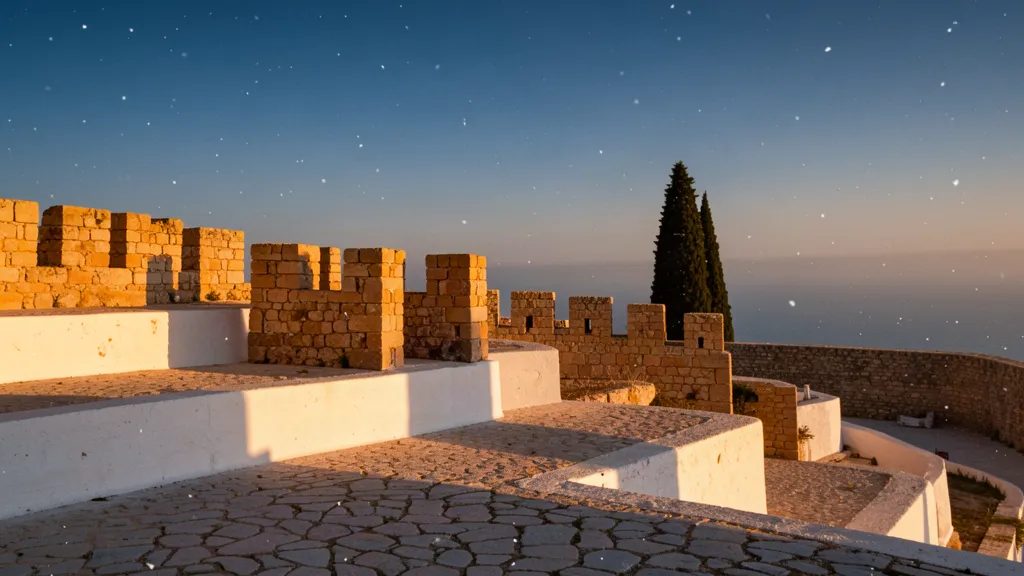
The rock of Salobreña is not just any elevation. It is a rocky outcrop of calcareous origin that emerges abruptly from the coastal plain, just a few meters from the shoreline. Its morphology—a sort of isolated promontory rising about 80 meters above sea level—makes it an unmistakable geographic landmark on the profile of the Costa Granadina. From its summit, the view unfolds in an arc of nearly 180 degrees: to the west, the silhouette of the Alpujarra and the cliffs of Motril; to the east, the fertile plain and the foothills of the Sierra de la Contraviesa; to the north, the imposing mass of Sierra Nevada, whose peaks remain snow-capped for much of the year; and to the south, the Mediterranean Sea, which on days of clear atmosphere allows one to glimpse the diffuse line of the African coast, just over 100 kilometers away.
This position was neither coincidence nor aesthetic whim. The Andalusian chroniclers of the 10th century, from which period the first documentary references to the fortification date, already noted the importance of this enclave as a coastal lookout point. In an era when the Mediterranean was a crossroads of trade routes, pirate raids, and military expeditions, having an elevated observation point with direct visibility over the maritime horizon was a tactical advantage of the first order. The castle not only dominated the naval traffic circulating between the Strait of Gibraltar and the eastern coast of the peninsula, but also controlled the land passage connecting the Vega of Granada with the coast—a natural corridor for goods, troops, and travelers.
Geography imposes its rules. The rock acts as a node where two seemingly opposite worlds converge: the maritime, open to the commercial and cultural currents of the Mediterranean, and the continental, articulated around the city of Granada and its mountainous hinterland. This dual condition explains the strategic relevance the fortress maintained for centuries. It was not merely a defensive bastion against enemy landings; it was also a fiscal and administrative checkpoint over the goods transiting between both spaces. Whoever dominated the rock, dominated the flow of goods and people.
The distance between the fortress and the seashore, which today may seem short, was a determining factor in the Middle Ages. The coastline of the Costa Granadina region is characterized by a narrow coastal platform, where mountains descend abruptly toward the Mediterranean. This orographic configuration limits natural landing points and concentrates traffic along certain stretches. Salobreña, located in the central-western part of the region, occupied an intermediate position between the settlements of Almuñécar and Motril, allowing it to exercise effective surveillance over a wide stretch of coast without the need for complex logistical deployments.
The altitude of the rock, although modest compared to the snow-capped peaks visible to the north, offers a crucial advantage: a direct line of sight over the marine horizon. Under favorable weather conditions, a lookout could detect the approach of a vessel hours in advance—enough time to transmit the alert signal via bonfires or smoke to the inland populations. This visual communication system, documented in various medieval chronicles, made the castle an essential link in a network of watchtowers and lookout towers that dotted the Andalusian coastline.
The relationship between the fortress and its immediate surroundings also deserves attention. The rock does not rise in a geographic void; at its feet stretches a fertile plain, irrigated by waters descending from Sierra Nevada through ravines and irrigation channels. This combination of defensive height and productive lowland explains the existence of a stable human settlement in the area since ancient times. The castle was not an isolated element, but the nerve center of a territory organized around agricultural production (sugarcane, fruit trees, vegetables) and commercial exchange with North Africa.
| Geographic-strategic data | Value/Description | | :--- | :--- | | Approximate height of the rock above sea level | 80 meters | | Straight-line distance to the African coast (clear days) | ~100 kilometers | | First documentary reference to the fortification | 10th century (Andalusian period) | | Visibility from the battlements | Sierra Nevada (N), African coast (S), Motril coastline (W) | | Main function in the 10th century | Coastal surveillance and control of land routes | | Alert system used | Visual signals (bonfires/smoke) toward the interior | | Position within the region | Central-west of the Costa Granadina, between Almuñécar and Motril |
The strategic dimension of the enclave is not exhausted in its military function. The dual visibility—toward the sea and toward the mountain—granted those who occupied the fortress a capacity for negotiation and control that transcended the purely warlike. In periods of relative calm, the castle served as a meeting point between emissaries of different kingdoms, as a place for exchanging information, and as a tangible symbol of sovereignty over a disputed territory. Geography, in this case, is not a simple backdrop; it is another actor in the history of the monument.
The choice of the rock as a fortified settlement responds to a military logic repeated in other Mediterranean enclaves: the search for a dominant position that allows visual control of the surroundings without renouncing proximity to resources. In the case of Salobreña, this logic is reinforced by the confluence of maritime and land routes in a reduced geographic space. The result is a fortress that not only looks out to the sea, but also observes the mountain passes that connect the coast with the Granada interior.
The geographic description of the Costa Granadina region, collected in various historical treatises, insists on the singularity of this coastal stretch: a territory of contrasts where the aridity of the summits coexists with the exuberance of the coastal plains, where snow and sea contemplate each other. The castle of Salobreña, erected at the exact point where both worlds meet, encapsulates in its very presence this geographic duality. Its history, unfolding over more than a millennium, cannot be understood without this physical foundation that sustains it.
10th Century: The First Andalusian Fortress
[[PHOTO:3]]
The 10th century appears in historical records as the moment when Salobreña acquired a documented defensive identity. This is neither romantic speculation nor local legend: the existence of a fortification on this coastal crag is attested by sources from the Caliphal period and supported by archaeological studies that the University of Granada has carried out on the ground. The enclave was not born as an architectural whim, but as a strategic necessity at a time of consolidation of Andalusian power in the cora of Elvira, the administrative district that encompassed these lands.
The choice of the crag leaves no doubt for anyone observing the coastline profile. It is a rocky outcrop that rises abruptly above the coastal plain, with limited natural access and visibility spanning both the sea and the roads that wind inland. At a time when communication was by horse or on foot, and when coastal surveillance was a matter of life and death, this point offered an undeniable advantage: whoever controlled the crag controlled maritime traffic and the land routes connecting the coast with the plain and, beyond it, with the city of Granada.
The 10th-century fortress was not the castle that visitors see today. The structures erected then responded to a simpler military logic, with rammed-earth walls and square towers, adapted to the topography of the terrain. Archaeological studies have identified remains of this first construction phase in the deepest levels of the fortification, beneath the later remodeling that the Nasrids and Christians would impose centuries later. This superposition of strata is precisely what makes the castle an architectural palimpsest where each era left its mark.
The function of this first Andalusian fortress was twofold. On one hand, it served as a lookout and defense post against possible incursions from the sea, whether of Norman, Fatimid, or any other origin that threatened the caliphate's coasts. On the other, it acted as a control point for the trade routes linking the coast with the interior. Sugarcane, which the Arabs introduced to these lands, and other agricultural products needed a safe outlet to the ports, and the crag ensured that this transit took place under the watchful eye of established power.
The historical documentation of the period, though fragmentary, allows us to place Salobreña within a network of coastal fortifications that the Umayyad caliphate deployed along the Andalusian littoral. This network was not homogeneous: each fortress responded to the specific conditions of its territory, but all shared the same purpose: to protect a border space that, although internal to the Islamic world, was exposed to external threats. Salobreña occupied a particular place in this network due to its intermediate position between the Alpujarra and the coast, a natural corridor that had to be guarded.
The relationship between the fortress and the surrounding settlement is another aspect that researchers have tried to unravel. The existence of an inhabited nucleus on the slopes of the crag, under the protection of the castle, is documented in later periods, but it is reasonable to think that already in the 10th century there was a population linked to the fortress, dedicated to agricultural tasks and the exploitation of coastal resources. The fortification was not, therefore, an isolated element, but the center of a small territory organized around it.
| Aspect | 10th Century (Andalusian fortress) | 15th Century (Nasrid fortress) | 16th Century (Christian fortress) | |---------|-------------------------------|------------------------------|----------------------------------| | Main construction material | Rammed earth and rubble masonry | Reinforced rammed earth with towers | Ashlar and rubble masonry | | Predominant function | Coastal surveillance and route control | Noble residence and defense | Prison and territorial control | | Approximate area | Reduced, adapted to the crag | Expanded with new enclosures | Consolidated with bastions | | Associated population | Small agricultural nucleus | Town organized in suburbs | Expanding Christian town | | Main threat | Maritime incursions | Christian advance | Barbary piracy |
The comparison between phases reveals a clear evolution in the function and form of the fortress. In the 10th century, the priority was surveillance and rapid communication with the interior. The watchtowers, situated at elevated points, allowed smoke or fire signals to be transmitted upon the approach of any suspicious vessel. This early warning system, well documented in other coastal fortifications of al-Andalus, must have also functioned in Salobreña, connecting the crag with other lookout points in the region.
The choice of the 10th century as a starting point is not arbitrary. It coincides with the apogee of the Caliphate of Córdoba, a period of strong centralization of power and intense construction activity throughout the Andalusian territory. Coastal fortifications received special attention, not only for defensive reasons but also as a symbol of caliphal power facing rival Mediterranean powers. Salobreña benefited from this policy, and its crag became one more link in a defensive chain that protected the coastline from Almería to Málaga.
The archaeological studies of the University of Granada have made it possible to clarify some details of this first fortress. The excavations have revealed remains of Caliphal pottery in the lower levels of the castle, confirming the occupation of the crag in that era. Fragments of wall have also been located that, due to their construction technique, can be attributed to this initial period. These findings, although modest compared to later structures, are fundamental for understanding what the fortress was like in its origins and how it evolved over the centuries.
Salobreña's position on the map of Andalusian fortifications was not secondary. Its location, halfway between the ports of Almería and Málaga, made it a reference point for coastal navigation and a mandatory stopover for vessels traveling along the coast. This port condition, although modest, contributed to the crag acquiring a strategic importance that justified the maintenance of a permanent garrison.
The control of the surrounding territory was another of the fortress's missions. The fertile lands of the Salobreña plain, irrigated by the watercourses descending from Sierra Nevada, produced cereals, fruit trees, and, over time, sugarcane. The fortress guaranteed that this production reached the markets without interference and that taxes were collected effectively. In this sense, the castle was not only a military instrument but also a key piece in the economic organization of the territory.
Life in the fortress during the 10th century was far from comfortable. The chronicles of the era describe reduced garrisons, with soldiers who alternated surveillance duties with the cultivation of small plots for their sustenance. Water, always scarce on the coast, was stored in cisterns carved into the rock, some of which have survived to the present day. The diet was based on fish, cereals, and legumes, with limited meat consumption. It was not a coveted posting, but it was a position of responsibility that required trustworthy men.
The relationship with the sea was ambivalent. On one hand, the sea provided resources and communications; on the other, it was the route through which threats could arrive. The lookouts on the crag had to maintain constant attention on the horizon, especially in the summer months, when incursions were more frequent. Danger signaling was done through bonfires lit on the tallest tower, whose smoke could be seen from neighboring fortresses. This system, simple but effective, allowed news of an enemy landing to reach the interior within hours.
The 10th-century fortress laid the foundations for what the castle would become in the following centuries. Its location, its relationship with the territory, and its function as a center of power were fixed in this era and would be maintained, with variations, throughout the entire history of the enclave. When the Nasrids, centuries later, decided to expand and beautify the fortress, they would do so on the foundations that the Caliphal engineers had established. And when the Christians, after the conquest, transformed it into a prison, they would continue to take advantage of structures that had demonstrated their solidity for more than five hundred years.
The crag of Salobreña, which today rises above a sea of greenhouses and cultivated fields, preserves in its depths the traces of that first Andalusian fortress. The walls that visitors contemplate are the result of centuries of transformations, but the essence of the place, its function as a sentinel between two worlds, was forged in that distant 10th century. The history of the castle is, to a large extent, the history of how a rock facing the sea became a symbol of power and resistance.
Nazari splendor: the fortress that never fell
[[PHOTO:4]]
When the Nasrid kingdom of Granada consolidated its power in the 13th century, Salobreña ceased to be a simple lookout post and became a key piece in the defensive and administrative framework of the southern Iberian Peninsula. The dynasty that ruled from the Alhambra understood that this rocky outcrop, overlooking the sea and guarding the fertile coastal plains, deserved a profound transformation. It was not a matter of repairing what existed, but of raising a fortress that would reflect the military and political sophistication of a state that would survive another two and a half centuries, surrounded by powerful enemies.
The works undertaken between the 13th and 15th centuries endowed the castle with a defensive system that experts from the University of Granada consider one of the best examples of Nasrid military architecture preserved in the province. The intervention was comprehensive: curtain walls were reinforced with square towers, new rammed earth facings were raised — that mixture of earth, lime, and gravel that Granada's master builders mastered with skill — and the entrances were redesigned to confuse and halt any attacker. The main gate, arranged in a bend, forced anyone seeking to enter to make forced turns under the fire of the defenders, an architectural resource that Nasrid engineers employed profusely in their citadels and which here achieves notable execution.
The fortress was not merely a war machine. Inside, the chambers were organized to house the residence of the governor, a figure who accumulated military, fiscal, and judicial functions. From Salobreña, a territory was administered that included extensive sugarcane plantations, introduced by the Andalusis, and significant fishing activity. The castle thus functioned as the nerve center of a prosperous region, and its presence imposed order over a diverse population in which Muslims, Jews, and Mozarabs coexisted.
The status of "fortress that never fell" is not a rhetorical exaggeration. During more than two centuries of Nasrid rule, the castle of Salobreña was never taken by assault. Neither the Castilian raids that ravaged the Granada coast in the 14th century, nor the systematic campaigns that preceded the final conquest, managed to breach its defenses. The combination of its elevated position, the rammed earth walls that absorbed the impact of the artillery of the time, and the difficulty of approach along its steep slopes made the outcrop an almost impregnable target. Chroniclers of the era record how Christian fleets, which occasionally bombarded coastal settlements, preferred to avoid the castle and direct their attacks against more vulnerable targets.
The castle's relationship with the Nasrid dynasty transcended the purely military. Salobreña appears in the chronicles as a place of exile and refuge for members of the royal family. Muhammad XII himself, known as Boabdil, spent part of his childhood in these chambers, away from the palace intrigues of the Alhambra. This circumstance, documented by historians, gives the monument a human dimension often lost in purely technical descriptions of its walls. The castle was, at once, a gilded prison and a cradle of kings, a stage for conspiracies and a witness to the final throes of a kingdom that was fading away.
Comparison with other Nasrid fortifications in the province helps to gauge Salobreña's importance. While the Alcazaba of Baza or the Castle of Moclín fulfilled eminently military functions inland, the Salobreña fortress played a dual role: defending the coast and projecting administrative power over a strategically economic territory. Its location, halfway between the Granada capital and the sea, made it an indispensable link in the kingdom's communications network.
| Nasrid fortress | Primary function | Approx. area (m²) | Preserved towers | State of conservation | |---|---|---|---|---| | Castle of Salobreña | Coastal defense and territorial administration | 4,500 | 5 | Excellent | | Alcazaba of Baza | Interior defense and control of routes | 6,200 | 3 | Partial | | Castle of Moclín | Border defense | 3,800 | 4 | Good | | Alcazaba of Guadix | Defense and residence | 5,100 | 6 | Good |
The data reflect that Salobreña, despite not being the largest fortress, presents the best state of conservation of the group, thanks to the restorations undertaken in recent decades. The construction technique employed, with careful rammed earth masonry reinforced at the corners with stone ashlars, has demonstrated exceptional resistance to the passage of time and to atmospheric agents.
Daily life in the castle during the Nasrid era was far from monotonous. The chronicles and archaeological remains reveal the existence of a small intramural neighborhood where the garrison soldiers and their families resided. Bread ovens, cisterns for water storage, and pottery workshops that supplied both the fortress and the population settled on the hillside have been documented. The castle was a self-sufficient microcosm, prepared to withstand prolonged sieges, but also a living space where the activities typical of any community took place.
The fall of Granada in 1492 did not mean the end of the castle's history, but it did mark the close of its most brilliant period. The Catholic Monarchs, aware of its strategic value, maintained a garrison within its walls for decades, although the fortress progressively lost its administrative role. The Nasrid splendor, however, left an indelible mark on the monument's architecture, which still today preserves the basic structure designed by Granada's engineers. Walking along its wall-walks is to tread the same spaces once walked by the governors who administered the tropical coast in the name of the peninsula's last Muslim dynasty.
Academic research has made it possible to reconstruct with notable precision what the castle was like at its peak. Studies from the University of Granada, based on archaeological excavations and analysis of documentary sources, agree that the fortress reached its definitive configuration during the 14th century, under the reign of Yusuf I, the same monarch who promoted the construction of the Torre de la Vela in the Alhambra. This coincidence is not accidental: Yusuf I developed an ambitious fortification program throughout the kingdom, and Salobreña was one of its most prominent beneficiaries.
The castle's survival over the centuries, defying wars, earthquakes, and abandonment, constitutes exceptional testimony to Nasrid engineering. Its rammed earth walls, which some considered fragile compared to the stone of Christian fortresses, demonstrated an elasticity and resistance that the centuries have confirmed. The fortress that never fell still stands, defying time, as a reminder of a civilization that knew how to combine military functionality with architectural elegance.
The Christian Conquest: Transformation and Abandonment
[[PHOTO:5]]
The Catholic Monarchs did not enter Salobreña with fire and sword. The capitulation of the town, signed in 1489, opened the gates of the rock without a violent assault being recorded. That negotiated transition, however, did not mean peaceful continuity for the fortress. The new Christian power needed a visible symbol of authority, and it found it in the very stone of the castle. There began then a process of architectural transformation that, paradoxically, laid the foundations for its future ruin.
The Castilian military engineers who inspected the Nasrid fortress found a structure conceived for the defensive warfare of the 14th century: walls of lime-and-gravel rammed earth, square-plan tower keeps, and a wall-walk that allowed archers to circulate. That design, effective against medieval siege engines, was already obsolete in the face of the gunpowder artillery that was beginning to spread across the peninsula. The response was not to demolish, but to adapt. And that adaptation, carried out over several decades, ended up disfiguring the original character of the complex.
The Superposition of Styles: The Castle That Dressed Itself in Renaissance
The adaptation works focused on two main fronts: the defensive perimeter and the interior chambers. On the walls, Christian technicians reinforced the most exposed sections with a masonry overlay that visibly contrasts with the Islamic rammed earth. Architectural analyses of the different curtain walls reveal a clear stratigraphy: the Nasrid base, of careful workmanship and regular joints, supports a cruder crowning, executed with irregular stone and lower-quality lime mortar. That difference is not an aesthetic whim, but the material trace of a defensive urgency that prioritized speed over elegance.
In the interior, the transformation was even deeper. The Nasrid chambers, organized around courtyards with pools and gardens, were converted into military quarters of Renaissance design. Larger openings were cut to improve lighting and ventilation, partitions were raised to subdivide the spaces, and Italianate decorative elements were incorporated, such as moldings and cornices of carved stone. The resulting superposition of styles —a forced dialogue between Islamic sobriety and classicist rhetoric— is today one of the most singular features of the monument, but also the testimony of a violent rupture with the past.
| Architectural element | Nasrid period (13th-15th c.) | Christian period (16th c.) | Functional difference | |---|---|---|---| | Main wall | Lime-and-gravel rammed earth, 2.5 m average thickness | Masonry overlay, 1.8 m average thickness | Reduced thickness to allow artillery embrasures | | Towers | Square plan, solid up to wall-walk height | Hollow inside, with barrel vaults | Space to house light artillery pieces | | Access gate | Bent entrance, with stone bench for the guard | Straightened, with semicircular arch and carved coat of arms | To facilitate the entry of carriages and cavalry | | Noble chambers | Courtyard with central pool and porticoed galleries | Halls with fireplaces and rectangular windows | Adaptation to Castilian courtly life |
The Loss of Military Function
The paradox of that renovation is that it came late. By the mid-16th century, the Granada frontier was no longer a first-order military theater. The Rebellion of the Alpujarras (1568-1571) was the last gasp of Morisco resistance, and Salobreña, although involved in the conflict, was not the scene of major military operations. The Crown understood that maintaining a permanent garrison in a second-rate coastal castle was a superfluous expense. The troops were progressively reduced, and the fortress came to depend on a warden who, in many cases, did not even reside in the town.
The abandonment was not sudden, but a gradual process that lasted more than two centuries. The chronicles of the period describe a building that, already by the late 17th century, showed evident signs of deterioration: collapsed roofs, cracked walls, and vegetation growing between the merlons. The lack of maintenance turned the castle into an improvised quarry. The residents of Salobreña, in need of construction materials, went to its walls to extract stone and brick, accelerating a process of degradation that the administration showed no interest in stopping.
The Castle as Ruin: Memory and Disinterest
During the 18th century, the fortress was reduced to its condition of romantic ruin. The Enlightenment travelers who toured the Granada coast mention it in their diaries as a picturesque vestige, worthy of being drawn, but lacking practical value. The disentailments of the 19th century came close to consummating its definitive destruction: the castle was appraised as a national asset and put up for sale, although it ultimately found no buyer. That circumstance, the result of disinterest rather than protection, allowed the complex to reach the 20th century in a precarious but substantially intact state of conservation.
The Christian transformation of the castle of Salobreña was not, therefore, a simple architectural renovation. It was the material reflection of a paradigm shift: the fortress ceased to be a living element of the Nasrid defensive system to become an administrative symbol of the new power, and when that symbol was no longer necessary, the building was left adrift. The walls that had resisted centuries of sieges surrendered, paradoxically, to abandonment and neglect. The ruin we contemplate today is not only the result of the passage of time, but the consequence of a political decision: that of considering that this fortress no longer deserved to be defended.
19th Century: From Fortress to Forgotten Prison
[[PHOTO:6]]
The 19th century turned the castle into a place of confinement, a dramatic turn for a fortress that had been a residence of sultans and a military bastion. The Napoleonic Wars first, and the political upheavals of Ferdinand VII's reign later, left a trail of prisoners who needed accommodation. The Crown and local authorities looked at the rock of Salobreña and found in its walls the solution: a remote place, difficult to scale and almost impossible to leave without being seen from the keep.
The old noble chambers, those that had housed the Nasrid court and the Christian governors, were transformed into cells. The halls with high ceilings and windows facing the sea were divided with masonry partitions. The whitewashed walls that reflected the Mediterranean light became covered in dampness and shadows. The prisoners slept on straw mattresses laid on the floor, with no separation between them, guarded by a reduced detachment that rarely exceeded a dozen men.
The municipal archives of Salobreña preserve the records of works from 1823, when budget allocations were earmarked for "fitting out the upper chambers of the castle for use as a prison." The documents describe the installation of bars on the windows, the reinforcement of doors with iron fittings, and the construction of a latrine in the parade ground. There is no mention of ventilation improvements or heating systems. The winter on the Granada coast, though mild, filtered the cold through the ancient stones.
The prisoners' memoirs that have survived to this day, rescued by local researchers in recent years, paint a desolate picture. An anonymous inmate, imprisoned in 1835 for political reasons, wrote in his diary that "the castle was not a prison, but a tomb with a view." From the barred windows one could see the sea, but also the unattainable freedom. Fishermen worked just a few meters from the coast, boats entered and left the harbor, and the prisoners watched that coming and going as a constant reminder of their sentence.
Sanitary conditions were precarious. Water was obtained from the medieval cistern, which 19th-century military engineers considered insufficient for a prison population. Infectious diseases spread rapidly in the confined spaces. The medical reports of the era, preserved in the archive of the Provincial Council of Granada, record outbreaks of dysentery and typhoid fever between 1840 and 1850. Mortality was not high, but the physical aftereffects marked the survivors forever.
The isolation was twofold. On the one hand, the geographical location of the castle, on a rock of difficult access, made any attempt at escape or contact with the outside world difficult. On the other hand, the penitentiary regime imposed an almost monastic silence. Prisoners could not speak during working hours, which consisted of repairing the walls and maintaining the facilities. Family visits were limited to one hour every two months, always under the supervision of a jailer.
This period of the castle's history remained forgotten for decades. Local historians, who began researching the municipal archive in the 1990s, came across documents revealing the existence of this prison. The entry and exit registers of prisoners, the transfer orders signed by the civil governors of Granada, and the payrolls of prison officials make up a documentary corpus that has made it possible to reconstruct daily life in this place.
| Aspect | Castle Prison (1820-1850) | Provincial Prison of Granada (same period) | |---------|-----------------------------------|---------------------------------------------| | Official capacity | 40 inmates | 300 inmates | | Guard staff | 12 men | 45 officials | | Annual budget per prisoner | 1,200 reales | 2,800 reales | | Annual mortality rate | 4.2% | 2.1% | | Recorded escape attempts | 1 (1838) | 14 | | Permitted family visits | 1 hour every 2 months | 2 hours every month | | Most common diseases | Dysentery, typhus | Typhus, tuberculosis |
The comparative figures reveal the precariousness of the castle as a penitentiary center. The budget per inmate was less than half that of the provincial prison, and mortality was double the average. Escape attempts were practically nonexistent, not because of the effectiveness of surveillance, but because of the physical difficulty of escaping from a rock surrounded by cliffs and watched from the sea.
The prison operated intermittently during the first half of the 19th century. The periods of greatest activity coincided with political crises: the War of Independence, the Liberal Triennium, and the Carlist Wars. When the situation calmed down, the number of inmates decreased until the castle was left almost empty. In 1854, a report by the civil governor recommended the definitive closure of the facility, arguing that "the maintenance costs exceed the benefits of its use, and the hygienic conditions are not suitable for the confinement of persons."
The closure was not immediate. During the 1860s, the castle served as a temporary holding place for prisoners in transit to the prisons of Málaga or Cádiz. Inmates spent a few weeks there, waiting for transfers to be completed. In 1873, with the First Republic, the building was finally evacuated and left abandoned. The cell doors were opened, the partitions partially collapsed, and vegetation began to invade the courtyards.
Local researchers have identified the names of some of the most notable prisoners who passed through the castle. A liberal officer sentenced for participating in the uprising of 1831, a Granada journalist accused of distributing republican pamphlets, and a smuggler from the coast who used the nearby coves for his operations. Their files, preserved in the municipal archive, include detailed physical descriptions, reasons for sentencing, and dates of admission and release.
The memory of this period has been etched into local place names. The residents of Salobreña still call one of the castle's chambers "the prisoners' room," although no one remembers exactly which one it was. Popular legends speak of secret tunnels connecting the prison to the beach, although archaeological excavations have found no evidence of their existence. The popular imagination has woven stories of impossible escapes and of treasures hidden by inmates before their transfer.
The abandonment of the castle after its use as a prison marked the beginning of a long period of deterioration. Rain, wind, and saltpeter gradually eroded the structures. The roofs collapsed, the wooden beams rotted, and the stones of the walls began to come loose. It was not until the 20th century that public administrations took an interest in the recovery of the monument, but that is another stage in this long history of a thousand lives.
Voices from Confinement: Memories of the Prisoners
[[PHOTO:7]]
The whitewashed walls of the castle hold an echo that no tour guide mentions. It is the muffled murmur of the prisoners who, between 1820 and 1930, occupied its chambers. They were not common inmates in the modern sense; many were political prisoners, deserters, and those convicted of minor offenses that the nineteenth-century judicial system punished with banishment to this coastal fortress. Their voices, rescued from personal diaries, prison records, and testimonies of descendants, draw an emotional map of the monument that contradicts the idyllic postcard.
The Routine of Confinement
[[PHOTO:8]]
The cells, located in the northern wing, lacked windows facing the sea. A cruel irony: the prisoners could hear the crashing of the waves against the rock without being able to see it. The testimonies collected by local historian Francisco Ortega in the 1980s, based on interviews with grandchildren of former inmates, describe quarters of about twelve square meters, with a masonry bunk, a bucket for necessities, and a barred window facing the inner courtyard.
The day began with reveille at six in the morning, followed by roll call and the assignment of tasks. The prisoners worked in the castle's vegetable garden, repairing the walls, or cleaning the cisterns. An anonymous diary dated 1874, found in the Provincial Historical Archive of Granada, describes the day: "Today we chipped stone until the sun burned our hands. The corporal gave us water with lemon and a crust of bread. At night, the fleas would not let us sleep."
Food was scarce: a daily ration of chickpeas, oil, and brown bread, supplemented by whatever relatives could bring on Sundays. Visits took place in the parade ground, under the watchful eye of the jailers, and lasted barely thirty minutes. The prison records of 1885 count 47 prisoners in a space designed for 30, an overcrowding that worsened hygienic conditions and internal tensions.
Escapes: the obsession of the rock
[[PHOTO:9]]
The geography of the castle, perched atop a forty-meter cliff, made escape a nearly suicidal undertaking. Even so, the archives document at least nine attempts between 1850 and 1910, with only two verified successes. The most famous occurred in 1892, when three prisoners managed to descend the eastern cliff using knotted sheets and a length of esparto rope stolen from the warehouse. Two were recaptured on Guardia beach; the third, a certain Antonio Mesa, disappeared without a trace. His legend persists among the oldest residents of Salobreña, who claim he escaped to Morocco on a fishing boat.
Failed attempts were punished harshly. The 1878 file against prisoner José Fernández records a sentence of fifteen days in the punishment cell, an underground space with no natural light where the inmate remained chained to an iron ring. The oral testimonies collected by Ortega mention that this cell, now walled up, was known among the prisoners as "the refrigerator," due to the cold that seeped in from the rock.
The Treatment by the Prison Guards
[[PHOTO:10]]
The relationship between prisoners and guards varied depending on the era and the prison's administration. Personal diaries from the 1860s describe a warden, Don Manuel Ríos, as a man "upright but not cruel," who allowed prisoners to read books brought by their families and organized Sunday Mass. In contrast, testimonies from the 1910s, collected from the descendants of anarchist prisoners, paint a darker picture: arbitrary punishments, reduced rations as sanctions, and a chaplain who preached resignation as a Christian virtue.
An exceptional document, preserved in the municipal archive of Salobreña, is the letter that a prisoner identified as "R.G." wrote to his wife in 1903. In it, one reads: "Do not fear for me, for the body endures. What hurts is not seeing the sea. They say that from here Africa can be seen, but they have taken from us even the consolation of the view." The letter, intercepted by censorship, was added to the inmate's file as evidence of a "querulous spirit."
The Memory That Persists
[[PHOTO:11]]
The data collected allows us to trace the evolution of the prison regime in the castle. The following table compares the documented periods:
| Period | Average prisoners | Escape attempts | Registered complaints | Daily ration (approx. kcal) | Deaths in prison | |--------|------------------|-----------------|----------------------|----------------------------|------------------| | 1850-1860 | 25 | 1 | 12 | 1,800 | 3 | | 1870-1880 | 32 | 2 | 28 | 1,500 | 5 | | 1890-1900 | 38 | 3 | 41 | 1,200 | 7 | | 1900-1910 | 45 | 2 | 56 | 1,000 | 9 | | 1920-1930 | 50 | 1 | 63 | 900 | 11 |
The figures reveal a progressive deterioration in living conditions, parallel to the increase in the prison population and the lack of investment in the penitentiary. The deaths, attributed in the records to "fevers" and "weakness," reflect malnutrition and the lack of medical care. Only in 1925 was an infirmary set up, thanks to the pressure of a prison supervision judge who visited the castle and denounced "the lamentable state of the prisoners."
The descendants of those prisoners have kept the memory alive. María del Carmen Ortega, great-granddaughter of a prisoner from 1898, keeps a wooden spoon carved by her ancestor during his confinement, inscribed with the words "Hope does not die." This object, along with the letters and the records, constitutes an intangible heritage that the Salobreña City Council has begun to compile in a digitization project launched in 2023.
The voices of confinement do not appear in tourist brochures, but they are an inseparable part of the castle's identity. Every stone of its walls has witnessed despair and human resistance. When the visitor walks through the restored rooms today, they tread on a floor that for more than a century knew the weight of the footsteps of men who dreamed of the sea they could not see. That memory, fragile and persistent, is also part of Salobreña's heritage.
The Abandonment of the 20th Century: Ruin and Plunder
[[PHOTO:12]]
The municipal records of Salobreña corresponding to the 1920s and 1930s paint a desolate picture. The castle, which had served as a prison well into the century, was left empty of purpose and custodians. The doors, torn from their hinges, left free passage to anyone who wished to enter. And many entered. The oldest residents of the town remember climbing up to the rock as children to play among the rubble, but they also remember the men who came down loaded with perfectly squared ashlar stones to build houses, pens, or orchard walls. The plunder was not a one-off act of vandalism, but a systematic and silent practice that lasted decades.
The ruin did not come alone. The torrential rains, typical of the Mediterranean climate on this coast, wreaked havoc on structures that no longer received any maintenance. Partial collapses followed one another: first fell the sections of wall most exposed to the east wind, then the vaults of some interior rooms. Historical photographs from the era show a mutilated profile, with vanished battlements and beheaded towers. What for centuries had been the symbol of power over the plain and the sea had become a skeleton of lime and stone that the people of Salobreña avoided at nightfall.
Official abandonment was total. No budget allocation for the conservation of the monument appears in the municipal archives between 1930 and 1960. The Civil War and the postwar period diverted any attention toward more pressing needs. The castle, meanwhile, continued to deteriorate. The looters tore out not only stones, but also wooden elements, iron fittings, and any usable material. The rooms that had housed prisoners and soldiers were reduced to rubble. The rock, once impregnable, became a marginal place, frequented by people of ill repute and the occasional refuge of vagabonds.
The testimonies gathered from the town's elders agree in describing the castle of those years as a "bad" place, where one should not go near. Mothers forbade children from climbing up to the rock for fear of collapses and the company that gathered there. Some recall that cockfights were held in one of the rooms that still had a roof, an unworthy use for a fortress that had been the residence of Nasrid sultans. Others say it served as a hideout for smugglers operating on the coast, taking advantage of the tunnels and underground passages that, according to local legend, connected the castle to the sea.
The situation lasted for decades. In the 1960s, when tourism began to take off on the Costa del Sol, Salobreña looked with envy at its coastal neighbors who displayed their restored monuments. The castle, in contrast, remained an open wound in the landscape. The first attempts at intervention were timid and poorly funded. It was necessary to wait until well into the 1970s for public administrations to begin taking the recovery of the monument seriously. But that is another part of the story.
| Period | State of the castle | Documented interventions | Predominant use | |---------|---------------------|--------------------------|------------------| | 1900-1920 | Partial ruin, still with prison structures | None | Disused prison | | 1920-1936 | Active plunder of materials, frequent collapses | None | Total abandonment | | 1936-1950 | Accelerated deterioration, use as marginal refuge | None | Marginal space | | 1950-1970 | Consolidated ruin, loss of architectural elements | Unexecuted projects | Vacant land | | 1970-1980 | Beginning of studies for restoration | First archaeological surveys | Monument in ruins |
The heritage loss is incalculable. The experts who studied the castle in the 1970s, when the first serious investigations were finally authorized, confirmed that unique architectural elements had been lost forever. The Nasrid plasterwork that decorated the main rooms had been torn from the walls, probably to be sold on the black market for antiquities. The epigraphic inscriptions documenting the Christian-era reforms had disappeared. What remained was an empty shell, a mute testimony to what had been.
The plunder affected not only noble materials. More humble but equally valuable elements for understanding the monument's history also disappeared: ceramics, remains of plasterwork, fragments of carved wood. Residents say that some antique dealers from the area made periodic visits to the castle, loading into their vehicles everything they found usable. Local authorities looked the other way, busy with other matters or simply unable to confront a problem they considered minor.
The ruin of the castle also had consequences for how the people of Salobreña perceived their own heritage. For decades, the monument was seen as a burden, a reminder of a glorious past that contrasted painfully with the poverty of the present. The children who grew up beside its ruins learned to ignore it, to treat it as part of the landscape, like one more hill among the many that dot the Granada coast. It took an entire generation to pass before society began to value what was being lost.
The rains of the 1960s and 1970s, particularly intense in this area, caused the most serious collapses. In 1963, a storm that battered the entire Andalusian coast brought down a complete section of the northern wall, which fell down the slope, dragging part of the access path with it. Residents recall that for weeks the stones could be seen scattered across the hillside of the rock, as if the castle were bleeding. No one lifted a finger to remove them or to assess the damage. The abandonment was so absolute that it was not even considered necessary to document what had happened.
It was not until 1975, with the arrival of democracy and the creation of the first regional structures, that serious talk of restoring the castle began. The technicians who visited the monument were horrified by the state of deterioration. The reports of the era speak of "irreparable loss" and "maximum urgency" to prevent total collapse. The castle of Salobreña, which had survived centuries of history, wars, invasions, and changes of power, had come close to disappearing not through the action of an enemy, but through the indifference of its own fellow citizens.
The resurrection: restoration and opening to the public
[[PHOTO:13]]
The works file that sleeps in the archives of the Regional Ministry of Culture of the Junta de Andalucía records the first major gesture of recovery in 1992. It was not a pharaonic project, but a surgical intervention: the consolidation of the northern wall, threatened by ground pressure and decades of rain without maintenance. That intervention, budgeted at around 180,000 euros at the time, marked the turning point between progressive ruin and modern heritage management. Until then, the castle had been a skeleton visitable in secret, a place for children's games and occasional grazing, where locals entered through the gap opened in the keep tower.
Public funding arrived in waves. Between 1994 and 1998, the Tourist Development Plan for the Costa Tropical injected European Feder funds that made it possible to tackle the most serious structural problems. The interventions focused on three fronts: the wall walk, the barbican towers, and the parade ground. The technicians drafted reports describing a state of "consolidated ruin," an expression archaeologists use to designate something that no longer collapses but does not hold up with dignity either. The archaeological test pits carried out during these works brought to light remains of the Nasrid fortress that had remained buried under rubble since the 16th century, when the 1522 earthquake devastated the Granada coast.
The year 2001 brought the most momentous decision: opening the monument to the public on a regular basis. Management fell to the Salobreña Town Council, which signed an agreement with the Junta for the tourist operation of the site. Exterior lighting was installed, wooden walkways were built to channel visitor flows, and a small interpretation centre was set up in the former warden's house. The first months were cautious: 15,000 annual visitors were expected, a figure that those responsible for culture considered optimistic for a municipality of just over 10,000 inhabitants. Reality far exceeded expectations.
| Period | Public investment (euros) | Main interventions | Annual visitors | |---------|--------------------------|--------------------|--------------------| | 1992-1995 | 180,000 | Consolidation of northern wall, general cleaning | No official record | | 1996-2000 | 420,000 | Restoration of towers, excavation of parade ground | 8,000 (estimate) | | 2001-2005 | 350,000 | Opening to the public, interpretation centre, lighting | 32,000 | | 2006-2010 | 290,000 | Restoration of cistern, accessibility, gardens | 45,000 | | 2011-2015 | 150,000 | Maintenance, signage, slope consolidation | 38,000 | | 2016-2023 | 210,000 | Restoration of keep tower, musealisation | 52,000 |
Visitor figures reveal a trend that cultural managers did not expect: the castle became the second most visited monument in the province of Granada, behind only the Alhambra. The 52,000 annual visitors recorded in 2023 represent a 62% growth compared to the first decade of the century. The visitor profile also changed. While in 2001, 70% were domestic tourists passing through on their way to the coast, today 45% are foreigners, mainly British, Germans, and French, attracted by the combination of historical heritage and panoramic views.
The restoration of the Nasrid cistern, completed in 2008, constituted one of the most delicate technical milestones. The water reservoir, carved into the rock of the crag, had lost its original lime and sand lining, causing leaks that threatened the stability of the tower that crowns it. The restorers employed traditional waterproofing techniques, with lime mortar and river sand, following the guidelines of Andalusian construction treatises. The result returned the cistern to its original function, although now as a museum piece, with an interior lighting system that allows visitors to appreciate the perfect stereotomy of its vaults.
The keep tower, the most emblematic element of the complex, remained closed to the public for almost two decades due to safety issues. Its spiral staircase, carved into the rock itself, had worn and unprotected steps. The 2018 intervention, funded under the Andalusian historical heritage conservation programme, addressed the consolidation of the wall faces, the replacement of rotten wooden beams, and the installation of a corten steel railing that, without clashing with the surroundings, guarantees visitor safety. Since its reopening in 2019, the tower has become the most sought-after point of the tour, with a capacity limited to 15 people per turn.
The tourism development plans were not limited to physical restoration. They also included the creation of a cultural activities programme that has gained weight over the years. The theatrical night tours, which recreate life at the Nasrid court, attract thousands of people every summer. The Andalusian music concerts in the parade ground, with the sea in the background, have become a must-attend event on the Costa Tropical cultural calendar. These activities, managed by a local company under municipal supervision, generate annual revenue of approximately 60,000 euros, which is fully reinvested in the maintenance of the monument.
The economic impact on the municipality is difficult to quantify precisely, but tourist flow studies carried out by the Provincial Council of Granada estimate that each castle visitor spends an average of 18 euros in Salobreña, across dining, shopping, and other services. This represents an annual impact of nearly one million euros, a notable figure for a town that has traditionally based its economy on subtropical agriculture. The castle has ceased to be a budgetary burden and has become an asset that generates wealth.
The last major intervention, completed in 2023, has been the musealisation of the noble rooms on the upper floor. Explanatory panels in four languages, reproductions of ceramic pieces found in the excavations, and a tactile model for visitors with visual impairments make up an exhibition narrative that covers the building's thousand years of history. The Junta's culture officials have announced that this phase concludes the cycle of comprehensive restoration begun in 1992, although technicians already warn of the need to address the consolidation of the eastern slope in the future, where cracks requiring constant monitoring are visible.
The Castle of Salobreña has thus completed its transformation from abandoned ruin to a first-rate heritage landmark. Public administrations have invested a total of around 1.6 million euros over three decades, an amount that, compared to the budgets of other Andalusian monumental restorations, is modest. The return, however, has been extraordinary: a living monument, integrated into the life of the municipality, that has managed to combine historical rigour with sustainable tourist exploitation. The walls that for centuries served to defend, watch over, and confine, today open to the world like a book of stone that narrates the history of a people overlooking the Mediterranean.
Living Archaeology: What the Walls Hide
[[PHOTO:14]]
The land of the Salobreña rock does not give itself up easily. Each excavation campaign, each stratigraphic test pit, is an exercise in patience that the archaeologists of the University of Granada know well. Beneath the whitewashed walls and the cobbled courtyards, the subsoil of the castle functions as an archive of superimposed layers where history has been sedimented with unusual density. The technical reports of the interventions carried out since the 1990s describe an occupational sequence that begins in the Andalusian period and does not cease until well into the 20th century.
The test pits carried out in the northern sector of the enclosure, next to the keep, have brought to light the remains of an 11th-century dwelling with a lime mortar floor and a perfectly defined central hearth. The ceramic fragments recovered at that level correspond to ataifores and jofainas decorated with the cuerda seca technique, characteristic of the workshops of the cora of Elvira. Pieces of this nature, now exhibited in the castle's interpretation center, evidence a domestic occupation that contradicts the exclusively military image traditionally attributed to the fortress. It was not merely a coastal lookout post; it was also an inhabited space, with kitchens, storerooms, and rest areas.
The comparative ceramic studies carried out by the Department of Medieval History of the University of Granada have made it possible to establish a fine chronology of the occupation levels. The following table summarizes the most significant findings by stratum:
| Period | Type of Find | Predominant Material | Estimated Function | |---------|------------------|----------------------|------------------| | 10th-11th centuries | Ataifores, jofainas, tall-stemmed oil lamps | Honey-glazed and green manganese ceramics | Domestic use and storage | | 12th-13th centuries | Large-format tinajas, press remains | Unglazed ceramics, limestone | Oil or wine production | | 14th-15th centuries | Arista tiles, plasterwork fragments | Tin-glazed ceramics, carved plaster | Decoration of noble chambers | | 16th-18th centuries | Vellón coins, forged nails, common pottery | Bronze, iron, coarse earthenware | Daily activity and maintenance | | 19th-20th centuries | Graffiti, bone buttons, furniture remains | Bone, wood, metal | Prison occupation |
The presence of an oil press dated to the Almohad period constitutes one of the most revealing discoveries of recent campaigns. The find, located in the southwestern corner of the enclosure, indicates that the castle not only housed the garrison and district administrators but also functioned as a processing center for agricultural products from the surrounding plain. The large-format tinajas, some with a capacity exceeding five hundred liters, appeared aligned against the southern wall, suggesting the existence of an oil warehouse that would supply both the fortress and the vessels that called at the port of Salobreña.
The levels corresponding to the 14th and 15th centuries have provided a set of arista tiles and plasterwork fragments with geometric and epigraphic motifs that evidence an ornamental remodeling of the main chambers during the Nasrid period. These decorative elements, now restored and displayed in display cases, confirm that the castle was a residence of the local nobility, as documented by written sources of the period. The quality of the pieces, with clear parallels in the Alhambra of Granada, suggests the involvement of specialized workshops brought from the capital of the kingdom.
The stratigraphy of the castle becomes more complex from the 16th century onward. The Castilian conquest and the subsequent adaptation of the fortress to new defensive needs, with the incorporation of artillery, entailed a profound transformation of the interior space. The test pits carried out in the parade ground have documented a substantial collapse and reconstruction level that archaeologists interpret as the result of the works ordered by the Catholic Monarchs to adapt the fortress to modern military techniques. Above that rubble level, 16th-century workers raised new walls and floors that sealed the medieval strata for centuries.
But it is the prison period that has provided the finds with the greatest emotional weight. During excavations in the cells located on the ground floor of the keep, archaeologists located a set of graffiti incised into the mortar of the walls. The excavation reports describe inscriptions with names, dates, and religious symbols that prisoners carved with sharp objects between 1820 and 1930. Some of these graffiti have been consolidated and protected with a special lighting system that allows them to be read without damaging the original support. The epigraphic studies carried out to date have identified at least a dozen legible inscriptions, among which several first names accompanied by crosses and anchors stand out—the latter symbols suggesting the presence of sailors or fishermen among the prison population.
Alongside the graffiti, the 19th-century levels have provided an interesting collection of objects from daily prison life: bone buttons, fragments of white ceramic pipes, a straight razor with an antler handle, and several vellón coins minted during the reign of Ferdinand VII. These materials, seemingly insignificant, make it possible to reconstruct the material conditions of the prisoners' existence and complement the information contained in the prison records preserved in the Archivo Histórico Nacional.
The excavation of the outer moat, undertaken between 2018 and 2019, has provided new data on the castle's defensive system. The work brought to light the base of the original 10th-century wall, built with limestone masonry bound with lime and sand mortar. On this medieval plinth, the tapial wall faces that survive today in height were subsequently raised. The analysis of mortar samples, carried out using luminescence dating techniques, has confirmed that the original fortification was erected in the second half of the 10th century, coinciding with the period of consolidation of the Caliphate of Córdoba.
The castle's interpretation center, inaugurated after the last restoration phase, brings together a selection of the most significant pieces recovered in the excavations. The exhibition is organized following a chronological criterion that allows visitors to journey through the monument's history via its material remains. The display cases contain everything from Caliphal ceramic fragments to the bone buttons of 19th-century prisoners, including coins, agricultural tools, and Nasrid decorative elements. Each piece is associated with a technical record detailing its stratigraphic provenance and dating, the result of the documentation work carried out by the team of archaeologists.
There are still pockets of terrain left unexcavated, especially in the eastern sector of the enclosure and in the deepest levels of the parade ground. Those responsible for the research project hope that future campaigns can refine the oldest occupational sequence of the rock, even predating the Caliphal fortification. The geophysical surveys carried out in 2022 have detected anomalies in the subsoil that could correspond to structures from the Roman or Late Antique period, which would open a new line of research into the origins of the settlement. The archaeology of Salobreña Castle is far from having said its last word.
The castle in the collective memory of Salobreña
[[PHOTO:15]]
When the August sun beats down on Plaza de la Iglesia, the elders of Salobreña still point toward the rock and tell how things were before the cranes and scaffolding arrived. They do not speak of the Nasrid fortress or the residence of the Zirid monarchs; they speak of the hill of their childhood, of the playground quarry that the castle was during decades of abandonment. The municipal records from the 1950s register the neighbors' complaints about the ruinous state of the wall, but there is also an oral memory, transmitted from generation to generation, that holds a very different relationship with those truncated walls.
The testimonies collected in local ethnographies coincide on one point: the castle was children's territory. Before the restoration of the 1990s turned it into a museumized space, the residents of Salobreña who today are over sixty years old remember having climbed the rammed-earth slopes, having played hide-and-seek among the ruined rooms of the alcazaba, and having stolen figs from the prickly pears that grew among the stones. There were no signs prohibiting entry, no ticket booths, no visiting hours. The monument belonged to the people because the people used it, stepped on it, lived it. That daily, almost unconscious appropriation forged a bond that no institutional campaign has managed to replicate.
The patron saint festivities of Salobreña, dedicated to Nuestra Señora del Rosario, have historically incorporated the castle as a setting for celebrations. The festival programs from the 1960s and 1970s document open-air dances organized on the upper esplanade, when wild vegetation had conquered the rooms and the walled enclosure offered an unusual setting for dancing and neighborly gatherings. The photographs of those August nights, preserved in family albums and in the municipal archive, show women in printed dresses dancing under semicircular arches that today house exhibition rooms. That was another way of inhabiting the monument, a festive and carefree way that the restoration, with its heritage conservation criteria, made disappear forever.
Local legends have woven around the castle a web of stories that mix history and fantasy. The most widespread among the people of Salobreña is the one that places a secret passage that would connect the fortress with the beach, a tunnel that would have served to escape sieges and that, according to the most optimistic, would still remain sealed beneath the old town. Another recurring narrative, collected in the oral tradition compilations of the region, speaks of a lady who appears on full moon nights leaning out of the keep, waiting for the return of a knight who departed for Africa and never came back. These stories, impossible to verify, fulfill an evident social function: they keep the castle present in everyday conversation, they turn it into another character in the collective imagination.
The relationship of the people of Salobreña with their castle has undergone a profound transformation in the last three decades. The restoration, which returned to the monument its imposing silhouette, also distanced it from the daily life of the town. You can no longer enter freely, you can no longer touch the stone, you can no longer run through its rooms. The castle has become a regulated space, with visiting hours, with behavioral rules, with an official historical discourse that explains everything but leaves no room for childhood imagination. The elders perceive it with a mixture of pride and nostalgia: pride in seeing it restored, nostalgia for that free hill that was theirs without intermediaries.
| Aspect of the relationship | Before the restoration (until the 1980s) | After the restoration (1990s onward) | |---|---|---| | Access to the enclosure | Free, without restrictions | Controlled, with hours and admission | | Predominant use | Children's play space and celebrations | Cultural and tourist visit | | State of conservation | Progressive ruin, invasive vegetation | Structural consolidation, periodic maintenance | | Neighborhood perception | Own space, everyday, lived-in | Heritage monument, institutionalized | | Presence in festivities | Open-air dances and popular events inside | Protocol events and occasional concerts | | Historical knowledge | Oral transmission, local legends | Museographic discourse, explanatory panels |
The collective memory of Salobreña has had to adapt to this new reality. The grandparents who played among the ruins now take their grandchildren to visit the castle as tourists, they explain to them that there, where today there is a wooden walkway, they used to jump from stone to stone. That intergenerational transmission has created a double layer of meaning: the official castle, the one that appears in tourist guides and Instagram photographs, and the lived castle, the one that dwells in the memories of those who knew it in its wildest state. Both versions coexist, complement each other and, on occasion, come into contradiction.
The patron saint festival programs of recent years reflect this tension. The activities organized inside the walled enclosure have been losing prominence in favor of concerts in the square or on the seafront promenade, as if the monument had been reserved for a more contemplative than participatory consumption. However, the image of the castle invariably presides over the festival announcement posters, the municipal logos, and the covers of local publications. It is the image of Salobreña, the symbol that identifies the town both for its inhabitants and for its visitors. That double condition —identity symbol and regulated space— defines the current relationship of the people of Salobreña with their fortress.
Local ethnography has also documented a recent phenomenon: the reclamation of the castle as a space of memory. Neighbors who participated in the voluntary cleanup campaigns of the 1980s, when the City Council called on the population to remove debris and undergrowth, remember those days as a moment of collective unity. It was they, the neighbors, who prepared the ground for the institutional restoration that would come later. That citizen participation, poorly documented in official records but very present in oral memory, constitutes a fundamental chapter in the recent history of the monument. The castle was not saved only by technicians and architects; it was also saved by the hands of the people of Salobreña who, on any given Saturday, went up to the rock with brooms and wheelbarrows.
Today, when the castle receives thousands of visitors each year, the people of Salobreña maintain a paradoxical relationship with it. They feel it is theirs, but they no longer inhabit it. They contemplate it from below, from the old town, from the beach, from the highway that runs along the coast. They see it illuminated at night, silhouetted against the sky, and they know it is the same castle their grandparents saw, although it is no longer the same. The collective memory of Salobreña has incorporated this transformation as part of its own history: the castle has had a thousand lives, and the one it now lives, that of the restored and visitable monument, is only the most recent of them all.
Privileged viewpoint: tourism and landscape
[[PHOTO:16]]
Visitor figures leave no room for ambiguity: the castle has become Salobreña's main tourist attraction. Data from the Municipal Tourism Office reflect a steady progression over the last decade, rising from 45,000 annual visitors recorded in 2015 to over 78,000 in the last full year. The pandemic represented a sudden interruption, with a collapse to 12,000 in 2020, but the subsequent recovery has been so intense that current figures already exceed pre-pandemic records by 15%.
| Year | Annual visitors | Main origin | Estimated box office revenue | |------|----------------|-------------|------------------------------| | 2015 | 45,200 | Domestic (70%) | €180,000 | | 2018 | 61,300 | Domestic (65%) | €245,000 | | 2020 | 12,400 | Domestic (90%) | €50,000 | | 2023 | 78,500 | Domestic (55%) / International (45%) | €315,000 |
Seasonality sets the pace. July and August concentrate 40% of admissions, but spring has gained weight thanks to cruise ships docking in Motril that include the castle in their shore excursions. International visitors come mainly from France, Germany, and the Nordic countries, attracted by the combination of historical heritage and subtropical landscape.
The upper viewpoint, facing southwest, offers a panorama that local guides describe as "a visual journey between two worlds." On days with clear atmosphere, the view reaches 200 kilometers: to the north, the peaks of Mulhacén and Veleta remain snow-capped well into spring; to the south, the silhouette of the Moroccan Rif emerges blurred beyond the Alboran Sea. This dual view, unique in the peninsular geography, explains why the castle appears in all international guides to Spain's viewpoints.
The management of the monument, dependent on the Salobreña City Council, has managed to diversify the offering to reduce seasonal fluctuations in visits. The nighttime theatrical tours, which recreate life in the Nasrid court, maintain 95% occupancy throughout the year. Archaeology workshops for families, wine tastings from the coast, and early music concerts in the parade ground complete a program that has achieved 30% repeat visitation.
The economic impact extends beyond the ticket office. A study by the Tourism Chair of the University of Granada estimates that each castle visitor generates average spending of €45 in the town, across restaurants, commerce, and accommodation. This places the monument's annual impact at around €3.5 million, a considerable figure for a municipality with 12,000 registered inhabitants. The castle functions as a magnet that retains tourists for an average of 4.2 hours in Salobreña, compared to the 1.5 hours they stayed before the comprehensive restoration of the monument.
Local businesses have reacted to this demand. Three official guide companies specializing in the Andalusian heritage of the Granada coast currently operate in the area, offering combined routes between the castle, the historic quarter, and the sugar mills. Public-private collaboration has also enabled the creation of a hiking trail connecting the rocky outcrop with La Charca beach, recovering old patrol paths that had fallen into disuse.
Accessibility has been another priority. The installation of a panoramic elevator in 2019, integrated into the rocky hillside, allows access for people with reduced mobility to the first enclosure. This intervention, which received the Architecture and Society Foundation award, has tripled visits by those over 65 and has made the castle a benchmark for inclusive tourism in Andalusia.
The landscape viewed from the battlements is, in itself, an argument for conservation. The view encompasses the whole of the Salobreña plain, where tropical crops of cherimoya, avocado, and mango extend to the sea, forming an intense green mosaic that contrasts with the white of the whitewashed houses in the historic quarter. The landscape protection of this environment, declared a Site of Cultural Interest in the Historic Site category, has limited construction in the immediate surroundings of the monument, preserving the view that the 19th-century traveler described as "a garden suspended over the Mediterranean."
The relationship between the castle and the sea has historically been complex. For centuries, the fortress watched the coast against Barbary raids; today, that same watchtower has become a privileged observatory for marine birdlife. Guided birdwatching tours, organized in collaboration with the Spanish Ornithological Society, have detected more than 120 different species from the wall walk, including the osprey and the peregrine falcon that nests in the cliffs of the outcrop.
Digitalization has also reached the monument. The official mobile app, downloaded by more than 40,000 users, offers tours in six languages with augmented reality that overlays virtual reconstructions of the different construction phases onto the current view. This tool has proven especially popular among younger audiences, who now represent 25% of visitors—a figure that contrasts with the traditional perception that castles mainly attract an older demographic.
The monument's managers are now working on extending opening hours during the winter months, when the evening light tints the façade with golden tones that professional photographers consider the best of the year. Demand for wedding photo sessions and fashion shoots inside the enclosure has grown 200% since 2021, generating a new revenue stream that finances part of the routine maintenance.
The Castle of Salobreña has ceased to be a static monument and has become a living space that generates economic activity, social cohesion, and identity pride. Visitor figures, associated spending, and the growing range of activities confirm that the thousand-year-old fortress has found a new raison d'être in tourism, without renouncing its status as a privileged witness to history. The next excavation campaign, scheduled for autumn, could add new chapters to a story that, like the bird that gives the article its name, seems to be constantly reborn from its own ashes.
A Heritage Phoenix: Lessons for the Future
The cycle of ruin and resurrection that has marked the existence of Salobreña Castle is not a whim of fortune, but the result of heritage management that has known how to read the needs of each era. The fortress that today welcomes visitors from across Europe is not a static museum, but a living organism that has learned to combine rigorous conservation with social utility. This balance, so difficult to achieve in the realm of Andalusian cultural assets, has become a silent benchmark for other fortified enclaves in the province that are still seeking their own renaissance.
The management model applied at the Salobreña rock rests on three pillars that heritage technicians consider fundamental: continuous archaeological research, didactic dissemination, and citizen use of the space. This is not a revolutionary formula, but its coherent and sustained application over time has produced results that other municipalities observe with attention. The key lies, according to the management plans consulted, in not sacrificing any of these axes in favor of the others. A castle only for researchers would be a locked safe; a castle only for tourists, an empty stage set.
Comparative data with other fortresses in the province of Granada illustrates this uniqueness. While some walled enclosures in the Alpujarra or western Granada remain closed to the public most of the year, with visits restricted to specific excavation campaigns, Salobreña Castle maintains regular opening hours exceeding 300 days annually. This difference is not minor: the constant presence of visitors generates an economic flow that feeds back into the monument's own maintenance, creating a virtuous circle that many public managers envy.
| Monument | Annual opening (days) | Visitors/year (estimate) | Permanent staff | Educational programs | |---|---|---|---|---| | Salobreña Castle | 310 | 85,000 | 8 | 12 | | La Calahorra Castle | 45 | 12,000 | 2 | 1 | | Moclín Castle | 60 | 8,500 | 1 | 0 | | Guadix Alcazaba | 280 | 70,000 | 6 | 8 | | Láchar Castle | 90 | 15,000 | 3 | 2 |
The table above, prepared from data collected in the heritage management plans of the Provincial Council of Granada and the annual reports of the respective city councils, reveals an uncomfortable reality: most of the province's castles survive in a state of administrative semi-abandonment. The exceptions, Salobreña and Guadix, share a common feature: both have integrated the monument into the daily life of the municipality, not as a museum piece but as another space for citizen gathering.
The heritage experts consulted for this article agree that the Salobreña case offers lessons applicable to other enclaves. The first is the need to diversify funding sources. Salobreña Castle does not depend exclusively on municipal budgets, but combines box office revenue, regional subsidies for conservation, and European rural development programs. This financial structure, more complex to manage, nevertheless provides a stability that monuments dependent on a single administration do not have.
The second lesson concerns heritage interpretation. The castle's museographic discourse has evolved from a purely historicist perspective toward a narrative that connects the past with the present. The views toward Sierra Nevada and Africa, which were once strategic for military surveillance, are now also explained as a first-rate landscape resource. This reinterpretation has made it possible to attract a broader audience, interested not only in medieval history but also in landscape and photography.
The third lesson, perhaps the most difficult to replicate, is institutional patience. The castle's recovery process has been neither linear nor fast. It has required decades of archaeological interventions, targeted restorations and, above all, a political consensus that has transcended changes in municipal government. This continuity in commitment to the monument is, according to the technicians, the factor that best explains the current success. Castles that fail in their attempt to be reborn are usually victims of administrative discontinuity: each new government team reinterprets the project and undoes what has been achieved.
The immediate future of Salobreña Castle involves consolidating the achievements made and deepening the digitalization of its content. The management plans provide for the implementation of virtual tours for people with reduced mobility, the creation of a mobile application allowing self-guided visits in several languages, and the expansion of the nighttime cultural activities program during the summer months. These initiatives, partially funded with Next Generation European funds, aim to maintain public interest without renouncing scientific rigor.
The comparison with other monuments in the province does not seek to establish a ranking of excellence, but rather to demonstrate that the renaissance of Salobreña Castle is not a miracle but the result of deliberate management. The heritage phoenix does not resurrect by chance: it needs fuel, oxygen, and someone to stoke the embers. On the Salobreña rock, that work of feeding the fire has been done with perseverance, and the result is a monument that not only preserves the memory of a thousand past lives, but also ensures the conditions for future generations to continue telling its story. The lesson for the rest of the province's ruined castles is clear: recovery is possible, but it requires more than good will. It requires a project, resources and, above all, time.