
Club Costa Tropical · The Journal
Motril: 500 Years as the Gateway to the Tropics
Motril (Granada) commemorates five centuries of port and agricultural history: 166 ships docked at its port between January and April 2026, a record that unites tradition and future.
Motril (Granada) commemorates five centuries of port and agricultural history: 166 ships docked at its port between January and April 2026, a record that unites tradition and future.
[[PHOTO:0]]
From charter of settlement to global port: five centuries of evolution
[[PHOTO:1]]
On October 10, 1505, the Reyes Católicos signed the charter of settlement that granted Motril its own legal status, barely thirteen years after the conquest of the Reino de Granada. That document was no mere administrative formality: it set the terms for the distribution of land, established the tax obligations of the new settlers, and laid the foundations for a municipality born under the logic of the Castilian repopulation. The town was then structured around a natural cove that served as an anchorage for shallow-draft vessels, dedicated primarily to fishing and the coastal shipping of agricultural products. Sugarcane, grown in the fertile Guadalfeo plain, found in that makeshift landing its main outlet to the markets of the western Mediterranean.
That medieval anchorage, exposed to the easterly gales and lacking any port infrastructure worthy of the name, conditioned the economic development of the region for centuries. Cargo had to be transferred by barge to ships anchored at a certain distance from the coast, a slow and risky operation that drove up the cost of any commercial transaction. Despite these limitations, the trade in sugar, raisins, and wine maintained a constant activity that linked Motril with ports as diverse as Génova, Lisboa, or the North African enclaves. The construction of the first stable wharf did not arrive until well into the 19th century, when the expansion of the sugar industry demanded facilities capable of receiving larger tonnage ships.
The qualitative leap took place over the course of the 20th century with the progressive expansion of the breakwaters and the creation of a service area that allowed for the diversification of traffic. The dock ceased to be a mere loading point for agricultural products to become a commercial port capable of handling solid and liquid bulk cargo as well as general merchandise. The Autoridad Portuaria de Motril-Granada, the public body in charge of its management, has driven a modernization plan in recent decades that includes new terminals, road access, and a firm commitment to intermodality. The result is a port facility that operates as a first-order logistics hub in the Andalusian Mediterranean arc, with regular maritime connections that position it as a gateway to North Africa.
The ferry lines connecting Motril with Melilla, Tánger, Nador, and Alhucemas today constitute the backbone of its passenger and roll-on/roll-off cargo activity. Every week, dozens of rotations allow the transit of travelers, vehicles, and goods between the peninsula and the Maghreb, a flow that intensifies during the Operación Paso del Estrecho and holiday periods. Official data from the Autoridad Portuaria for the first four months of 2026 confirm the solidity of this traffic: between January and April, a total of 166 vessels docked at the various facilities. The figure includes both passenger ferries and cargo ships dedicated to the movement of bulk cargo, containers, and general merchandise.
That sustained activity is not the result of chance or a passing conjuncture. It responds to a positioning strategy that takes advantage of the geographical proximity to the African continent and the availability of logistics land in the port environment. The port of Motril has specialized in market niches that complement the offerings of other, more saturated Andalusian facilities, such as Algeciras or Málaga. The importation of agri-food products, the export of construction materials, and the traffic of refrigerated goods are among the segments that have experienced the most notable growth in recent years.
The evolution from that 1505 charter of settlement to the 21st-century global port summarizes, to a large extent, the very history of Motril. The city has gone from being an agricultural town focused on sugarcane cultivation to becoming a diversified municipality where port activity, tourism, and services coexist with a subtropical agriculture that remains a hallmark of the region's identity. The port acts as an economic engine and as a structuring element of the territory, generating direct and indirect employment and attracting investments that transcend the strictly port sphere.
The challenges of the future lie in consolidating that position without renouncing the environmental sustainability demanded by the Mediterranean environment. The Autoridad Portuaria is working on projects for the electrification of docks, emission reduction, and improvement of energy efficiency in the facilities. The expansion of the logistics activity area is also being considered to attract new operators demanding land next to the quay. The balance between economic growth and coastal preservation will mark the agenda for the coming years, in a context where competition among ports in the western Mediterranean is intensifying.
Five centuries after that foundational document, the medieval anchorage has been transformed into a complex infrastructure that manages international flows of goods and passengers. The charter of settlement granted Motril legal and administrative personality; the port has provided it with international projection and a reason for being that transcends the local. The connection between these two milestones is not merely symbolic: without the institutional stability guaranteed by that royal privilege, it would hardly have been possible to undertake the sustained investment demanded by a port infrastructure of these dimensions. The present of Motril is largely explained by the capacity of its institutions and its business fabric to take advantage of a geographical position already intuited by the 16th-century navigators.
Berber piracy: the scourge that forged coastal defense
[[PHOTO:2]]
During the 16th and 17th centuries, the coastal strip of Motril became a territory marked by fear. The raids by Berber pirates from North Africa were not isolated episodes, but a constant threat that conditioned the daily lives of the inhabitants. The beaches that today welcome thousands of tourists were, for two centuries, the scene of swift landings, looting, and the capture of captives destined for the slave markets of Argel or Tetuán. The historical documentation preserved in municipal and ecclesiastical archives reflects a succession of alarms, flights inland, and economic losses that particularly struck families dedicated to maritime trade and sugarcane cultivation.
The defensive response was not long in coming, although it arrived gradually and was conditioned by the Crown's scarcity of resources. Along the Granada coast, a system of watchtowers was erected to provide early warning of the presence of suspicious vessels. These structures, located at elevated points with direct visibility to the sea, communicated with each other through smoke signals during the day and bonfires at night. The Torre de la Rijana, perched on a rocky promontory between Calahonda and Castell de Ferro, is one of the best-preserved examples of that surveillance network. Its silhouette, visible from the A-7 highway, recalls the essential role it played as the first link in an early warning system that saved countless lives.
The Castillo de Carchuna responds to a different but complementary defensive logic. Built in a strategic position next to the coastline, its main mission was to serve as a refuge for the rural population scattered across the nearby farmhouses and farmlands. When the watchtowers sounded the alarm, the peasants abandoned their tasks and gathered behind the walls of the fortification, where they could hold out until reinforcements arrived from Motril or Granada. The current structure, restored in recent decades, retains original elements that allow one to imagine the harshness of those days of siege, with dozens of families crammed into a small space and watching the maritime horizon.
The impact of Berber piracy on the urban development of Motril was profound and lasting. The need for protection pushed the population to concentrate in the historic center, away from the front line of the beach and articulated around the main church and the stately homes. This defensive retreat delayed the expansion towards the coast for centuries, which would only occur decisively from the 19th century onwards, when the pirate threat had completely disappeared. The sugarcane fields, the economic engine of the region, were cultivated under the permanent uncertainty of an attack that could destroy months of work in a single night.
The local economy also suffered the consequences of this chronic insecurity. Maritime trade, which was one of the main outlets for Motril's sugar to European markets, was frequently interrupted by the presence of corsairs in the waters of the western Mediterranean. Local shipowners had to invest considerable sums in hiring armed escorts or paying for marine insurance, which notably increased the cost of exports. Some families chose to divert their investments towards the purchase of inland lands, considered safer, which slowed the development of a commercial bourgeoisie fully oriented towards the sea.
The defense of the coast did not depend solely on fortifications and watchtowers. The local militias, formed by neighbors with little military training, assumed the first response to any landing. The municipal records of the time detail the obligation of adult men to arrive armed at the toll of the bell, under penalty of a fine for those who failed to appear. This permanent mobilization took arms away from agricultural labor and generated a climate of tension that was transmitted from generation to generation. The testimonies collected in the minutes books of the Motril council repeatedly mention the difficulty of keeping the sugar mills operational when the threat of an attack forced the suspension of milling.
The legacy of that era of insecurity remains inscribed in the toponymy and in the collective memory of the region. The names of places such as Punta de la Mona, Cala del Muerto or Peñón de Jolúcar evoke episodes of violence and resistance that have reached the present through oral tradition. The towers and castles that dot the Granada coastline, far from being mere archaeological remains, constitute a material testimony to the adaptive capacity of a society that knew how to organize itself to survive in a border territory. The restoration of these structures, promoted in recent decades by public administrations and private entities, has made it possible to recover a heritage that for too long remained abandoned to oblivion.
Berber piracy not only conditioned the defensive architecture and the economy of Motril. It also left a profound mark on the mentality of its inhabitants, who learned to live with uncertainty and to develop mechanisms of neighborhood solidarity in the face of common danger. Religious confraternities, mutual aid brotherhoods, and extended family networks functioned as support structures for those who lost their property or suffered the capture of a relative. The liberation of captives, managed through religious orders such as the Trinitarians and the Mercedarians, was a constant concern that mobilized considerable economic resources and kept alive the hope of being reunited with the missing.
The gradual disappearance of the pirate threat throughout the 18th century allowed Motril to begin a slow transformation towards a more open city connected to the sea. The watchtowers gradually lost their military function, and many of them were abandoned or converted to civilian uses. The port, which for centuries had been a vulnerable point, began to consolidate itself as commercial infrastructure serving an expanding agricultural economy. That transition, however, did not erase the memory of the centuries of insecurity that had forged the character of the city and its particular relationship with a Mediterranean that was at once a source of wealth and of danger.
Sugarcane: From Monoculture to Industrial Museum
[[PHOTO:3]]
The landscape that today defines the Motril plain, with its terraced fields and centuries-old network of irrigation ditches, is largely a direct legacy of sugarcane. The Arabs introduced the crop to the peninsula and found exceptional conditions in this coastal strip: high ambient humidity, mild temperatures year-round, and deep alluvial soils. That plant, demanding in both water and labor, forever transformed the relationship between the people of Motril and their land.
From the 16th century onward, sugar became the true economic engine of the region. Sugarcane mills and ingenios proliferated across the plain, generating an activity that ranged from the intensive cultivation of the cane to the refining and marketing of the final product. Motril's sugar traveled to markets in the interior of the peninsula and was also exported by sea, taking advantage of the port infrastructure that even then connected the city with Mediterranean trade routes.
The expansion of the monoculture reached its peak between the 19th and 20th centuries, when the industrialization of the production process changed the scale of the activity. Large factories replaced the old artisanal mills, concentrating the grinding and processing of the cane in higher-capacity facilities. The landscape of the plain was covered in an intense, uniform green, while the factory chimneys rose as landmarks visible from any point in the region.
The social and working life of Motril was profoundly shaped by this production system. Thousands of day laborers worked in the zafra, the harvest campaign that each year mobilized the local population and attracted seasonal workers from other regions. The cane cutters, with their machetes and work clothes, were part of the everyday landscape, and the agricultural calendar set the pace for the family economy of entire generations.
The decline began to take shape in the second half of the 20th century, when competition from beet sugar and imports from other markets eroded the profitability of the crop. The area dedicated to sugarcane progressively shrank, and the factories closed their doors one after another. The final blow came in 2006, when the last sugar factory in Motril ceased operations, putting an end to nearly five centuries of uninterrupted productive history.
That closure marked a turning point in Motril's identity. The city faced the need to reinvent itself economically, but also to decide what to do with the material legacy of that era. The industrial buildings, heavy machinery, and documentary archives were at risk of disappearing, wiping out in one stroke the memory of an activity that had defined the region for generations.
The response came with the creation of the Motril Sugar Industrial Museum, located in the former Nuestra Señora del Pilar factory. This space, opened to preserve and disseminate the sugar heritage, houses original machinery that allows visitors to understand the complete process of transforming cane into sugar. Visitors can walk through the old buildings and observe up close the mills, boilers, and evaporation systems that operated at full capacity for decades.
The museum is not limited to the exhibition of machinery. Its documentary collection includes accounting records, historical photographs, engineering plans, and oral testimonies that reconstruct daily life around the factory. This collection allows researchers and the general public to understand not only the technical process but also labor relations, work organization, and the social impact of the sugar industry in the region.
The choice of the Nuestra Señora del Pilar factory as the museum's headquarters has an added symbolic value. It is one of the most representative facilities of the Motril industrial period, and its conservation has allowed an architectural complex to remain standing that would otherwise have succumbed to neglect or urban speculation. The building itself is a piece of the narrative, a physical testament to the scale that sugar production reached at its peak.
Motril's economic transition after the end of sugar has been complex and not without difficulties. The region's agriculture has diversified into subtropical crops, such as avocados and mangoes, which today occupy much of the former sugarcane land. The service sector and port activity have absorbed part of the workforce that previously depended on sugar, shaping a new, more diversified production model.
The sugar industrial heritage has paradoxically become a first-order tourist and cultural asset. The museum attracts visitors interested in industrial archaeology and the social history of Andalucía, and has been integrated into the cultural routes of the Costa Tropical. The memory of sugar, far from being a nostalgic burden, functions as a differentiating element that enriches the city's heritage offerings.
The conservation of this legacy poses significant challenges for the future. Maintaining the original machinery requires constant investment, and digitizing the documentary collection requires specialized technical and human resources. Public administrations and cultural entities have undertaken the commitment to preserve this heritage, aware that its loss would cause irreparable damage to the collective memory of Motril.
Sugar remains present in the toponymy, the architecture, and the oral memory of the people of Motril. Many families maintain direct ties to the sugar industry, whether through ancestors who worked in the factories or memories linked to the zafra and life on the plain. That living memory is the indispensable complement to the museum, the thread that connects the industrial past with the present of a city that has known how to transform itself without renouncing its roots.
The Port of Motril: A Commercial Bridge to North Africa
[[PHOTO:4]]
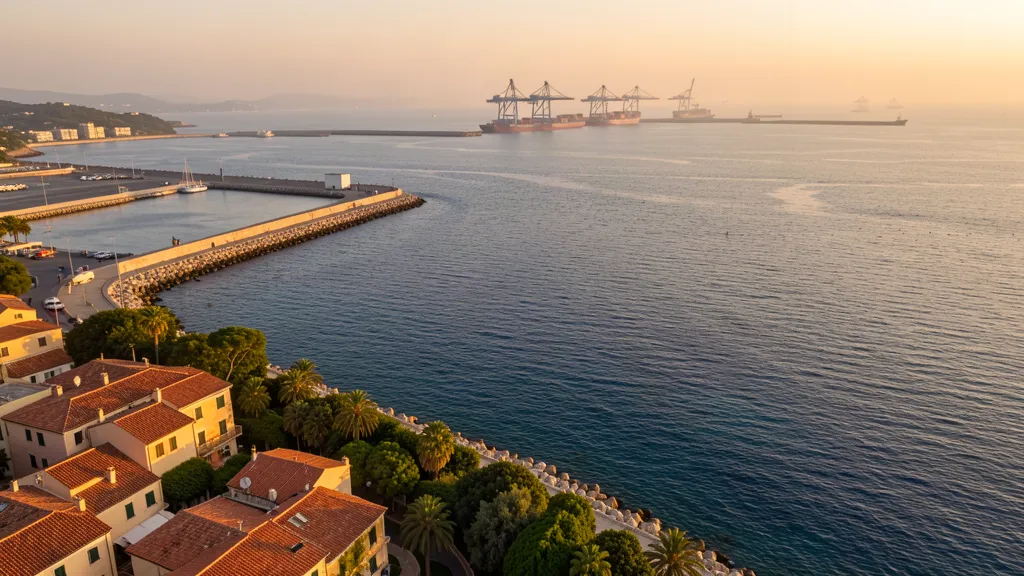
The Levante wharf wakes before the city. At six in the morning, when the light is still battling the Mediterranean haze, the cranes are already tracing their steel choreography over the dark mirror of the water. The Port of Motril-Granada, the only port facility in the province, maintains a logistical pulse that knows nothing of early mornings or holidays. Its geographical position, just a few nautical miles from the African coast, makes it a permanent point of friction between two continents that look at each other daily from opposite shores.
The figures handled by the Port Authority confirm an activity that goes beyond mere statistical anecdote. Between January and April 2026, a total of 166 ships docked at the port's various facilities, a cadence equivalent to more than one ship a day touching Granadan soil. It is not just about volume, but consistency: the Motril harbor has ceased to be a port of call and has become a stable node within the routes of the Strait and the Alboran Sea.
Regular ferry lines form the backbone of this connection. Four North African destinations—Melilla, Tangier, Nador, and Alhucemas—receive and send passengers and cargo from the Motril berths with a regularity that has transformed the perception of the port. What was once a fishing and agricultural enclave is now a terminal where road traffic, containers, and passengers crossing the Mediterranean for family, commercial, or tourist reasons coexist.
The route to Melilla deserves special mention for its emotional and economic density. The autonomous city, separated from the peninsula by a sea that narrows here, finds in Motril its natural gateway in and out. The flow of travelers embarking and disembarking each week maps out a human landscape of cross-border relations: families divided by water, merchants moving goods in both directions, and workers alternating seasons on either side of the Strait.
Tangier, for its part, represents the connection to the most dynamic Morocco, in the midst of industrial expansion. The Tangier port, which has become one of the major logistical hubs in the western Mediterranean, finds in Motril a complementary partner. The goods leaving the Granadan harbor for Tangier not only supply northern Morocco but also integrate into supply chains that reach sub-Saharan Africa. The Motril port thus functions as a hinge between Andalusian production and the emerging markets of the neighboring continent.
Nador and Alhucemas complete a map of connections that reflects the human geography of the Rif. Both cities, with strong migratory ties to the peninsula, receive a constant flow of passengers from Motril traveling for family or commercial reasons. Operation Crossing of the Strait, which mobilizes hundreds of thousands of people between Europe and the Maghreb every summer, has one of its most relevant boarding points on the eastern Andalusian coast in this port.
Cargo traffic presents a diversified profile that avoids dependence on a single sector. Agri-food products from the Vega of Granada, construction materials, agricultural machinery, and consumer goods coexist on the docks with the roll-on/roll-off cargo traveling on the ferries. This variety of cargo gives the port remarkable resilience against fluctuations in international markets, an advantage that the Port Authority has cultivated through investments in infrastructure and land connectivity.
The connection with the peninsular interior is crucial to understanding the true scope of the port. The A-44 highway, which connects Motril with Granada and links to the rest of the Andalusian road network, allows goods unloaded at the port to reach the main distribution centers in southern Spain in just a few hours. This land capillarity multiplies the strategic value of the harbor, which not only serves its immediate region but also acts as a gateway for all of eastern Andalusia.
The Port of Motril has known how to read the times without renouncing its human scale. In contrast to the enormity of Algeciras or Valencia, the Granadan harbor offers agile operations and reduced waiting times that attract medium-sized logistics operators. This agility, combined with geographical proximity to North Africa, shapes a competitive profile based on specialization and efficiency rather than gross volume.
The institutional dimension of the port has also evolved in recent years. The Port Authority of Motril, chaired by José García Fuentes, has promoted a strategy of sustained growth that includes the expansion of storage areas and the improvement of road access. These actions seek to consolidate the port as a relevant player in the Mediterranean arc, without losing sight of its social function as a generator of employment and wealth in the Costa Tropical region.
The immediate horizon poses challenges that the port addresses with a mixture of prudence and ambition. Competition from other Andalusian ports, the volatility of migratory flows, and geopolitical tensions in the Maghreb are variables that require flexible planning. The diversification of routes and the attraction of new traffic, such as tourist cruises, are part of a strategy that seeks to secure the future without mortgaging the present.
The relationship with North Africa transcends the purely commercial to enter the realm of institutional cooperation. Contacts between the Port Authority and its Moroccan and Melillan counterparts are fluid, with technical exchanges and reciprocal visits that strengthen operational ties. This port diplomacy, discreet but constant, builds a capital of trust that proves essential when incidents arise or scale conditions are negotiated.
The Port of Motril embodies a geographical paradox that defines the entire Granadan coast: the proximity of Africa is both a historical threat and a contemporary opportunity. What for centuries was a border of danger—the Berber incursions that ravaged the region—is today a space of exchange and prosperity. The same winds that once drove pirate sails toward the Motril beaches now propel ferries loaded with goods and passengers crossing the sea in just a few hours.
This transformation has been neither accidental nor immediate. It responds to decades of investment in infrastructure, the improvement of land connections, and a determined commitment to the internationalization of the local economy. The result is a port that has stopped looking exclusively at the sea to integrate into a broader logistical system, where goods flow without friction between the peninsular interior and the markets of the Maghreb.
The 166 ships docked between January and April 2026 are the quantitative evidence of a deeper qualitative process. Each call represents a business decision, an optimized route, a fulfilled contract. Behind each ship is a value chain involving stevedores, transporters, customs agents, and logistics operators who depend on the port for their daily livelihood. The Motril harbor is, in this sense, a complete economic ecosystem that beats to the rhythm of the tides and the markets.
The future of the port is being written in terms of consolidation rather than excessive expansion. The physical limitations of the harbor, squeezed between the sea and the city, discourage speculative growth. The strategy is to optimize existing spaces, improve operational efficiency, and deepen commercial relations with the ports on the other side of the Strait. A commitment to the quality of service that, judging by recent data, is yielding tangible results.
Álvaro de Bazán: the naval hero who bridges past and present
[[PHOTO:5]]
The figure of Álvaro de Bazán emerges in the history of Motril with the forcefulness of someone born to defy the limits of his time. In 2026, five hundred years will have passed since his birth, an anniversary that the city in Granada is preparing for with a commemorative program that transcends a mere protocolary tribute to become an exercise in collective memory. The 16th-century seafarer and military man, considered one of the most brilliant naval strategists of his era, represents a tangible link between the maritime past of the region and its current projection as a leading port hub in the western Mediterranean.
The Port Authority of Motril-Granada has taken a leading role in organizing the commemorative events, a decision that underscores the enduring relevance of Bazán's legacy to the city's maritime identity. The planned activities include cultural gatherings, outreach events, and visits by figures linked to the naval and institutional spheres, all aimed at rescuing from oblivion the figure of a man whose strategic vision anticipated the importance of controlling the trade routes of the southern peninsula. The port, which today operates as a bridge between Europe and North Africa, finds in this celebration a historical mirror in which to see itself.
Álvaro de Bazán was not a local hero in the strict sense of the term, but rather a figure of imperial reach whose military career was forged in the most complex arenas of the Hispanic Monarchy. His prowess in naval combat, demonstrated in campaigns that spanned from the Mediterranean to the Atlantic, earned him the recognition of his contemporaries and a prominent place in European military historiography. The Motril commemoration does not seek to appropriate his figure, but rather to reclaim the geographical and human context that saw him born, a coastline in Granada that for centuries functioned as a living frontier between civilizations and as a launching pad for maritime projection.
The fifth centenary arrives at a singular moment for Motril, as the city consolidates its commitment to the blue economy and cultural tourism as engines of development. The commemorative program is integrated into a broader heritage recovery strategy that seeks to imbue the municipality's tourist offerings, traditionally focused on sun and beach, with historical content. The figure of Bazán provides a narrative of depth that connects the Costa Tropical with the great currents of European naval history, a narrative asset that few Mediterranean coastal destinations can offer.
The events planned for 2026 include the participation of the Port Authority as host to a large part of the activities, a gesture that reinforces the symbolic connection between the contemporary port infrastructure and the maritime tradition embodied by the honoree. The visits by naval and institutional figures scheduled for the anniversary will help project internationally the image of Motril as a city with a relevant maritime past and a dynamic port present. The commemoration thus becomes a platform for cultural diplomacy that transcends the strictly local sphere.
The choice of Álvaro de Bazán as the centerpiece of the 2026 cultural program responds to a logic of selective recovery of the past, one that seeks in history references capable of engaging with the aspirations of the present. The seafarer from Granada is not merely a bronze figure destined for textbooks; he is a reminder that Motril's relationship with the sea has been, for centuries, a constant that has defined its character and its economy. The anniversary allows this bond to be updated, endowed with new meanings, and projected toward the generations that today move through a port that, without the epic of the 16th-century galleys, remains a space for exchange and connection between worlds.
The commemorative program is structured around the idea of historical continuity, a concept that the Port Authority has successfully incorporated into its institutional discourse. The infrastructure that today manages the traffic of goods and passengers to North Africa is the direct heir to a maritime tradition that Álvaro de Bazán knew in his childhood and that he helped to magnify with his military campaigns. That line of continuity, which spans five centuries of history, constitutes the central argument of a celebration that aspires to leave a lasting mark on the city's collective memory.
The international dimension of the anniversary is manifested in the very trajectory of the honoree, whose naval campaigns took him to operate in scenarios as diverse as the central Mediterranean, the Portuguese Atlantic, or the coasts of Flanders. That global projection, unusual for a man born in a provincial city in the southern peninsula, serves today as a metaphor for the aspirations of a Motril seeking to consolidate its position as a logistical and cultural hub in the Mediterranean arc. The 2026 commemoration offers the opportunity to inscribe the city's name in a historical conversation of European scope.
The cultural program planned for the fifth centenary includes events that combine academic rigor with accessible outreach to the general public, a formula that has proven its effectiveness in other similar commemorations held in Spanish port cities. The outreach events will allow the figure of Bazán to be contextualized within the complex geopolitical chessboard of the 16th century, while the institutional events will strengthen the bond between the city and the institutions that today manage its relationship with the sea. The balance between these two registers constitutes one of the main challenges of a celebration that aspires to reach diverse audiences.
The legacy of Álvaro de Bazán in Motril is not limited to the 2026 anniversary, but is part of a broader process of revaluing local maritime heritage. In recent years, the city has undertaken a revision of its historical narrative that seeks to incorporate the naval dimension into an identity traditionally associated with agriculture and the sugar industry. The figure of the seafarer from Granada adds to this narrative a temporal depth and an international projection that enrich the municipality's cultural offerings and diversify its tourist attractions.
The participation of the Port Authority in the commemorative program also responds to a strategy of institutional outreach to the citizens, an objective that Spanish port infrastructures have pursued intensely over the last decade. The port ceases to be perceived as an exclusively industrial space to become a first-order cultural actor, capable of leading initiatives that connect historical memory with contemporary economic activity. The Bazán anniversary offers an unbeatable opportunity to consolidate this positioning.
The fifth centenary of the birth of Álvaro de Bazán places Motril at a symbolic crossroads of great potential. The city has the opportunity to reclaim a maritime past that for too long has remained in the background, eclipsed by the agricultural and industrial narrative that has dominated its historical account. The 2026 commemoration can become the turning point that consolidates a new way of understanding Motril's identity, one in which the sea regains the prominence it always had in shaping the city.
Greenhouses and the tropics: agriculture that defies the climate
[[PHOTO:6]]
The traveler driving along the road connecting Motril and Almuñécar is greeted by a spectacle that is equally bewildering and mesmerizing: a sea of white plastic stretching across the hillsides for as far as the slope allows. These are the greenhouses of the Costa Tropical, structures that have transformed the landscape and economy of the region over the past four decades. Beneath these translucent covers grow crops that would be little short of a botanical eccentricity in any other corner of Europe. Cherimoya, avocado, mango, and papaya find here an exceptional microclimate, shaped by the warm influence of the Mediterranean and the natural protection that Sierra Nevada provides against the cold inland winds.
The uniqueness of this coastal strip is no recent discovery. For centuries, the farmers of the vega motrileña have been reading the thermometer with a precision that rivals today's digital sensors. Sugarcane, which dominated the agricultural landscape from the 16th century well into the 20th, was the first major bet on a tropical crop on European soil. That experience left a legacy that goes beyond industrial heritage: it proved that the combination of abundant water, mild temperatures, and fertile soils made Motril an exceptional agricultural territory. When sugar beet and international competition doomed sugarcane, local farmers had already begun experimenting with other species from distant latitudes.
The avocado has become the great protagonist of this transformation. Plantations of the Hass variety, originally from California but perfectly adapted to the conditions of the Costa Granadina, now occupy hundreds of hectares in the municipal districts of Motril, Vélez de Benaudalla, and Salobreña. The production is destined for both the national market and European exports, where the Andalusian avocado competes at an advantage thanks to its proximity and minimal transport times. Alongside this star crop, the cherimoya maintains an almost symbolic status: it is the fruit that gives the region its name and best represents the fusion between the Mediterranean and the tropics that defines this land.
Greenhouses have made it possible to extend the production calendar and protect crops from harsh weather conditions. The plastic structures, many of them built on terraced levels that make the most of the terrain's slope, create a controlled environment where humidity and temperature are regulated naturally. These are not highly technified greenhouses like those in the poniente almeriense, with hydroponic systems and computerized climate control. Here, a more artisanal model prevails, where side ventilation and drip irrigation are enough to maintain the optimal conditions required by these subtropical crops.
Intensive agriculture generates a considerable volume of employment in a region that has seen other traditional sectors decline. Crews of day laborers follow one another throughout the year in the tasks of pruning, harvesting, and preparing the fruit. The packinghouses, scattered across the industrial estates of Motril and its surroundings, employ hundreds of workers in the sorting and packaging of the produce. This business fabric, made up mostly of cooperatives and small family companies, has managed to find its niche in a globalized market where traceability and quality make the difference.
Mango and papaya represent the latest frontier of this climate-defying agriculture. They are more demanding crops in terms of temperature and less tolerant of episodes of strong wind or heavy rain that occasionally batter the coast. The most innovative farmers have begun planting them in the most sheltered areas, drawing on the experience accumulated with avocado and cherimoya. The results are promising, although production is still limited and mainly destined for market niches that value the exclusivity of a tropical product grown in Europe.
The success of this agricultural model does not hide its contradictions. The demand for irrigation water is high and coincides with a scenario of growing water stress throughout the Mediterranean basin. The aquifers in the region are under considerable pressure, especially in the summer months, when the flow of the Guadalfeo and Verde rivers drops and evaporation skyrockets.
Irrigation communities have modernized much of the distribution infrastructure, replacing earthen ditches with pressurized pipes and localized irrigation systems. Even so, the debate over the long-term sustainability of this intensive agriculture is open and pits against each other positions that are difficult to reconcile.
Land management is another front that generates controversy. The expansion of greenhouses and subtropical plantations has transformed the landscape of the vega and the hillsides near the coast. Some voices call for stricter regulations to halt the occupation of forest soils or areas of high ecological value. Others argue that agriculture is the only activity capable of anchoring the population in the rural nuclei of the region's interior.
Between these two positions moves a local administration trying to balance environmental protection with the maintenance of a sector that feeds thousands of families. The Costa Tropical looks to the future with the certainty that its agriculture will continue to be an economic pillar, but also with the awareness that the current model needs adjustments.
Agronomic research, driven by centers such as the Instituto de Investigación y Formación Agraria y Pesquera de Andalucía, is working on varieties more resistant to drought and on cultivation techniques that reduce the water footprint. The challenge lies in preserving the uniqueness of a territory where Europe meets the tropics without exhausting the resources that make this encounter possible. The coming years will tell if Motril's agriculture is capable of reinventing itself once again, just as it did when sugarcane ceased to be profitable and farmers turned to the avocado as a lifeline.
Cruise tourism: Motril opens up to the Mediterranean
[[PHOTO:7]]
The port of Motril has stopped looking solely towards the strait to open up wide to the entire western Mediterranean. For decades, the port of Granada built its identity on cargo traffic and regular connections with North Africa, but in recent years a new vocation has been taking shape along its docks. Cruise ships, those floating hotels that redraw the economies of port cities, have begun to take notice of this Andalusian port of call, which offers something increasingly scarce along the Mediterranean coast: authenticity without mass tourism.
The announcement that Motril and Granada will be the official hosts of the 2025 International Cruise Nautical Tourism Congress has provided a definitive boost to this strategy. The event, which brings together shipowners, shipping agents, tour operators, and destination managers from around the world, will put the city on the global map of the sector during the days of its celebration. This is no ordinary congress: it is the meeting where routes are decided, port calls are negotiated, and infrastructure is presented to major international operators. The fact that Motril is listed as an official host means that industry professionals will tour its facilities, evaluate its services, and, predictably, include the Granada port of call in their future itineraries.
The port has the technical arguments to back up this ambition. Its depths allow the berthing of large vessels without the limitations that affect other docks along the Andalusian coast, and its facilities have been progressively adapted to accommodate passengers disembarking with high expectations. The maritime terminal, originally designed for ferry traffic, has gradually incorporated improvements aimed at cruise tourists: reception areas, information points, and access logistics that connect the dock to the city center in just a few minutes. This proximity between the ship and the city constitutes a competitive advantage that few Mediterranean ports can offer.
The push for nautical tourism does not come out of nowhere, but rather fits into a broader strategy of economic diversification. Motril has realized that its cultural, gastronomic, and heritage offerings need an international showcase to reach the public that currently travels by cruise ship. The traveler disembarking at the port of Granada is not just looking for an organized excursion; they seek experiences that connect with the identity of the territory. And Motril has abundant raw material: from the sugar route and its industrial heritage to the local markets where the coast's tropical produce is proudly displayed.
The connection with the city of Granada acts as an additional magnet for cruise lines. The Alhambra, the Albaicín, and the monumental complex of the Nasrid city are less than an hour away by highway, a manageable distance for full-day excursions. No other Andalusian port offers such direct access to the main tourist attraction of the autonomous community. This geographical uniqueness makes Motril a natural gateway for cruise passengers wishing to visit the Alhambra without sacrificing a peaceful port of call, away from the crowds of other Mediterranean destinations.
The economic impact of each cruise port call cascades through the local business fabric. Downtown shops, port restaurants, private transport companies, and tour guides benefit from a flow of visitors that, although concentrated in terms of hours, leaves a tangible return on the city's economy. Industry studies estimate that a cruise passenger spends an average of between sixty and one hundred euros per port call, a figure that, multiplied by the thousands of passengers who can disembark in a single season, represents a considerable economic injection for a municipality the size of Motril.
The Port Authority has worked in recent years to position the port of Granada in the western Mediterranean circuits. Commercial negotiations with major cruise lines have begun to bear fruit, with a gradual increase in requested port calls and a growing presence at international trade fairs in the sector. The stated objective is to consolidate Motril as a home port or port of call for itineraries connecting the south of the Iberian Peninsula with North Africa, the Balearic Islands, and the Spanish Levant. The geographical position of the port, halfway between Málaga and Almería, gives it a strategic role in the routes crossing the Alboran Sea.
Cruise tourism also poses challenges that the city will need to manage intelligently. The arrival of thousands of passengers in a single day requires precise coordination between the Port Authority, the City Council, and tour operators to avoid bottlenecks and ensure a satisfactory experience. The sustainability of this model will depend on Motril's ability to integrate port calls without altering the character of a city that has made Mediterranean calm one of its hallmarks. Municipal leaders are aware that the balance between tourist openness and the preservation of the urban fabric will be the key to long-term success.
The 2025 International Cruise Nautical Tourism Congress will also serve to show the world a city that has managed to reinvent itself without renouncing its roots. Event participants will be able to see firsthand the possibilities of a port that combines commercial operations with a tourist vocation, and which enjoys a privileged setting between the sea and the mountains. The holding of this professional event in Motril and Granada is a recognition of a trajectory of silent but constant work that has been placing the Costa Tropical on the radar of major shipping companies.
The cruise season is shaping up as a new chapter in the maritime history of this city, which has been living facing the sea for five hundred years. The ships that dock at its docks today bring passengers from dozens of nationalities, curious to discover a corner of the Mediterranean that does not appear on the mass tourism routes. Motril welcomes them with the naturalness of someone who does not need to feign their character, with a port that has learned to diversify its sources of activity and with its gaze fixed on a horizon where nautical tourism is consolidated as an engine of development. The gateway to the tropics now opens also to the great white ships that sail the Mediterranean, and it does so without fanfare, like someone who has been waiting for the visit for centuries without losing their composure.
The Port Police: Guardians of Maritime Activity
[[PHOTO:8]]
Amidst the network of cranes, silos, and open yards that outline the industrial profile of the port of Motril, there is a corps whose presence goes unnoticed by the occasional traveler but is essential for every operation to run smoothly. The Port Police of the Motril-Granada Port Authority assumes a threefold responsibility: the security of port operations, access control, and the permanent surveillance of facilities that span dozens of hectares. Their work begins long before the first truck passes through the control arches and continues until the last ferry leaves the harbor mouth bound for North Africa.
The scale of this work is best understood by observing the daily flow of vehicles, goods, and people that coexist within the port premises. Every day, hundreds of trucks loaded with fruit and vegetable products, construction materials, or general cargo access the terminals, while passengers on the regular routes to Melilla, Tánger, Nador, and Alhucemas move through the designated areas. The Port Police acts as the first security filter, verifying documentation, authorizing access, and coordinating internal movements to prevent interference between activities that, by their very nature, require different paces and protocols.
To bring this reality closer to the public, the Motril-Granada Port Authority organizes an annual open day dedicated specifically to this corps. The initiative, which has become a staple in the port's outreach calendar, includes exhibitions and demonstrations of the technical and human resources at the Port Police's disposal. Attendees can get a close-up look at the equipment used at access controls, the surveillance systems deployed around the perimeter, and the response procedures for emergency situations requiring immediate and coordinated action.
The open day pursues an objective that goes beyond mere exhibition. By allowing the residents of Motril and the entire region to see firsthand how maritime activity is protected, a bond of trust is forged between the port and its urban surroundings. For decades, the relationship between the city and its harbor was marked by a certain physical and administrative distance, a barrier that initiatives like this help to dissolve. The port ceases to be an alien space and becomes a collective heritage whose operations deserve to be understood and valued.
In recent years, the surveillance of port facilities has grown increasingly complex, stemming from the diversification of activities housed within the premises. It is not just a matter of controlling the transit of goods or passengers, but also of ensuring security in storage areas, at the solid and liquid bulk terminals, and on the docks where vessels of very different characteristics berth. The Port Police must adapt its protocols to each scenario, from the arrival of a cruise ship with hundreds of tourists to the unloading of fertilizers or the stowage of refrigerated containers.
Technical resources play an increasingly relevant role in this work. Video surveillance systems, electronic access controls, and internal communications allow for continuous monitoring of the facilities, even during night shifts or periods of peak simultaneous activity. The demonstrations carried out during the open day show how these tools are integrated with the fieldwork of the officers, who patrol the various areas of the port and respond to any incident that could compromise the security of operations.
Access control is one of the most visible functions for those who work daily at the port. Every vehicle attempting to enter the premises must pass a verification process that confirms its authorization, its destination within the facilities, and, in certain cases, the nature of the cargo it carries. This procedure, which may seem routine, is essential to prevent unauthorized access and to maintain a reliable record of the activity taking place at any given time. The Port Police manages this flow with a combination of administrative rigor and operational agility that avoids unnecessary delays in the logistics chains.
The outreach day also includes demonstrations of emergency response procedures, an aspect that rarely reaches the public but is part of the officers' regular training. Coordination with other security forces and the port's own emergency services is periodically rehearsed to ensure an effective response to hypothetical incidents. These exhibitions allow attendees to understand the level of preparation required in an environment where risks of a very diverse nature coexist, from those derived from cargo handling to those linked to maritime traffic.
The work of the Port Police extends beyond the physical boundaries of the premises. Surveillance of the water surface, supervision of berthing and unberthing operations, and control of anchorage areas are part of their responsibilities, carried out in coordination with other authorities. This maritime dimension of their work is especially relevant in a port like Motril, where the proximity of the strait's commercial shipping routes and the intensity of passenger traffic demand constant attention to safety conditions at sea.
The open day has become an eagerly awaited event for families in the region, who find in it an opportunity to discover a world usually closed to the public. The youngest visitors approach the vehicles and equipment with a curiosity that the organizers channel through age-appropriate activities. Adults, for their part, appreciate the transparency of an institution that opens its doors to explain without reservation how it protects one of the economic engines of the Costa Tropical.
The Motril-Granada Port Authority has managed to turn this initiative into an instrument of civic education. By showcasing the human and technical resources of the Port Police, a clear message is conveyed about the professionalism of those who ensure the security of maritime operations. The open day does not seek easy applause or a display of force, but rather an understanding of a job carried out in silence, away from the spotlight, yet indispensable for the port to continue fulfilling its role as the gateway from the European tropics to the Mediterranean and North Africa.
Blue Economy: The Sustainable Future of the Port of Motril
[[PHOTO:9]]
The Levante wharf dawns with a different light when the calendar marks a working day at the liquefied natural gas supply facilities. The operators inspect the cryogenic hoses with the same meticulousness as a surgeon preparing their instruments, while the docked vessel awaits a fuel that drastically reduces sulfur oxide and suspended particulate emissions. The scene, unthinkable just a decade ago in a port accustomed to the bustle of bulk cargo and ferries, summarizes the strategic shift that the Motril-Granada Port Authority has imparted to its facilities. The blue economy has ceased to be an abstract concept in offices to become a tangible reality that runs through every mooring, every administrative concession, and every expansion project.
The term blue economy encompasses a broad spectrum of activities that share a common denominator: generating wealth from the sea without depleting its resources. In the case of Motril, this philosophy translates into a determined commitment to diversifying port uses, overcoming the traditional dependence on commercial traffic with North Africa. Inshore fishing, which still operates from the local fish market with catches of sardine, anchovy, and horse mackerel, now coexists with experimental aquaculture initiatives studying the cultivation of Mediterranean species in waters near the outer breakwater. Coastal tourism, for its part, has found an unexpected ally in the port to help de-seasonalize the offerings of the Granada Costa Tropical.
The installation of LNG supply points constitutes the spearhead of this transformation. Liquefied natural gas has positioned itself as the preferred transition fuel for shipping companies operating on short-sea routes, those connecting Mediterranean ports with frequent calls and tight turnaround times. By offering this service, Motril places itself on the map of ports prepared to serve a merchant fleet increasingly conditioned by European environmental regulations. The Port Authority has carried out the necessary adaptation works on the wharf quay, trained mooring personnel in specific safety protocols, and established agreements with authorized suppliers to guarantee product availability year-round.
Sustainability is not limited to the reduction of atmospheric emissions. Port managers have incorporated energy efficiency criteria into the new administrative buildings, with LED lighting systems in the open areas and presence sensors in the internal roadways. The selective collection of waste generated by vessels has been reinforced with specific containers for used oils, bilge water, and plastic waste, comfortably meeting the requirements of the MARPOL convention. These seemingly minor measures shape a port ecosystem where the environmental footprint is measured with objective indicators and published in annual reports accessible to any citizen.
The promotion of nautical activities represents the most visible side of this strategy for the general public. The marina, integrated into the inner dock, has expanded its range of moorings for recreational boats and improved the auxiliary services aimed at transiting sailors. The sailing and canoeing schools operating on its premises attract a young audience discovering the Granada coastline from a perspective different from that of conventional sun-and-beach tourism. The Port Authority collaborates with these entities by providing spaces on favorable terms and facilitating the administrative procedures for organizing regattas and crossings.
Aquaculture is emerging as a sector with growth potential in the Motril port environment. Feasibility studies commissioned by the Port Authority itself point to the possibility of installing marine cages in sheltered areas of the nearby coastline, where currents guarantee a constant renewal of water and temperatures remain stable for much of the year. The cultivation of gilthead seabream, sea bass, and red drum could generate skilled employment in a region where intensive agriculture absorbs most of the available workforce. Technicians insist on the need to maximize health controls and avoid any impact on the Posidonia oceanica seagrass beds, a protected habitat that acts as a natural nursery for numerous commercial species.
Diversification towards the blue economy does not imply the abandonment of the traditional traffic that has sustained the port for decades. The movement of goods with Melilla, Tangier, Nador, and Alhucemas continues to be the economic pillar of the facility, with figures that remain stable even in adverse circumstances. The difference lies in the fact that these traffic flows now coexist with new lines of business that bring resilience to the whole. A port that depends on a single type of activity is a vulnerable port; a port that combines roll-on/roll-off cargo, bulk cargo, passenger traffic, recreational boating, and energy services is a port prepared to absorb the ups and downs of international trade.
Training constitutes another pillar of this strategy. The Port Authority has signed agreements with local vocational training centers to provide courses in port machinery operation, refrigeration facility maintenance, and environmental management applied to the maritime environment. Students carry out internships at the facilities themselves, familiarizing themselves with safety protocols and the daily operations of a commercial port. This pipeline of local professionals reduces dependence on outside personnel and roots technical knowledge in the territory.
The relationship with the Granada business community has intensified through technical days and sectoral meetings where business opportunities linked to the blue economy are presented. Engineering, environmental consulting, and nautical services companies have found in the port a receptive interlocutor for innovative proposals. Administrative agility, a scarce commodity in public administrations, has become a hallmark of Motril's port management. Files are processed within reasonable timeframes, and technicians respond swiftly to queries raised by investors.
The time horizon of this transformation is measured in decades, not in legislative terms. Port infrastructures require long-term planning that transcends political cycles and demands broad consensus among administrations, operators, and civil society. The blue economy offers precisely that framework of stability: a future project that does not depend on electoral circumstances or passing fads, but on the conviction that the sea can be a source of prosperity without becoming a dumping ground. Motril, with five hundred years of port history behind it, seems to have understood that the best way to honor its past is to build a future where economic activity and environmental preservation walk along the same wharf.
Heritage and Memory: Motril Between Land and Sea
[[PHOTO:10]]
Motril's relationship with its memory is not told from offices or grand headlines, but from the slow pulse of its streets and the edge of its rooftops. One need only look up in the old town to come across the tower of the Church of the Encarnación, a sober volume that has organized the city's skyline since the 16th century. Built over an ancient mosque, the temple condenses in its fabric the logic of a population accustomed to superimposing layers: first the Nasrid medina, then the Christian parish, later the Baroque and Neoclassical reforms that gave it its current appearance. This visible stratigraphy turns the building into more than just a religious monument: it is a stone archive where one can read the tensions and agreements that have shaped Motril's identity.
Just a few minutes' walk away, the Convent of San Francisco offers another key to interpretation. Its foundation, linked to the Franciscan order, recalls the role religious communities played in the social and territorial articulation of the region following the Castilian conquest. Over the centuries, the complex has served a wide variety of uses, from a conventual space to public facilities, and in this transformation is reflected a constant of the city: the ability to reuse its heritage without stripping it of meaning. Today, its walls continue to dialogue with the urban environment, integrated into a fabric that does not isolate them like museum pieces, but keeps them alive within the daily routes of the locals.
This same logic of continuity extends towards the coastline, where watchtowers dot the coastal profile like sentinels from an era when the sea was, above all, a horizon of threat. Built between the 16th and 17th centuries to warn of Berber incursions, these defensive structures formed part of a coordinated system that visually connected the coast of Granada with the interior. Their presence, often discreet compared to the prominence of the beaches and crops, serves as a reminder that Motril's maritime vocation was not born with the modern port, but is rooted in a historical geography where surveillance and trade coexisted with the agriculture of the fertile plain.
It is precisely agriculture, and sugar in particular, that has left a heritage footprint that Motril has managed to turn into a narrative. The Industrial Sugar Museum, located in a former sugar mill, documents the splendor and decline of a sector that for decades defined the economy, landscape, and social relations of the region. The warehouses, chimneys, and preserved machinery are not presented as inert remains of a bygone past, but as testaments to a productive model that transformed the territory on a scale difficult to imagine today. The museum also helps to understand the link between the countryside and the port: the sugar that left through the dock was the result of a cycle that began in the cane plantations and ended in European markets.
That thread between land and sea is what Motril aims to reinforce with the future port interpretation center, a project that seeks to explain the evolution of the port infrastructure and its impact on the city. The initiative does not aim to compete with the sugar museum, but to complement it: if the former tells the story of what was produced, the latter will narrate the story of what was moved, exchanged, and imported. Both spaces, separated by just a few kilometers, trace a narrative arc that goes from the furrow to the crane, from the mill to the container, and which summarizes in two cultural facilities the dual vocation that has defined Motril for five hundred years.
The value of this heritage is not exhausted in its historical dimension. For a city that has chosen to diversify its economy through tourism, these resources constitute a first-order asset, capable of attracting visitors interested in experiences that go beyond sun and beach. The combination of religious monuments, defensive architecture, industrial archaeology, and port culture offers a coherent and differentiated itinerary, difficult to find in other municipalities along the Andalusian Mediterranean coast. The key lies in articulating it well, in connecting it through routes, signage, and narratives that allow the traveler to understand the relationships between each piece.
The educational component is equally relevant. Schools in the region have in these spaces an open classroom where they can teach subjects such as modern history, economic geography, or pre-industrial technology. A student who visits the Sugar Museum not only learns how a sugar mill worked; they also understand why Motril has the urban structure it has, why certain neighborhoods exist, and why the port is located where it is. This comprehensive understanding of the territory is the foundation for a citizenry more aware of its heritage and better prepared to decide on its future.
The conservation of this legacy has not been without difficulties. The urban growth of recent decades, tourist pressure, and lack of resources have tested the ability of administrations to protect the most fragile elements. Some watchtowers have reached the 21st century in a precarious state, and certain buildings in the old town have undergone interventions that show little respect for their heritage value. The creation of protection instruments and investment in restoration have improved the situation, but the balance between development and preservation remains a permanent challenge for a city that does not want to give up on growing.
Part of Motril's future is at stake in that balance. Memory is not a burden that prevents progress, but a substrate that gives depth to any transformation project. A city that knows its history can plan its port better, design its public spaces better, and present its image to the outside world better. Heritage, understood as a living system of relations between land and sea, between the agricultural past and the logistical present, is the best guarantee that growth will not come at the expense of identity, but in its favor.
Social challenges: employment, housing, and youth in Motril
[[PHOTO:11]]
The dynamism of the docks and the strength of the agricultural cooperatives paint a picture of prosperity that fails to fully reflect the daily lives of a significant portion of the population of Motril. Beneath the surface of the major economic indicators lies a more complex reality, marked by temporary work, tight wages, and the difficulty of emancipation for younger generations. Intensive subtropical agriculture and the tourism sector, the two main drivers of local employment, share a characteristic that conditions the labor market: seasonality.
This dependence on agricultural campaigns and the peak tourist season generates an intermittent hiring pattern that complicates life planning for thousands of families. Peaks in hiring during the avocado and mango harvest months, or during the summer in hospitality establishments, contrast with periods of inactivity where unemployment spikes. For field workers, many of them settled in the peripheral neighborhoods of the city, precariousness is not a temporary situation but a structural condition that has dragged on for decades.
Youth unemployment constitutes the sharpest edge of this imbalance. Data from the offices of the Servicio Andaluz de Empleo place Motril above the provincial average in unemployment rates for those under thirty, a phenomenon that pushes many graduates to seek opportunities outside the Costa Tropical. The paradox is evident: a city with an expanding port, a powerful agri-food industry, and a growing services sector fails to retain its most qualified human capital. The lack of stable and well-paid job offers acts as a silent expeller, emptying the classrooms of high schools and Granada's university faculties of Motril talent.
Added to this difficulty in finding quality employment is a problem that has worsened in recent years: access to housing. The boom in tourist rentals in areas close to the beach and the pressure of demand from other provinces have pushed prices to levels unaffordable for many residents. A two-bedroom apartment in the city center or in coastal developments can easily exceed seven hundred euros a month, a figure that overwhelms the budget of an agricultural worker on a temporary contract or a young person with a service sector salary.
The Motril City Council, aware of this social fracture, has promoted, in collaboration with the Junta de Andalucía and the central government, several training and employment programs aimed at diversifying the local economy. Employment workshops linked to the blue economy, the digitalization of small businesses, and the energy rehabilitation of homes seek to create labor niches alternative to agriculture and tourism. The push for dual vocational training at the port, with courses in logistics and international trade, aims to connect the real demand of companies with the qualifications of Motril's youth.
Social organizations working on the ground, such as Cáritas Diocesana and the Cruz Roja, assist families daily who alternate periods of employment with phases of severe hardship. Their managers describe an increasingly heterogeneous profile: young couples with children who cannot afford rent, construction workers retrained in agriculture without a safety net, and women over forty-five who have been left out of the labor market. The chronic nature of these situations has led the city council to reinforce emergency social aid and socio-labor integration programs.
The challenge of affordable housing has become a political priority in the current municipal term. The construction of a protected housing development for rent in the northern expansion area of the city, next to the new regional hospital, represents the first project of its kind in over a decade. The initiative, financed with European funds from the Recovery Plan, involves the construction of eighty energy-efficient homes aimed at those under thirty-five and single-parent families. Administrative deadlines, however, are moving slowly while the list of applicants registered in the municipal register of protected housing seekers already exceeds a thousand family units.
Tourist seasonality, far from being mitigated, has been accentuated by the emergence of tourist apartments in the historic center and in the areas of Varadero and Playa Granada. Owners find holiday rentals to be much more profitable than residential leases, which has drastically reduced the supply of permanent housing for residents. Neighborhood associations have expressed their concern to the municipal plenary about the transformation of the center into a space oriented towards visitors, with souvenir shops and franchises displacing traditional small businesses.
Youth talent retention programs promoted by the Cámara de Comercio de Motril and the Mancomunidad de la Costa Tropical attempt to reverse the brain drain of university graduates. Internship grants in port companies, awards for blue entrepreneurship projects, and networking events between the Universidad de Granada and the local productive fabric seek to create an ecosystem that offers real alternatives to emigration. The results are still modest, but they point in a direction that social agents consider essential: productive diversification as the only way to break the cycle of temporary employment.
Labor precariousness in the agricultural sector also has a gender dimension that does not go unnoticed by the unions. Women working in subtropical fruit packing houses endure intensive working hours during the campaign, with contracts by the day or week and wages that barely exceed the provincial agreement. The lack of work-life balance services, such as public nurseries with schedules adapted to field shifts, hinders their stable integration into the labor market. Agrarian organizations and union representatives agree on the need for a comprehensive plan that addresses training, occupational safety, and contractual stability throughout the entire agri-food chain.
The social future of Motril hinges on the ability of its institutions to transform economic dynamism into shared well-being. The city has formidable assets: a growing port, competitive agriculture, a privileged climate, and an enviable geostrategic position. The challenge lies in ensuring that these assets generate stable employment, affordable housing, and opportunities for the young people who today watch from a distance as their city prospers without that prosperity reaching them.
Tropical Gastronomy: The Flavor of Motril at the Table
[[PHOTO:12]]
The breeze rising from the port brings salt, but also a sweet aroma that slips through the streets of the town center. It is the scent of ripe cherimoya, of freshly cut mangoes at the stalls of the municipal market, of the sugarcane that for centuries defined the landscape and the palate of this land. Motril's cuisine knows no borders between the sea and the orchard; it moves naturally between the fish market and the vegetable plot, between the frying pan and the syrup.
The fish from the Granada coast arrive every morning at the kitchens of local bars and restaurants with a freshness that needs no artifice. Anchovies, sardines, horse mackerel, or mackerel are prepared with the simplicity of those who know that the product is king. A sardine skewer roasted over sugarcane, a fry of assorted small fish, or a brothy rice with seafood from the bay summarize a seafaring tradition that coexists without fanfare with the tropical pantry that extends just a few kilometers from the coastline.
This coexistence between the salty and the sweet, between iodine and sugar, is the most recognizable hallmark of Motril's gastronomy. The mango from the region, with its fibrous pulp and intense sweetness, appears in salads, sauces for fish, and desserts that surprise visitors. The cherimoya, delicate and aromatic, is eaten fresh or incorporated into artisanal ice creams and cakes that have gained fame beyond the province. This is not a forced fusion cuisine, but a territorial logic: what grows by the sea ends up meeting what the sea returns every day.
Sugarcane rum deserves a chapter of its own. Motril keeps alive a rum-making tradition that dates back to the times when sugarcane covered much of the Vega and sugar mills set the economic pace of the region. Local distilleries produce aged and spiced rums that are served neat, on the rocks, or as the base for cocktails that have found their place in Motril's hospitality scene. Ron Pálido and Ron Montero, names linked to the city's industrial history, remain present at the bars and on the after-dinner tables, as a liquid reminder of that sugary past.
Local pastry offers another of the great attractions for those sitting down to eat in Motril. Piononos, small cylinders of sponge cake soaked in syrup and topped with toasted cream, are perhaps the best-known sweet in the province, although their origin is disputed with the neighboring Santa Fe. In Motril, they are made with a certain moisture and an intensity of cinnamon that makes them recognizable. Tortas de Motril, on the other hand, speak of the Arab and Mediterranean heritage that runs through all Granadian pastry: olive oil dough, sugar, cinnamon, and almond, baked until they reach that crispy point that makes them the perfect companion for a mid-afternoon coffee.
Arab influence is not limited to sweets. It is perceived in the use of honey, in the spices that flavor stews, in the presence of nuts, and in a certain fondness for sweet and sour contrasts that also appears in savory dishes. Eggplant, roasted peppers, vegetable couscous, or cabello de ángel empanadillas are examples of a repertoire that has managed to preserve that Andalusian memory without renouncing modernity.
The restaurant sector has understood that this unique pantry is a first-order tourist asset. Restaurants in the city and nearby coastal towns have incorporated tasting menus focused on local produce, rum tastings, and visits to tropical fruit farms that end at the dining table. Gastronomy has become a gateway to the territory, a way of explaining Motril through the palate. Local chefs, many of them trained in the province's hospitality schools, champion the traditional repertoire while exploring new interpretations of ingredients such as avocado, papaya, or lychee, which are increasingly present in the region's crops.
The figures for gastronomic tourism back up this commitment. Routes that combine a visit to the port, a stroll through the historic center, and a meal at a local restaurant have grown steadily in recent years. Establishments that work with local produce stand out in specialized guides and attract visitors looking for more than just sun and beach. The restaurant industry has become an economic engine that complements port and agricultural activity, generating employment and retaining population in the territory.
The Motril municipal market serves as a daily showcase of this wealth. There, fish from the bay coexist with freshly harvested tropical fruits, goat cheeses from the mountains, cured meats from the Alpujarra, and local wines. The building, renovated in recent years, maintains the bustle of traditional food markets: vendors hawking their wares, customers returning week after week. It is the place where Motril's dual identity is best understood: gateway to the sea and gateway to the tropics.
The mango season, between August and November, marks a peak in local gastronomic activity. The events dedicated to this fruit include cooking demonstrations, tastings, and special menus at participating restaurants. The cherimoya, whose campaign runs from October to January, stars in similar initiatives to promote a delicate and scarce crop, concentrated in very few areas of the world. Motril takes advantage of this uniqueness to position itself as a differentiated gastronomic destination, far from the clichés of mass tourism.
Motril's cuisine is the result of a privileged geography and a history that has left its mark on every recipe. From the sea come the fish that feed the seafaring tradition; from the plain, the tropical fruits that bring sweetness and exoticism; from the sugarcane, a rum with personality that is sipped slowly. All of this is served on a table where Arab heritage, Mediterranean memory, and the ambition of a restaurant scene that looks to the future without renouncing its roots coexist.
Connections and transport: Motril on the logistics map
[[PHOTO:13]]
The A-44 motorway, known as the Sierra Nevada route, descends from Granada to the Granada coastline along a route that has shortened distances and transformed the port's relationship with its hinterland. In just over forty minutes, a truck leaving the Motril docks can join the A-92 and, from there, reach Sevilla, Madrid, or the Levante without leaving the high-capacity network. This direct connection with the A-7, the backbone of the Mediterranean, places Motril in a corridor that concentrates a large portion of the freight traffic in the southern peninsula. The geographical position, so often invoked as an abstract asset, translates here into measurable transit times and a real competitive advantage for logistics operators working with North Africa.
Container traffic has grown steadily over the last few financial years, driven by the demand for agri-food products and the movement of general cargo in and out of the Granada port. Regular ferry lines to Melilla, Tánger, Nador, and Alhucemas do not just transport passengers; their holds accommodate semi-trailers, vehicles, and roll-on/roll-off cargo that find in Motril a less congested embarkation point than other ports along the Mediterranean arc. This operational fluidity, combined with the proximity to the large horticultural and fruit-growing farms on the coast, has turned the port area into a key piece for Andalusian exports to Marruecos and the rest of the Magreb.
The Autoridad Portuaria de Motril has prioritized in recent years the improvement of land access and the expansion of storage areas to respond to this increase in activity. The esplanades next to the muelle de las Azucenas, where refrigerated containers are stacked during the fruit and vegetable campaign, reflect the pulse of an infrastructure that no longer depends exclusively on solid bulk or cruise ship calls. The port has diversified its traffic and, in doing so, has strengthened its role as an intermodal node in the south of the peninsula, although this intermodality still suffers from a structural shortfall that conditions its future development.
The lack of a rail freight connection looms as an outstanding issue over any debate about the logistical future of Motril. While other Andalusian ports have operational terminals that move containers inland without relying on trucks, the Granada port continues to await a branch line to connect it to the general network. This absence forces virtually all the cargo crossing its docks to travel by road, increasing costs for operators and reducing the capacity to attract long-haul traffic. The administrations have included the project in various strategic plans, but the realization of the link remains unanchored to a firm timetable.
The imbalance between the efficiency of road access and the lack of rail largely defines Motril's position on the Andalusian logistics map. The city has managed to exploit its status as the southeastern gateway to the peninsula, with a maritime offering that covers the Strait routes and a road network that connects it to the main consumption centers. However, the absence of a freight train prevents it from competing on equal terms with Algeciras, Valencia, or Barcelona for traffic that requires rail distribution to the center and north of Spain. This limitation has not halted recent growth, but it conditions the ceiling to which the infrastructure can aspire in the medium term.
Logistics operators located in the port area agree in valuing the agility of customs services and the availability of land as factors that at least partially compensate for the lack of railway. The warehouses in the polígono del Vadillo, just minutes from the docks, house companies dedicated to transit between Europe and the Magreb, as well as transport firms that cover regular routes to the peninsular Levante. This activity generates direct and indirect employment and consolidates a specialized business fabric that, despite its modest size compared to other enclaves, brings resilience to the local economy.
The maritime connection with North Africa is a strategic vector that goes far beyond the purely commercial. The links with Melilla guarantee the supply of the autonomous city and the transit of travelers who use Motril as a gateway to the peninsula. The routes to Marruecos channel a growing flow of agri-food and auxiliary industry goods, in a scenario of economic integration between both shores. This function as a bridge between continents gives the Granada port a geopolitical relevance that traffic figures alone fail to reflect.
The future of the puerto de Motril-Granada, according to the plans of the Autoridad Portuaria, involves consolidating existing traffic and opening new lines of business linked to the blue economy and cold logistics. The expansion of the logistics activities zone, the improvement of road access from the A-7, and the progressive digitalization of customs processes are among the short-term priorities. The rail connection, although relegated to an uncertain horizon, remains present in planning documents as necessary infrastructure for Motril to deploy its full potential as a logistics node in southern Europe.
Meanwhile, the city watches as its port gains weight in the trade flows of the western Mediterranean without sacrificing its human scale. The sunsets over the dock, with cranes silhouetted against the sky and ferries maneuvering to berth, compose a scene that summarizes the duality of Motril: a regional capital that has turned its geographical position into an argument for the future. The pending challenge of the railway does not overshadow this trajectory, but it does serve as a reminder that logistical competitiveness is built with sustained investments and a vision that transcends political cycles.
Culture and Leisure: An Offering That Complements the Port
[[PHOTO:14]]
Motril's cultural calendar knows nothing of low seasons. While the docks set the economic pulse of the city, its stages and streets sustain a year-round program, featuring events that have transcended the local sphere to become regional benchmarks.
The Festival de Música y Danza, heir to a tradition rooted in the summer cycles of the Granada coast, brings together performers of national and international renown each summer in venues such as the Teatro Calderón and the gardens of the Casa de la Palma. The combination of classical repertoire, flamenco, and contemporary proposals has allowed this festival to act as a magnet for an audience that would otherwise not have Motril on their cultural map.
The fiestas de San Isidro, patron saint of farmers, add a different dimension to the leisure offering. Every May, the city throws itself into a celebration that blends the religious and the festive, with decorated floats, cart contests, and open-air parties that last until dawn. The link between these festivities and the agricultural sector is no coincidence: Motril has historically been a land of farmers and day laborers, and San Isidro represents the continuity of that identity well into the 21st century.
Semana Santa, for its part, showcases a sculptural and musical heritage that winds through the streets of the historic center with a deep-rooted tradition passed down from generation to generation. The Motril brotherhoods, some with over four centuries of history, take to the streets with floats that combine Baroque imagery with the sobriety characteristic of the Andalusian tradition.
The port has ceased to be an exclusively industrial space to become part of the city's cultural agenda. The open days organized by the Autoridad Portuaria allow residents and visitors to get up close to the operations of the docks, the storage silos, and the berthing areas that are normally restricted. These visits, usually scheduled on specific weekends, have sparked growing interest among a family audience that discovers in the port area an unexpected setting for learning and curiosity. The holding of the Congreso Internacional de Turismo Náutico de Cruceros has added a layer of international projection to this strategy, bringing together operators, shipping companies, and experts in Motril in a sector the city aspires to develop with greater ambition.
The push for nautical tourism is no passing whim. The port of Motril boasts a sports marina and a body of water that, combined with the subtropical climate of the Granada coast, offer favorable conditions for sailing practically all year round. The congresses and professional meetings linked to this activity generate a flow of visitors who stay overnight in the city, spend in its hospitality venues, and discover a complementary offering that goes beyond sun and beach. The connection between the port area and the urban center, still in need of improvement in terms of pedestrian accessibility, has become one of the recurring debates among local tourism stakeholders.
Motril's cultural program relies on a network of facilities that has been modernized over the last two decades. The Teatro Calderón, renovated and reopened after years of neglect, serves as the central hub for performing arts, while municipal centers and outdoor spaces host film cycles, exhibitions, and workshops aimed at diverse audiences. The offering is not limited to major events: throughout the year, literary presentations, small-format concerts, and educational activities follow one another, keeping the city's cultural fabric alive. This grassroots programming, less visible than the flashy festivals, is crucial for retaining a local audience that consumes local culture.
Cultural tourism has ceased to be a minor add-on to become a strategic pillar of Motril's positioning. Attendance figures for major events and the growing presence of visitors from other Andalusian provinces and the Comunidad de Madrid confirm that the city has outgrown the label of an exclusively holiday destination. The combination of historical heritage, stable programming, and sea-related events shapes a destination profile that aspires to compete in the quality tourism segment, away from the mass tourism that affects other points on the Mediterranean coast. The cultural and leisure offering acts, in this sense, as a de-seasonalizing factor that allows tourist pressure to be distributed throughout the year.
The relationship between the port and culture does not end with congresses or open days. The docks have served as a setting for film shoots, photo sessions, and sporting events that take advantage of the unique landscape of an industrial area in direct contact with the sea. This versatility has aroused the interest of production companies and organizers who find in Motril a natural film set with favorable logistical conditions. The city, aware of this potential, has begun to articulate a strategy to attract film shoots and audiovisual productions that generate economic impact and external visibility.
The pending challenge is to consolidate a cultural offering that does not depend exclusively on public budgets or the political climate. Collaboration between the Autoridad Portuaria, the City Council, and the private sector has yielded specific results, but tourism operators are calling for medium-term planning that guarantees the continuity of events and the improvement of reception infrastructure. The experience of other Andalusian port cities shows that the effective integration of the waterfront and the city's cultural life requires sustained investment and a shared vision among administrations. Motril has all the necessary ingredients: a consolidated calendar, a port with projection, and a unique identity that distinguishes it from other destinations in the southern peninsula.
Looking to the Future: Motril and Its Blue Horizon
[[PHOTO:15]]
For months now, the Muelle de las Azucenas has been bustling with cranes and workers, heralding the upcoming expansion of the cruise ship docking area. The Port Authority has scheduled the Cruise Congress for 2025, a forum that will place Motril on the international circuit of Mediterranean port calls. This is not just another industry event, but an opportunity for shipowners, tour operators, and maritime agents to see firsthand the capacity of the Granada harbor to absorb tourist traffic that no longer depends strictly on seasonality. The event also coincides with the commemoration of the fifth centenary of the birth of Álvaro de Bazán, the seafarer who projected the name of Motril onto the Atlantic routes and who now serves as a symbolic thread to reclaim the city's oceanic vocation.
This vocation is reflected in figures and far-reaching decisions. The port has ceased to be a mere embarkation point for North Africa to become a logistics hub that combines general cargo, solid bulk, and ro-ro traffic with growing ship repair activity. The blue economy, understood as the sustainable use of marine and coastal resources, is beginning to permeate the discourse of local institutions and vocational training centers. Programs related to nautical studies, port logistics, and aquaculture have seen increased enrollment in recent academic years, an indicator that the new generations no longer associate the future of Motril exclusively with the cultivation of avocados or cherimoyas.
Diversifying the productive fabric is the great pending challenge. Motril has historically depended on the agri-food sector, which has generated wealth but also structural vulnerability to fluctuations in international markets and episodes of drought. The industrial estates around the Carretera del Puerto and the Camino de las Ventillas now house technology-based companies working on the digitalization of logistics processes and smart fleet management. These initiatives are still modest in terms of turnover, but they reveal a shift in mindset among local business owners, who are increasingly aware that competitiveness depends on innovation, not just on the price of fresh produce.
In parallel, the City Council has launched a plan to modernize municipal markets and commercial thoroughfares in the historic center. The pedestrianization of streets such as Catalanes and the improvement of lighting in the Plaza de la Aurora are part of a strategy aimed at retaining visitors beyond their port call. Cruise tourists have just a few hours to get a feel for the city, and the experience must be attractive enough to prompt a return visit with more time to spare. Hotel overnight stay data from recent years point to a sustained increase in the average length of stay, a sign that the cultural and gastronomic offerings are beginning to work as a standalone draw rather than just a complement to sun and beach tourism.
The youth of Motril play a central role in this transformation. The classrooms of the university campus, affiliated with the University of Granada, have diversified their offerings with degrees focused on business management and tourism, while the downtown coworking spaces have welcomed a generation of entrepreneurs betting on circular economy, digital design, and environmental consulting projects. This young, educated population is the main asset in curbing the brain drain to Granada or Málaga, a phenomenon that has hampered the region's endogenous development aspirations for decades. The availability of affordable housing and improved rail connections appear as essential conditions for this human capital to decide to stay.
Motril's blue horizon is not limited to the port or the coastal strip. The city aspires to become a laboratory of solutions for climate change adaptation in the western Mediterranean, an area in which collaboration with the University of Granada and Andalusian research centers can generate knowledge transferable to other coastal municipalities. Pilot projects for the regeneration of posidonia seagrass meadows and water quality monitoring in the harbor have attracted the interest of European innovation funds, which see the Costa Tropical as an ideal territory to test models of coexistence between port activity and the conservation of marine ecosystems.
The commemoration of the fifth centenary of Álvaro de Bazán offers a first-order narrative lever to project this external image. The historical days, naval reenactments, and conference cycles planned for the coming months are not conceived as an exercise in nostalgia, but as a platform to debate the role of medium-sized port cities in the commercial geopolitics of the 21st century. Motril cannot compete in volume with Algeciras or in glamour with Málaga, but it can specialize in high value-added niches such as perishable goods logistics, sustainable nautical tourism, or support services for the offshore industry in North Africa.
This specialization requires close coordination between the Port Authority, the Regional Government of Andalusia, and the business community. The regional budgets have allocated funds to improve road access to the port facilities and to expand the logistics activities zone, measures that must be implemented without delay if the window of opportunity opened by the growth in traffic with Morocco and Algeria is to be seized. Competition with other ports along the Mediterranean arc is fierce, and administrative sluggishness can squander in a matter of months a competitive advantage built over years.
The future of Motril hinges on the ability to balance tradition and modernity without either force canceling out the other. Tropical agriculture will remain an economic pillar and an identity trait, but it can no longer sustain on its own the quality employment demanded by an increasingly educated population. The port, the blue economy, and cultural tourism outline a triangle of opportunities that will only materialize if local institutions maintain a long-term strategic vision and if the citizens embrace as their own a project that transcends electoral cycles. The gateway to the tropics, opened five hundred years ago, now looks toward a horizon where the blue of the Mediterranean is much more than just a backdrop color.