
Club Costa Tropical · The Journal
The Alpujarra keeps alive the trades its hands still know how to weave
In Pampaneira, the workshop « El Telar de Mercedes », housed in a 300-year-old building, keeps alive traditional Alpujarran weaving with 18th-century looms and handmade jarapas.
In Pampaneira, the workshop « El Telar de Mercedes » keeps alive one of the oldest textile traditions of the Alpujarra: century-old looms, multicoloured jarapas and knowledge passed from master weaver to craftswoman.
[[PHOTO:0]]
A trade learned with the hands and passed from master weaver to craftswoman
[[PHOTO:1]]
In the old town of Pampaneira, a listed house more than three hundred years old holds one of the best-kept secrets of the Alpujarra: the loom. There, among threads of linen, wool, alpaca and cotton, tapestries, blankets and jarapas are still woven by hand with techniques that have not changed in essence since the end of the 18th century.
The place, known as « El Telar de Mercedes », is considered the oldest artisanal textile centre in the comarca, with more than thirty-five years of uninterrupted activity. It is neither a museum nor a stage set for tourists: it is a living workshop where the shuttle still crosses the warp every day, and where the visitor can sit before a century-old loom and watch a jarapa come into being.
The jarapa, a hallmark of the Alpujarra, is a long-pile cotton cloth with vivid colours, used as a bedspread, rug, throw or tapestry. Its great versatility and chromatic richness, with patterns that blend the Arab heritage with other distant influences, make it one of the pieces most sought after by visitors.
Mercedes Carrascosa: the master who revived a tradition
[[PHOTO:2]]
Behind this workshop lies a story of revival that defines the Alpujarran textile trade. Mercedes Carrascosa, born in Pampaneira and coming from a family of artisans, devoted her life to reviving the textile traditions linked to the Moorish roots of the region. She did not merely keep a trade alive: she rescued it from oblivion and brought it back to the heart of village life.
Her dual role as craftswoman and former mayor of Pampaneira made her an exceptional figure in the sector. From public office she promoted the value of local craftsmanship and, from the loom, she defended the quality that distinguishes handmade work. This combination of political commitment and manual skill earned her recognition that goes beyond the comarca.
Today, Mercedes is regarded as one of the oldest weavers in the Alpujarra. But her greatest legacy is not only the work she has produced over the decades: it is having opened the way for this tradition to continue in the hands of new generations of craftswomen.
The succession: Epifania Lagrillière, the craftswoman who took up the baton
[[PHOTO:3]]
The continuity of « El Telar de Mercedes » is a lesson in how a trade can survive when it finds the right hands. The person responsible for keeping it active today is Epifania Lagrillière, a craftswoman of Swedish origin who settled in the Alpujarra in 1992.
In her home country, Epifania learned to handle the hand looms of Nordic jarapas. Once in the Alpujarra, she worked as an apprentice to the master weaver Mercedes Carrascosa, perfecting her technique on the more complex low-warp looms. With more than twenty years of experience, she today produces a varied range of fine fabrics with natural materials.
The workshop keeps three high-warp looms and one low-warp loom with a flying shuttle, operating according to techniques from the end of the 18th century. On them are worked natural fibres such as linen, wool, alpaca and cotton, used to make tapestries inspired by the nature and architecture of the Alpujarra, as well as blankets, cushions, ponchos, shawls and scarves, many of them made to order.
The result is a demonstration of how tradition and continuity can coexist: the technique inherited from Mercedes, the Nordic knowledge of Epifania and the shared vocation of keeping alive a trade that rural Spain watches disappear in too many corners.
The loom as resistance: techniques that refuse to die
[[PHOTO:4]]
The low-warp loom has no instruction manual. Nor did that of her master, nor that of the master's master. The knowledge travels from hand to hand, from woman to woman, in a circuit that barely leaves a written trace and that depends, like so many things in the Alpujarra, on memory and patience.
The process begins long before the hand touches the wool. The fibre must be combed, cleaned of impurities, carded to align the strands and finally spun. On the looms of the comarca, natural fibres such as wool, linen, alpaca and cotton are still worked. The colours, many of them obtained with natural dyes, complete a cycle that respects the rhythms of nature.
The high-warp loom, one of the oldest known on the peninsula, works on an apparently simple logic: two vertical posts hold a top roller where the warp is wound, and a bottom roller gathers the finished fabric. But the simplicity of the frame hides considerable technical complexity. The heddles, the threads that raise and lower the warp to create the shed, are worked with the feet by means of pedals. The weaver must coordinate the rhythm of the feet with the casting of the shuttle and the blow of the beater that compacts the weft.
Potters of clay: a trade that shapes identity
[[PHOTO:5]]
The clay of the Alpujarra has a memory. The fist that kneads it in Órgiva knows this, as does the kiln that fires it in Ugíjar, two of the last bastions where pottery resists becoming a museum piece. Here, the trade is not learned at school: it is inherited through gesture, through the exact pressure of the fingers on the wheel, through that patience demanded by clay when it is still only promise.
The technique is the same as that brought by the Andalusian artisans centuries ago, and the wood-fired kilns keep that low-dome architecture that seems to sprout from the earth, camouflaged among prickly pears and terraces. The competition today comes not from another artisan, but from the industrial ceramics that flood the markets with identical, perfect and empty pieces, mass-produced at a cost no manual workshop can match.
Yet the value of the artisanal piece lies not in the perfection of the series, but in its uniqueness. Every jug, every pot, every jar leaves the kiln with the small imperfections that betray the hand that made it. That difference, hard to explain but easy to perceive, is precisely what gives value to a trade that refuses to disappear.
Esparto weavers: the esparto grass that holds the memory
[[PHOTO:6]]
Esparto is not cut: it is pulled out. The master esparto worker has known this since childhood: you must wait for the waning moon of August, when the fibre has built up just the right strength and the sap is resting. Then you pull on the tuft with a dry flick of the wrist, without gloves, letting the leaf come out clean from the earth. This gesture, repeated for millennia, is the first act of a trade that the Iberians already practised on these very slopes.
The harvest is only the beginning. The freshly pulled esparto must dry in the sun for days. Then comes the beating: striking it with a wooden mallet on a flat stone until the fibre softens. Then it is braided, twisted and sewn. The whole process, from the tuft in the field to the finished basket, can take weeks. There is no shortcut.
The capachos, the mats placed under oil presses to filter the golden liquid, were for centuries the comarca's flagship product. The baskets, the serons for the pack animals, the mats for drying figs and grapes: everything came from hands that today barely find orders, but which keep the technique as a treasure.
The forge and leather: trades that forge character
[[PHOTO:7]]
Antonio's anvil is still cold at seven in the morning. The blacksmith of Mecina Fondales lights it with olive wood and charcoal, a ritual he has repeated for decades. The iron must reach the right temperature to become malleable, and that heat cannot be improvised. Nor can the exact blow, the precise twist, the temper that turns a shapeless bar into a ploughshare.
The forge and leather tanning complete the map of trades that refuse to disappear in this comarca. Two disciplines that do not share a raw material but do share a fate: silent survival. The blacksmiths of the area still make ploughshares, horseshoes, farm tools and decorative elements that adorn balconies and gateways. The tanners, for their part, make straps, bags, belts and harnesses using a traditional method.
Both trades demand a physical skill not acquired in the classroom. There are no schools that teach these gestures. They are passed from father to son, from master to apprentice, in workshops where the silence is broken by the sound of the hammer or the rasp of the blade on leather.
The Granada Feria de Oficios: showcase and hope
[[PHOTO:8]]
When the craft of the Alpujarra leaves its villages, it almost always heads for Granada. Fairs such as those held in the Andalusian capital turn the heart of the city into an open-air workshop, where the master craftsmen of the comarca do not only sell, but demonstrate. The wheel turns, the shuttle crosses and the public, urban and hurried, slows its step. It is the only time many consumers see the hands behind the object.
For the workshops of the comarca, most of which are small and depend on direct sales, these gatherings are a regular connection with a market that would otherwise be out of reach. The fairs are not only a showcase: they are also a place where the artisan gauges how their products are received and spots trends.
The relationship with the public has another, less visible but just as relevant, consequence: consumer education. When a craftswoman explains how wool is dyed with plants from the surroundings, or why a jarapa takes so much time at the loom, she is passing on knowledge that no tourist leaflet contains. The buyer who understands the process appreciates the object more and accepts its price more readily.
The generational handover: the pending task
[[PHOTO:9]]
The question that runs through the workshops of the Alpujarra is not whether there is a market for their products, but who will take the loom bench when the current masters are gone. It is a concern shared across rural Spain, where many traditional trades watch their last practitioners grow old without young people coming forward to succeed them.
In the case of Alpujarran textiles, there is reason for hope: the handover at « El Telar de Mercedes » shows that a trade can continue when it finds the right hands. Epifania Lagrillière, trained as an apprentice to Mercedes Carrascosa, is proof that knowledge can be handed down even without a family bond, as long as there is vocation and dedication.
But each trade has its own story. Pottery, esparto, the forge or leather depend on masters who, in many cases, have not yet found who will take up their testimony. The physical hardship of the work, the irregular income and the lack of social recognition keep many young people away from a path that nevertheless offers a quality of life and a sense of purpose that few urban jobs can match.
Craft and tourism: salvation or folklorisation?
[[PHOTO:10]]
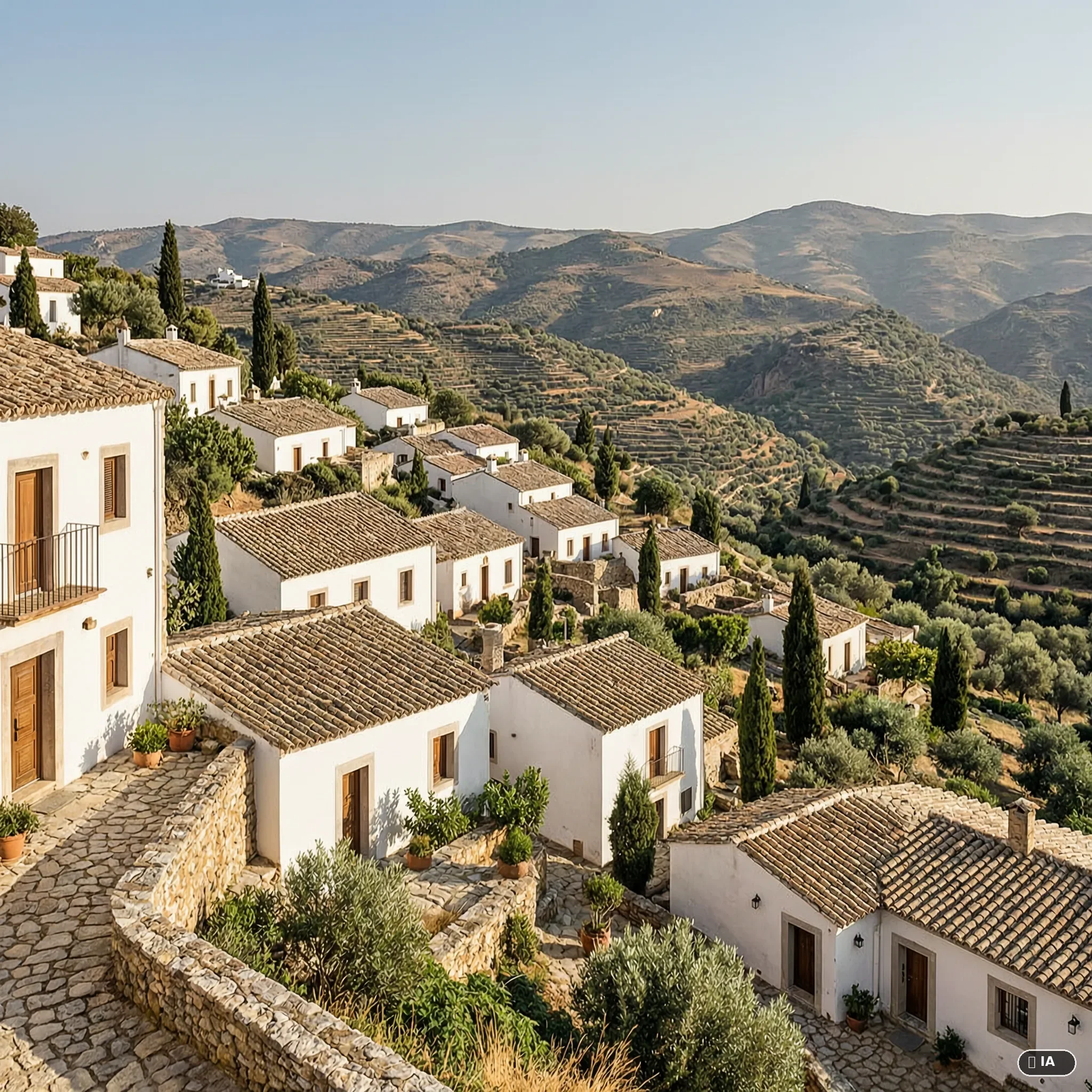
The midday sun bounces off the whitewashed façades of Pampaneira and tourists fill the main street. They go into the shops, photograph the working looms, ask prices. Many come out with a piece of pottery or a small souvenir. The Alpujarra lives off tourism, and its craft lives to a large extent off the tourist. The question is: at what price?
Tourism has turned part of the craft into a showcase of the picturesque, but it has also created the economic support that keeps many workshops open. In the white villages of the comarca, the workshops open their doors to visitors, offer tours and courses, explain their work. This openness, far from denaturing the trade, has been essential to its survival.
The risk of folklorisation is real. When the visitor only wants a cheap souvenir, production tends to be simplified to fill the shop windows. But the workshops that have resisted that pressure offer something no souvenir shop can replicate: the chance to see the artisan at work, to learn the origin of the materials, to understand why a piece takes so long to finish. That experience is part of the product's value.
Women artisans: the guardians of the loom
[[PHOTO:11]]
The history of Alpujarran textiles is, in large part, a history of women. For generations, they were the ones who wove in silence, inside their homes, without a contract and without a voice in the decisions of the sector. The trade was passed from mothers to daughters, from mothers-in-law to daughters-in-law, in a domestic circle that left almost no written trace.
The figure of Mercedes Carrascosa changed that dynamic. She not only wove, but occupied positions of decision-making, going on to become mayor of Pampaneira, and publicly defended the value of local craftsmanship. Her example opened the way for other women to see the loom not as an inherited obligation, but as a dignified trade with a future.
The continuity of the workshop in the hands of Epifania Lagrillière confirms this evolution: the transmission of knowledge is no longer exclusively family-based, but open to anyone with a vocation who can appreciate the value of handmade work. Women remain the main guardians of the loom, but now with a visibility and recognition their predecessors never had.
The handmade economy: the value of time
[[PHOTO:12]]
Alpujarran craftsmanship faces a paradox: it has never aroused so much interest among visitors and, at the same time, it has never been so hard to keep a workshop going. The difference between the price of a handmade piece and its industrial equivalent is not a whim, but the reflection of hours of work and of knowledge that is not acquired on an intensive course.
Every jarapa, every tapestry, every piece of pottery or esparto carries the time of the person who made it. A medium-sized blanket takes weeks of work. A commissioned tapestry can take even longer, between the preliminary design studies, preparing the loom and the weaving itself. That time is the true cost of the piece, and it is precisely what industry cannot replicate.
The handmade economy will never compete with industrial production in volume or price. Its battle is a different one: that of quality, durability, cultural identity and dignified employment. Every piece that leaves a workshop of the Alpujarra carries a story, a territory and a trade that, if it disappears, will not return.
The Alpujarra as a laboratory for rural Spain
[[PHOTO:13]]
The Alpujarra of Granada works like an experiment in the open air. For decades, this comarca has tried out a formula that combines rural tourism, artisanal production and landscape conservation, and the results offer lessons that other regions of depopulated Spain observe closely.
The three villages that form the tourist heart of the comarca — Pampaneira, Bubión and Capileira — have managed to retain part of their population and attract new residents, many of them drawn by a way of life that the city no longer offers. Craft is one of the pillars of that retention: every open workshop sustains a value chain that extends to the supplier of materials, the shop that sells the pieces and the visitor who comes to discover them.
The main lesson the Alpujarra offers the rest of rural Spain is that productive specialisation can coexist with economic diversification. The visitor drawn by the hiking trails discovers a humanised landscape, worked gardens, workshops where cloth is woven, esparto worked or clay shaped. That authenticity is what sets the comarca apart from other destinations that have turned their villages into empty backdrops.
The future of the trades: between memory and innovation
[[PHOTO:14]]
Mercedes' loom no longer holds a place reserved for tradition alone: it has become a space where memory combines with new perspectives. The scene sums up what is happening in many Alpujarran workshops: the technique is preserved, but the process looks forward. The question is no longer whether these trades will survive, but how they will do so.
The key is openness. The workshops that receive visitors and teach their trade, that accept apprentices without the need for family ties, that explain the value of handmade work, are the ones that best stand the test of time. « El Telar de Mercedes » is the clearest example: a trade that could have disappeared with its founder found in an apprentice from another country the continuity it needed.
Innovation does not necessarily betray tradition. New artisans bring knowledge that is added to what was inherited, as Epifania Lagrillière did by combining the Alpujarran technique with the Nordic knowledge of jarapas. That blend, far from diluting the trade, enriches it and opens new markets for it.
A legacy that only survives if it is shared
[[PHOTO:15]]
The Alpujarra keeps a treasure that does not appear on any map: the knowledge of its hands. Knowing how to weave a jarapa, knead clay, pull and braid esparto, forge iron or tan leather. This knowledge, accumulated over centuries, is found in no manual and cannot be downloaded from the internet: it lives in the hands of those who practise it and is transmitted only from master to apprentice.
The story of « El Telar de Mercedes » shows that this legacy can survive if it is shared. Mercedes Carrascosa devoted her life to reviving and passing on a tradition; Epifania Lagrillière takes it up and keeps it alive; and whoever visits the workshop and watches a jarapa come into being takes away more than a souvenir: the awareness that Alpujarran craftsmanship is a living part of the comarca's identity.
Meanwhile, the loom still sounds in the brightest corner of that century-old house in Pampaneira. The rhythm is constant, hypnotic: the pedal going down, the shuttle crossing, the beater striking. A time measured not in clock hours, but in centimetres of cloth, in skeins of wool consumed, in finished pieces that will carry its memory into houses it will never know. That time, the time of the loom, is the one that refuses to die.