
Club Costa Tropical · The Journal
Diving in Cerro Gordo: complete dive guide
Discover the Cerro Gordo Marine Reserve (Granada-Málaga): 12 km of cliffs, over 200 species, and diving spots for all levels. Twelve kilometers of coastline that ignore administrative borders. The Maro-Cerro Gordo Cliffs Natural Area unfolds like a stone amphitheater over the Mediterranean,
Discover the Cerro Gordo Marine Reserve (Granada-Málaga): 12 km of cliffs, over 200 species, and diving spots for all levels. Twelve kilometers of coastline that ignore administrative borders. The Maro-Cerro Gordo Cliffs Natural Area unfolds like a stone amphitheater over the Mediterranean, embracing both provinces.
[[PHOTO:0]]
Cerro Gordo: Geography and Submarine Ecosystem
[[PHOTO:1]]
Twelve kilometers of coastline that recognize no administrative borders. The Maro-Cerro Gordo Cliffs Natural Area unfolds like a stone amphitheater over the Mediterranean, embracing the municipal districts of Nerja, in Málaga, and Almuñécar, in Granada. This coastal strip, declared a Special Area of Conservation (SAC) within the Natura 2000 Network, constitutes one of the best-preserved stretches of coastline in all of Andalusia; according to the 2020 coastal status report from the Junta de Andalucía, 85% of the Andalusian coastline retains more than 70% of its natural state.
The cliffs rise abruptly from the sea. Cliffs exceeding 200 meters of vertical drop plunge directly into the water, creating a natural barrier that has historically limited human access and, paradoxically, has protected what now lies hidden beneath the surface. This vertical wall does not end at the waterline; it continues its descent underwater, shaping a submarine landscape of walls, tunnels, caves, and overhangs that divers explore in awe. Visibility, which under optimal conditions can reach 25 to 30 meters, allows one to appreciate the magnitude of this geological drop that extends into the depths until reaching sandy bottoms and seagrass meadows at around 30 meters.
The secret of this biological richness lies in a singular oceanographic phenomenon. At this point on the Andalusian coast, Atlantic currents entering through the Strait of Gibraltar converge with Mediterranean water masses, generating a convergence of currents that produces coastal upwelling, raising nutrients (nitrates 15-20 μM) from deep waters. This mixing of waters of different temperatures and salinities creates a thermal gradient that favors the proliferation of plankton, the base of the trophic chain that sustains an exceptionally diverse biological community. Scientific studies put the number of species inhabiting this enclave at more than a thousand, including 217 fish, 89 macroscopic invertebrates, and 12 species of marine mammals recorded during dives, a density that few points in the western Mediterranean can match.
| Indicator | Maro-Cerro Gordo Cliffs | Western Mediterranean Average | |---|---|---| | Protected area (km of coastline) | 12 | — | | Species recorded | >1,000 | ~600-700 | | Average visibility (meters) | 15-25 | 10-20 | | Posidonia oceanica coverage (ha) | 350 ±25 according to 2021 bathymetric mapping by the Andalusian Water Agency | Variable | | Orange coral conservation status | Vulnerable (IUCN) | In decline |
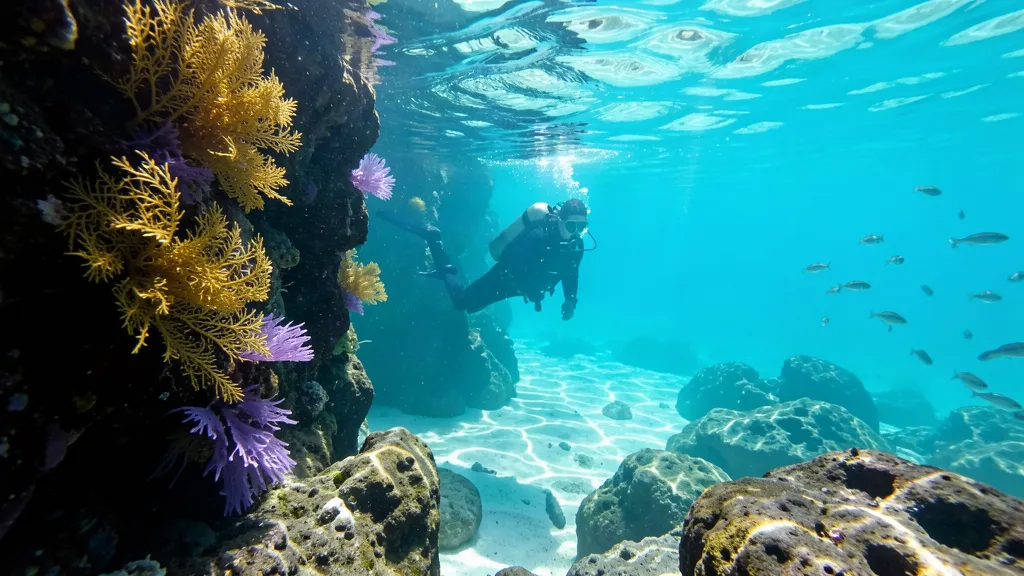
The seabed is organized into concentric bands that respond to depth and light intensity. In the first few meters, the rock appears covered by a carpet of photophilic algae, where communities of small fish teem, finding refuge among the hollows. As one descends, light loses intensity and the landscape transforms. From 15 meters down, the vertical walls become covered with gorgonians and corals that filter the water in search of suspended particles. Among them, the orange coral (Astroides calycularis) stands out, an endemic species of the southwestern Mediterranean that the International Union for Conservation of Nature (IUCN) classifies as vulnerable. Its colonies, of an intense orange color that contrasts with the blue of the water, form veritable hanging gardens on the shadiest walls, a spectacle that attracts divers from all over Europe.
The Posidonia oceanica meadows complete the ecosystem. This marine phanerogam, endemic to the Mediterranean, extends over sandy bottoms at depths between 5 and 30 meters, forming an essential habitat for the reproduction and feeding of numerous species. Posidonia acts as an underwater lung, generating oxygen and fixing carbon, as well as stabilizing sediments and protecting the coastline from erosion. Its presence in Cerro Gordo is an indicator of the excellent quality of the waters, as this plant is extremely sensitive to pollution and requires clear, well-oxygenated waters to thrive. Among its leaves, seahorses, cuttlefish, and a multitude of juvenile fish take refuge, finding in this vegetal labyrinth the necessary protection for their early stages of life.
The confluence of these habitats —vertical walls, caves, overhangs, and meadows— generates a spatial heterogeneity that multiplies ecological niches. It is not unusual to spot in a single dive groupers guarding their territories in rocky cavities, schools of barracudas patrolling the water column, octopuses camouflaging among the crevices, or loggerhead sea turtles approaching the meadows in search of food. The occasional presence of bottlenose dolphins and, on rare occasions, fin whales during their migrations, adds a spectacular component that turns each dive into a potentially unrepeatable experience.
The protection granted by the SAC designation is not a mere administrative formality. It implies a management plan that regulates human activities, including fishing, boat anchoring, and, of course, recreational diving. Authorized dive centers operate under strict protocols that limit the number of daily dives at the most sensitive sites, such as the caves housing orange coral colonies. This sustainable management has proven its effectiveness: the periodic censuses conducted by the Junta de Andalucía reflect stability in the populations of key species, a fact that contrasts with the decline observed in other Mediterranean areas where human pressure is not as regulated.
Seasonality sets the biological rhythm of these waters. During the summer months, surface temperature can reach 24 degrees, while in winter it drops to 14. This thermal oscillation conditions the presence of migratory species and the reproductive activity of benthic communities. The most experienced divers know that winter offers the greatest technical visibility (25-35 meters), although spring and autumn combine excellent visibility (20-30 meters) with more pleasant temperatures and optimal operating conditions, when the levante and poniente winds alternate and the waters remain calm after winter storms. It is then that plankton blooms and the walls teem with life in a spectacle of color and movement that alone justifies the trip to this corner of the Costa Tropical.
According to the POSIDONIA-2023 project (University of Málaga), 12 new species associated with meadows were identified in 2022. The latest studies focus on the impact of climate change on orange coral populations and on the capacity of posidonia meadows to act as carbon sinks. Preliminary data point to a slight increase in the average water temperature in recent decades, a phenomenon that could alter the delicate balance of this underwater sanctuary. Continuous monitoring of these indicators will be essential to adapt conservation strategies to a scenario of global change whose consequences are not yet fully understood.
Best Seasons and Conditions for Diving
[[PHOTO:2]]
The calendar sets the schedule, but the sea decides. In the Maro-Cerro Gordo Cliffs Natural Area, the diving window opens practically all twelve months of the year, although each season leaves its own mark on the dive. Data collected from the dive centers in La Herradura and Maro paints a clear picture: summer offers thermal comfort, while the intermediate seasons deliver the best underwater postcards.
The summer season, which runs from June to September, concentrates the bulk of the activity. The water thermometer reaches readings ranging between 22 and 26 degrees Celsius, allowing for extended dives without the need for thick suits. With a 5 mm wetsuit, divers feel comfortable even on the longest profiles of the itinerary, such as the one around Punta de la Mona or the one descending toward the drop-off at Cerro Gordo. Visibility during these dates ranges between 15 and 25 meters—a figure that, while not spectacular, is more than sufficient to appreciate the richness of the seabed.
However, summer has a price: the crowds. The beaches of Maro and the access to the natural area fill with bathers, and dive center boats share coves with jet skis and tourist excursions. The currents, to be sure, remain gentle and predictable, making these months the preferred option for those new to diving or for those seeking a relaxed immersion.
The equation changes completely as the calendar moves toward October. The water begins to lose temperature progressively until it stabilizes, between December and February, at readings ranging from 14 to 18 degrees. Visibility, paradoxically, improves. The absence of phytoplankton and reduced surface water agitation allow transparency peaks to exceed 30 meters on the most stable days. This is the season of the deep blues, of those dives where the bottom looks like a cliff suspended in the void.
Local instructors consulted for this guide agree in pointing to spring and autumn as the sweet spot. April, May, October, and November offer a balance hard to beat: temperatures around 17-20 degrees, excellent visibility, and reduced human pressure. The currents, though somewhat livelier than in summer, remain manageable for divers with a minimum of experience. It is during these dates that schools of barracuda and large groupers are most active, and when the vertical walls of Cerro Gordo look their best. It should be noted that, in strictly technical terms, winter offers the greatest transparency peaks (25-35 m); spring and autumn, however, combine very high visibility with more pleasant temperatures and reduced human pressure, making them the most balanced option for the majority of divers.
| Parameter | Summer (Jun-Sep) | Spring/Autumn | Winter (Dec-Feb) | |-----------|-----------------|---------------|------------------| | Water temperature | 22-26°C | 17-20°C | 14-18°C | | Average visibility | 15-25 m | 20-30 m | 25-35 m | | Currents | Gentle | Moderate | Strong | | Diver traffic | High | Medium | Low | | Recommended suit | 5 mm | 5-7 mm | 7 mm + hood | | Recommended level | All | All | Advanced |
The table above summarizes the average conditions recorded by the area's dive centers over the last five seasons. The data comes from dive logs and coastal weather stations, and serves as a general reference. The sea, as always, reserves the right of admission.
For the diver planning a visit, the practical recommendation is clear: if you're looking for thermal comfort and don't mind sharing the water, summer delivers. If what you're after is the best combination of visibility, tranquility, and marine life, the April-May and October-November window is unbeatable. Winter is reserved for the most experienced—those who aren't daunted by a marked thermocline and who know how to read the currents that intensify at the edges of the natural area.
One detail worth keeping in mind: the orientation of the cliffs. Dives on the Maro side, more sheltered, present more stable conditions than those on the La Herradura front, which is exposed to the easterly wind. When the weather forecast announces strong easterly winds, dive centers usually redirect their outings toward the more protected spots of the natural area—a flexibility appreciated by those who have traveled from afar to dive.
The time of day also plays its part. The early morning hours, with the sun still low, offer raking light that illuminates the seabed spectacularly. At midday, the overhead light penetrates more forcefully but flattens the colors. The most experienced divers tend to reserve the first dive of the day for the deeper profiles and the second, later in the afternoon, for the shallow reefs where the activity of the fauna changes completely.
In short, there is no bad season for diving in the Maro-Cerro Gordo Cliffs Natural Area, but there is an optimal season depending on what each diver is looking for. The key is to adjust expectations to the calendar and to let yourself be guided by the local professionals, who know every nook and cranny of this coastline and know how to read the signs the sea offers each morning.
Immersion Points: From Beginners to Experts
[[PHOTO:3]]
The Cerro Gordo coastline is organized as a difficulty gradient that allows divers to chart a progression path without straying far from the coast. Three points concentrate the attention of local dive centers, each with a distinct underwater personality and a clear target audience. The signage of access points and the regulation of activities, managed under the umbrella of the Natural Park, ensure that human pressure does not erode the ecological value of the seabed.
El Cañuelo: The Gateway to the Deep Mediterranean
At the eastern end of the park, the cove of El Cañuelo presents itself as the perfect natural classroom for those taking their first strokes with scuba equipment. Its shore entry, with no need for a boat, removes the logistical barrier that intimidates many novices. The slope of the bottom is gentle and progressive, a gradual descent that never punishes the diver with abrupt changes in depth. The operational limit is set at 18 meters, a depth that comfortably allows compliance with decompression tables without stress and with a wide safety margin for recreational dive profiles.
Visibility at El Cañuelo typically ranges between 10 and 20 meters, depending on the season and the swell. The meadows of Posidonia oceanica extend from 5 meters deep—that endemic seagrass that acts as the lung of the Mediterranean and a nursery for juvenile fish. Among its leaves, the attentive diver can observe seahorses (Hippocampus hippocampus) and a community of nudibranchs that changes with the seasons. The benthic fauna, less spectacular than that of the deeper sites, compensates with a chromatic richness that surprises those who take the time to observe.
| Parameter | El Cañuelo | Punta de la Mona | Bajo de San Pedro | |---|---|---|---| | Access | From shore | Boat | Boat | | Maximum depth | 18 m | 25-30 m | 30 m | | Recommended level | Beginner / Open Water | Advanced / Deep Diver | Advanced / Technical | | Currents | Absent or very mild | Moderate, channelable | Variable, sometimes intense | | Bottom type | Sandy with meadows | Vertical walls | Rocks with gorgonians | | Average visibility | 10-20 m | 15-25 m | 20-30 m | | Notable biodiversity | Posidonia, seahorses, nudibranchs | Sponges, corals, fish schools | Red gorgonians, groupers, barracudas |
Punta de la Mona: The Wall Jump
As the diver accumulates dives and confidence, the next step up is found at Punta de la Mona, the promontory that separates the waters of La Herradura from the rest of the park. Here the profile changes drastically: the bottom ceases to be a gentle slope and becomes a vertical wall that drops to depths exceeding 40 meters. Dives are conducted from a boat, with controlled descents that take the diver to the face of the wall, where life clings to the rock in overlapping layers.
Currents at Punta de la Mona are moderate but constant, a factor that demands good buoyancy and the ability to read the water before committing. Advanced divers find a stage of contrasts here: the wall harbors colonies of encrusting sponges, yellow gorgonians, and a stable population of groupers that allow themselves to be observed with patience. Schools of barracudas and horse mackerel patrol the water column, creating silver flashes that contrast with the deep blue of the background. The recommended operating depth is between 25 and 30 meters, always with dive profiles that respect safety stops.
Bajo de San Pedro: The Gorgonian Sanctuary
The most demanding point in the park is found at Bajo de San Pedro, a rocky elevation that rises from 30 meters deep and acts as a magnet for marine life. This underwater pinnacle, isolated in the middle of the current, concentrates a density of biodiversity that few spots in the Andalusian Mediterranean can match. Red gorgonians (Paramuricea clavata) form veritable forests on its slopes, with colonies reaching considerable sizes thanks to the protection offered by the natural park status.
Diving at Bajo de San Pedro requires meticulous planning. Currents can be intense and shifting, forcing divers to maintain strict discipline regarding bottom times and air management. The maximum depth of 30 meters places this dive at the limit of recreational diving, requiring advanced certifications and demonstrable experience in open water with current. The reward is proportional to the effort: visibility frequently reaches 30 meters, and the wall of the pinnacle becomes a stage of life where large groupers, conger eels, and schools of mullet coexist in a fragile but visible balance.
The regulation of access to these three points is not arbitrary. Underwater signage and mooring buoys installed by the regional administration channel dives toward areas of lower ecological sensitivity, while the most valuable bottoms are reserved for passive observation. Authorized dive centers operate with limited daily quotas of divers, a measure that has proven effective in preserving the integrity of the reefs and maintaining the quality of the experience.
The choice of dive site should not be based solely on depth or the fame of the location. The diver who is honest with themselves evaluates their real level of comfort in the water, their ability to manage air under stress, and their experience in current-prone environments. Cerro Gordo offers the possibility of progressing gradually, of gaining experience at El Cañuelo before facing the wall of Punta de la Mona, and of saving Bajo de San Pedro for when technique and serenity underwater are fully consolidated. The transition between these scenarios is not a leap but a ladder that the Andalusian Mediterranean places at the disposal of those who respect its rhythms and its limits.
Biodiversity: species you can spot
[[PHOTO:4]]
The official census of the Natural Area exceeds one thousand cataloged species, including 217 fish, 89 macroscopic invertebrates, and 12 species of marine mammals recorded during dives—a figure that turns every dive into a biological lottery where the grand prize changes with depth and season. The Maro-Cerro Gordo Cliffs Natural Area acts as a natural filter: currents flowing down from the Strait drag nutrients that sustain a complete trophic chain, from microplankton to the large predators that occasionally make an appearance.
The great protagonist of these seabeds is the orange coral (Astroides calycularis), a Mediterranean endemic species that finds here one of its strongest strongholds in the entire peninsula. Its colonies, of an intense orange color that contrasts with the dark rock, cover the vertical walls and cave ceilings between five and thirty meters deep. It is not uncommon for divers to initially mistake these formations for algae, but upon approaching they discover the extended polyps—tiny tentacles that activate with the current to capture plankton. The density of colonies at certain points along the coast, especially in the area of cliffs most exposed to the waves, reaches levels that marine biologists consider exceptional for the western Mediterranean.
Among the fish, the dusky grouper (Epinephelus marginatus) reigns in the depths. Specimens exceeding one meter in length take refuge in underwater cracks and caves, and experienced divers know that patience is the key to observing them. They are not aggressive animals, but they are extremely cautious: a sudden movement or the noise of tanks against rock makes them disappear within seconds. Younger specimens, smaller in size and with their characteristic mottled brown livery, are bolder and approach groups of divers with a curiosity that belies their reputation for being elusive.
Meagres form schools that can disorient the diver. Hundreds of individuals with silver bodies and dark fins gather in compact formations that turn in unison, creating a visual spectacle reminiscent of large oceanic shoals. They are most frequently found during low-light hours, especially at dawn, when they approach shallower waters to feed. Gilthead seabream, for their part, patrol alone or in small groups the edges of seagrass meadows, where they find crustaceans and mollusks among the vegetation.
Schools of barracuda (Sphyraena sphyraena) are another characteristic sight of Cerro Gordo. These predators, with elongated bodies and prominent jaws, congregate in groups that can exceed fifty individuals in open waters, right where the rocky bottom gives way to sand. Their behavior is cautious: they keep their distance from divers, but they do not flee, allowing slow approaches that are rewarded with privileged observation of their coordinated hunting behavior.
On the rocky bottoms, life concentrates in microhabitats. Nudibranchs, those shell-less mollusks with impossible colors, glide among sponges and bryozoans in search of food. Patience is essential to spot them: they measure only a few centimeters, but their chromatic palette—electric oranges, deep blues, intense purples—gives them away against the dark background. Divers with cameras dedicate entire dives to these small animals, which in Cerro Gordo present a diversity that rivals that of much larger protected marine areas.
The seagrass meadows, mainly Posidonia oceanica and Cymodocea nodosa, harbor the most delicate inhabitants of the ecosystem. Seahorses (Hippocampus hippocampus and Hippocampus guttulatus) cling with their prehensile tails to plant stems, camouflaged among the leaves thanks to their ability to change color to blend in with their surroundings. Their presence is an indicator of ecological health: these animals are extremely sensitive to pollution and habitat deterioration, and their survival in Cerro Gordo confirms the good conservation of these underwater meadows.
Octopuses (Octopus vulgaris) and cuttlefish (Sepia officinalis) complete the cast of most sought-after invertebrates. The octopus, master of camouflage, hides in any available crevice, and attentive divers can spot it by the mound of shells it accumulates at the entrance of its den. Cuttlefish, more elegant in their movement, glide over the sandy bottom with an undulating motion of their lateral fins, changing the texture and color of their skin in fractions of a second.
The occasional jewel of these waters is the loggerhead sea turtle (Caretta caretta). Although it is not a frequent sighting, encounters are repeated every season, especially between July and September, when waters reach their maximum temperature. The specimens that approach the coast are usually juveniles, between thirty and fifty centimeters of shell, that take advantage of currents to move between feeding areas. An encounter with a turtle in Cerro Gordo is a moment no diver forgets: the animal approaches with disarming confidence, maintains eye contact for a few seconds, and continues on its way without altering its pace.
| Species | Scientific name | Usual depth | Probability of sighting | Best season | |---------|-----------------|-------------|-------------------------|-------------| | Orange coral | Astroides calycularis | 5-30 m | Very high | All year | | Dusky grouper | Epinephelus marginatus | 15-40 m | Medium | Spring-summer | | Meagre | Sciaena umbra | 10-25 m | High (schools) | All year | | Barracuda | Sphyraena sphyraena | 5-20 m | High (schools) | Summer-autumn | | Octopus | Octopus vulgaris | 3-25 m | Medium | All year | | Cuttlefish | Sepia officinalis | 5-30 m | Medium | Spring | | Seahorse | Hippocampus spp. | 3-12 m | Low | All year | | Loggerhead sea turtle | Caretta caretta | Surface-15 m | Very low | July-September | | Nudibranchs | Multiple species | 5-30 m | Medium (requires patience) | All year |
The vertical distribution of species follows a clear pattern. The first meters, down to ten, are dominated by light and movement: schools of small fish, white seabream, and salema that feed in the water column, while octopuses lie in wait from the crevices. Between ten and twenty-five meters, the orange coral reaches its maximum development and the rocky walls are covered with encrusting sponges and gorgonians. Below twenty-five meters, light diminishes and life becomes more selective: groupers, conger eels, and large crustaceans dominate a landscape where the blue darkens until it merges with the depths.
Responsible observation is the only unwritten rule that every diver must respect in Cerro Gordo. The Natural Area has specific regulations that prohibit the extraction of any organism, living or dead, and limit the number of divers per dive site. These restrictions, far from being an inconvenience, guarantee that future generations can enjoy an ecosystem that continues to surprise biologists with each new sampling campaign. According to the POSIDONIA-2023 project (University of Malaga), 12 new species associated with meadows were identified in 2022. The biodiversity of Cerro Gordo is not a static catalog: it is a living system that changes with the seasons, currents, and water temperature, and that offers each dive the possibility of discovering something new.
Shore Diving vs. Boat Diving: Advantages
[[PHOTO:5]]
The choice between strapping on fins at the shoreline or launching into the void from a zodiac is no minor matter. It defines the character of the day, the budget, and, above all, the type of seabed you will tread. In the Maro-Cerro Gordo Cliffs Natural Area, both modes coexist without overlapping, offering experiences that, although they share the same setting, have little in common with each other.
Shore diving finds its natural habitat in coves such as El Cañuelo and Maro. Access requires nothing more than a walk across the sand and an entry into the water with minimal gradient, which eliminates the logistics of weight belts and the tension of leaps into the void. This mode allows total autonomy: the diver sets their own pace, decides the dive time, and does not depend on collective departure schedules. The cost drops drastically, as the price of boat transport is eliminated, and repeating the dive at the same spot allows for an intimate knowledge of the terrain, something local guides take advantage of to point out corners that escape the eye on a first visit.
The downside appears in the geographical limitation. From land, the radius of action is confined to the coastal strip accessible by swimming, which leaves out some of the most spectacular sites in the Natural Area. Bajo de San Pedro, a rocky outcrop that emerges isolated several hundred meters from the coast, or Cueva de la Virgen, with its vault of submerged stalactites, are exclusive territory of boats. The current, moreover, plays a more decisive role in shore exits, where entering and exiting the water becomes an exercise in constant reading of the swell.
Boat diving, for its part, offers an efficiency that local dive centers have perfected with daily zodiac departures. These light, fast boats can cover in ten minutes distances that from shore would mean an exhausting swim of more than an hour. The advantage is not only one of reach, but of effort management: the diver arrives at the dive site with air intact and energy reserved for the bottom, not for surface travel. Logistics are simplified, since the center handles the transport of tanks, weights, and equipment, and safety is reinforced by the presence of a skipper who monitors the surface while the group is submerged.
| Criterion | Shore Diving | Boat Diving | |----------|-------------------|-------------------| | Average cost per dive | €10-15 (equipment rental only) | €35-50 (guided outing with equipment) | | Access to remote sites | Limited to nearby coves (El Cañuelo, Maro) | Complete (Bajo de San Pedro, Cueva de la Virgen) | | Diver autonomy | Total: own schedule and pace | Dependent on the group and the skipper | | Prior physical effort | High: approach and return swim | Minimal: direct jump to the site | | Equipment logistics | Manual transport to the shore | Managed by the center | | Adverse sea conditions | Unfeasible with moderate swell | Operational with more margin | | Recommended level | All certifications | From Open Water onward, depending on the site |
The choice is not exclusive, but complementary. Divers who frequent the area usually alternate both modes throughout the week: a shore dive at dawn, when the sea is calm and the raking light illuminates the posidonia beds, followed by a zodiac outing the next day to explore the vertical walls of Bajo de San Pedro. The combination allows enjoying the intimacy of the coves and the spectacular nature of the more distant sites without giving up either of the two experiences.
The dive centers of Nerja and La Herradura have understood this dynamic and offer mixed packages that include both modes. Zodiac outings, with capacity for eight or ten divers, depart at first light to take advantage of good sea windows, while shore dives are recommended during the central hours of the day, when the sun shines directly on the sandy bottoms and visibility reaches its maximum. This time distribution is no coincidence: it responds to a deep knowledge of the wind and current patterns that characterize the area.
The final decision depends, ultimately, on the diver's profile. Those seeking a self-managed experience, with time to explore every corner at their own pace and without rushing, will find in the coves of El Cañuelo and Maro a perfect setting. Those who prioritize the variety of dive sites and logistical convenience will find in the zodiacs the ideal tool to cover the maximum ground in the shortest possible time. In both cases, the seabed of Cerro Gordo responds with the same generosity: biological richness does not understand modes, only depth and the patience of those who observe it.
Dive centers and certifications in the area
[[PHOTO:6]]
The number of dive centers in the arc formed by Almuñécar and Nerja exceeds a dozen active establishments, a density that few areas of the Andalusian coastline can match. Most operate under the umbrellas of PADI or SSI, the two international certifying bodies that dominate the recreational market, although there are also more technically oriented schools working with TDI or even with the Andalusian Federation of Underwater Activities for those seeking a more federation-based, less commercial route.
The geographical distribution of these centers follows a clear logic: those based in Nerja look eastward, toward the cliffs of Maro, while those in Almuñécar orient their trips westward, toward Punta de la Mona and its surroundings. This natural division of the territory means that each center knows its stretch of coast inside out—its currents, its optimal hours, and the spots where visibility remains stable even when the levante wind stirs up the surface.
Training as the gateway
The discover scuba diving session, that first point of contact that so many tourists take advantage of during their holidays on the Costa Tropical, falls within a range of 60 to 80 euros. The session includes full equipment, a brief theoretical explanation on the shore or in the center's pool, and a guided dive in shallow waters, generally at less than six meters. Local instructors handle this experience with skill: they know that a customer arriving with no prior experience needs confidence, not technical information, and so they ration their explanations and prioritize the sensation of weightlessness over everything else.
Those who decide to make the leap to full certification, the famous Open Water Diver, face an outlay ranging between 300 and 400 euros. The course extends over three or four days, with a theoretical portion that can be completed online before arriving at the coast, and several training dives in which the student learns to control buoyancy, read the pressure gauge, and resolve basic emergency situations. The centers in the area have perfected this process: the calm waters of La Herradura beach or Cala de Maro offer ideal conditions for initial practice, with sandy bottoms that forgive mistakes and visibility that rarely drops below ten meters.
| Service | Indicative price | Duration | Includes | |---------|-----------------|----------|----------| | Discover scuba diving | €60-80 | 2-3 hours | Full equipment, basic theory, guided dive | | Guided dive (certified diver) | €35-50 | 1-2 hours | Local guide, tanks, weights, boat transfer | | Open Water Diver course (PADI/SSI) | €300-400 | 3-4 days | Manual, certification, 4-5 dives, equipment | | Advanced Open Water course | €250-350 | 2-3 days | 5 specialty dives, certification | | Deep Diver specialty | €180-250 | 2 days | 4 deep dives, manual, certification |
Progression toward deep waters
The Advanced Open Water certification, which allows descending to 30 meters, is seeing growing demand among divers who visit the area recurrently. Specialty courses, such as the Deep Diver that qualifies divers for dives up to 40 meters, take advantage of the topography of the Maro-Cerro Gordo Cliffs Natural Area to offer descent profiles combining vertical walls, tunnels, and shallow caves. Local instructors, many with more than a decade of experience in the area, know the exact points where the thermocline manifests and where upwelling currents bring cold, nutrient-rich water that attracts large pelagics.
The value for money of these courses is hard to match elsewhere in the Spanish Mediterranean. In the Balearic Islands or on the Costa Brava, certification prices usually run 20 to 30 percent higher than those on the Costa Tropical, and the density of divers per square meter of seabed is considerably greater. Here, the feeling of open space, of almost private diving, becomes an added value that centers know how to exploit without needing to advertise it.
The profile of the diver arriving at Maro-Cerro Gordo
The centers in the area have learned to diversify their offerings to serve a heterogeneous clientele. During July and August, the bulk of customers are domestic and international tourists looking for a one-off activity, a discover dive, or a recreational dive without further commitment. Outside the season, the profile changes: local divers appear, European residents spending long periods on the coast, and organized groups coming specifically to get certified or complete their technical training.
The instructors, mostly Andalusians with years of experience in these waters, also act as informal guides to the area. They know the common names of species, the breeding seasons of groupers, the corners where octopuses take refuge, and the hours when sunlight penetrates most strongly to illuminate the posidonia meadows. This local wisdom, difficult to convey in a diving manual, becomes the true differentiating value of the area's training offering.
The logistics of guided dives, with prices around €35-50, typically include transport by RIB to the more distant dive sites, full equipment, and the company of a guide who knows the secrets of every corner. The smaller centers, those operating with two or three boats, offer a more personalized service, with small groups rarely exceeding six divers per guide. The larger ones, capable of moving twenty or thirty people a day, compensate for less individual attention with more solid infrastructure and more flexible schedules.
The choice between one center or another ultimately depends on the type of experience sought. Those prioritizing comfort and organization will find in the larger establishments a well-oiled machine. Those valuing closeness and deep knowledge of the terrain will lean toward the family-run schools, where the same instructor who certified you accompanies you on the next day's dive. Both options coexist in a commercial ecosystem that, despite competition, maintains notable standards of safety and quality.
Safety: advice from local instructors
[[PHOTO:7]]
The weather forecast is checked twice. Once upon waking, with coffee, and again on the boat or on the shore, just before zipping up the wetsuit. The instructors at the centers between Almuñécar and Nerja have turned this double check into a non-negotiable ritual. The levante wind, the one that blows from the east and ruffles the surface without warning, is the first proper noun to appear in any conversation about safety in the Paraje Natural de los Acantilados de Maro-Cerro Gordo. When the levante picks up, visibility suffers and the sea becomes a milkshake of plankton and sand; the dive loses all its charm and gains in risk. The local rule is simple: if the forecast announces levante above 15 knots, an alternative dive site is sought on the west face of the cliffs, or the activity is called off.
The surface marker buoy is not an optional accessory or a concession to bureaucracy. It is the diver's floating extension, the only visible link to the surface in an environment where recreational boat traffic intensifies in summer. Local instructors insist that it must be deployed throughout the entire dive, not just at the end, during the safety stop. The reason is practical: an orange or yellow buoy on the surface allows boats to detect the group's exact position and maintain the required distance. In a natural area with hidden coves and makeshift anchorages, the buoy is the difference between a calm dive and a major scare.
The orange coral, that chromatic jewel covering some vertical walls of Cerro Gordo, is a spectacle to be admired without touching. The instructors are blunt: the ban on touching it is not a regulatory quirk, but rather a response to the extreme fragility of a protected species that takes decades to grow just a few centimeters. A poorly placed fin, a glove that rests on it out of inertia, a diver seeking stability by grabbing onto the rock: any contact can irreparably damage entire colonies. The recommended technique is to maintain a minimum distance of one meter from the bottom and control buoyancy with millimeter precision. On guided dives, the divemaster points out points of interest without getting close, and the group must imitate that behavior.
Air management on deep dives at Cerro Gordo deserves a chapter of its own. Dive profiles in this area typically reach 25 or 30 meters, where consumption spikes and the margin for error shrinks. Local instructors apply a golden rule they repeat at every briefing: reserve one-third of the air for the ascent, one-third for unforeseen events, and consume only the remaining third at the bottom. The temptation to stay a few more minutes watching a gorgonian or a moray eel is understandable, but the price can be steep. Monitoring the pressure gauge must be constant, almost obsessive, and the decision to begin the ascent is not negotiated with curiosity.
Always diving with a buddy is the commandment that closes any list of recommendations. At Cerro Gordo, where local currents shift subtly but perceptibly with the tide, solitude underwater is a luxury no one can afford. The instructors say that the most treacherous currents are not the ones that drag violently, but the ones that divert the diver a few meters off course without them noticing. Upon surfacing, one can find oneself several hundred meters from the entry point, disoriented and without visual reference. The buddy is the one who detects that drift, who warns with a tap on the tank, who shares air in an emergency.
The pre-dive briefing is the sacred moment where all these warnings are condensed. The instructors repeat it with infinite patience, dive after dive, even if the group consists of divers with hundreds of dives behind them. In that briefing, the bottom profile is drawn, points of interest are marked, areas of predictable current are indicated, and hand signals for communication are established. The emergency plan is also set: what to do if visual contact with the guide is lost, where the alternative ascent point is, and what the procedure is if someone runs out of air.
| Safety measure | Recommended frequency | Risk mitigated | Level of obligation | |---|---|---|---| | Checking the weather forecast | Twice (morning and before the dive) | Levante wind, swell, reduced visibility | Essential | | Surface marker buoy deployed | Throughout the entire dive | Collision with boats, loss of reference | Mandatory | | Minimum distance from orange coral | 1 meter | Damage to protected species, administrative penalty | Mandatory | | Pressure gauge monitoring | Every 5 minutes | Running out of air at depth | Essential | | Buddy diving | Always | Getting lost, disorientation, medical emergency | Absolute | | Pre-dive briefing | Before every dive | Unfamiliarity with the environment, local currents | Mandatory |
The table above summarizes the recommendations that local instructors repeat ad nauseam. They are not individual whims, but the result of years of experience in an environment that, while extraordinarily beautiful, is not without dangers. The undertow current that forms at certain points when the tide goes out, for example, has caught more than one overconfident diver off guard. The locals know it well and avoid it, but those arriving for the first time need it explained clearly.
Equipment also plays a crucial role in safety. The instructors recommend checking the condition of the wetsuit seals, the tank pressure, and the operation of the buoyancy compensator before each day's diving. A faulty zipper or a pressure gauge that doesn't read accurately can turn a routine dive into an unpleasant experience. Most centers in the area perform this check systematically, but the responsible diver should also do it on their own.
The maximum recommended depth at Cerro Gordo for recreational divers is 30 meters, and local instructors do not hesitate to remind people when someone suggests going deeper. The seabed of this natural area offers enough attractions between 15 and 25 meters that there's no need to take risks. The vertical walls, tunnels, and shallow caves concentrate most of the biodiversity, and sunlight still reaches down to illuminate the colors intensely. Further down, the landscape becomes gloomier and the safety margin drops drastically.
Surface signaling doesn't end with the buoy. The instructors also recommend carrying a whistle and, where possible, a personal locator device. On a coastline with steep cliffs and hard-to-reach coves, being seen from land or from a boat can make all the difference. The whistle, small and lightweight, fits in any BCD pocket and doesn't get in the way during the dive. Its sharp sound travels much farther than a shout.
Hydration is another aspect that local instructors mention frequently. The Andalusian Mediterranean, with its dry climate and pleasant temperatures, invites you to forget that the body loses fluids even underwater. Mild dehydration can cause fatigue, cramps, and increased susceptibility to decompression sickness. The dive centers in the area usually have fresh water available on the boat or at the base, and recommend drinking before and after each dive, not during.
Respect for the rules of the Paraje Natural de los Acantilados de Maro-Cerro Gordo is, ultimately, a form of self-respect. The penalties for touching coral or diving in restricted areas can be substantial, but the real punishment s
Regulations and conservation in the reserve
[[PHOTO:8]]
The surface buoy is not a decoration. It is a safe-conduct pass. In the Maro-Cerro Gordo Cliffs Natural Area, every dive is registered under the umbrella of regulations that admit no exceptions and no "I didn't know." The Andalusian Regional Government, through the Territorial Delegation for Sustainability and the Environment, patrols these waters with variable but constant frequency, and checks are intensified during the summer months, when the influx of bathers and divers multiplies the pressure on the ecosystem.
The legal framework protecting this stretch of coastline is based on the Natural Resources Management Plan (PORN) and the Master Plan for Use and Management (PRUG), tools that delimit with surgical precision what can and cannot be done within the boundaries of the natural area. The regulations are clear: fishing in any of its forms is prohibited, both professional and recreational, as is the extraction of any species, dead or alive, including the empty shell that a novice diver might be tempted to keep as a souvenir. That shell, on the seabed, serves an ecological function that the inexperienced eye does not perceive.
Anchoring on Posidonia oceanica meadows, that plant endemic to the Mediterranean that scientists consider the lung of our waters, is strictly prohibited. This is not a recommendation: it is a classified offense. Vessels that need to stop must use the mooring buoys installed by the administration or anchor in sandy areas, where the impact is significantly lower. Posidonia is not a simple plant ornament; it is an ecosystem in itself, a habitat that harbors more than a thousand species, including 217 fish, 89 macroscopic invertebrates, and 12 species of marine mammals recorded in dives, and it takes decades to regenerate if damaged. A single dragged anchor can destroy in seconds a shoot that had been growing for thirty years.
| Offense | Minimum fine | Maximum fine | Observations | |------------|---------------|----------------|---------------| | Fishing without a license in the reserve | €300 | €3,000 | Includes shellfish gathering and collection | | Anchoring on Posidonia meadows | €600 | €3,000 | Vessel is removed if necessary | | Extraction of species (flora or fauna) | €150 | €3,000 | Includes shells, corals, and gorgonians | | Diving without a surface buoy | €100 | €600 | Mandatory throughout the reserve | | Diving outside marked areas | €200 | €3,000 | Exclusion zones for protection |
The fines, as shown in the table, can exceed €3,000 in the most serious cases. This is not a symbolic deterrent figure; it is a real penalty applied with judgment. The Andalusian administration has tightened the sanctioning regime in recent years, aware that tourist pressure on this natural space is growing at a rate that demands vigilance. Environmental agents carry out inspections both on the surface and, in collaboration with the Maritime Service of the Civil Guard, underwater. It is not uncommon for a diver to encounter an agent underwater checking that the buoy is correctly deployed and that the activity is taking place in the designated areas.
Diving, it should be remembered, is only permitted in marked areas. The natural area has a zoning system that distinguishes between intensive-use zones, where recreational activity is concentrated, and integral reserve zones, where access is prohibited for any human activity. This distinction is not arbitrary: it responds to the need to protect the sites of greatest ecological value, those where biodiversity reaches levels not recorded in other areas of the Andalusian Mediterranean. Authorized diving centers know these limits perfectly and communicate them to their clients before each dive. The diver who acts independently, without the backing of a center, assumes the responsibility of knowing and respecting these boundaries.
The conservation of the natural area does not depend solely on institutional surveillance. There is a component of shared responsibility that regular divers in the area have internalized. The diving associations of the Costa Tropical actively collaborate with the administration in monitoring and seabed cleanup tasks. Every year, hundreds of kilos of waste are removed from these waters, from abandoned fishing gear to plastics carried by currents. This work, silent and voluntary, complements the action of the agents and helps maintain the balance of an ecosystem that, despite its protection, continues to suffer the effects of human activity.
The Andalusian Regional Government has also established a carrying capacity control system at the most frequented dive sites. During the months of July and August, the number of divers accessing certain sites daily is limited, and diving centers must request prior authorization to operate there. This measure, which at the time generated some controversy among tourism operators, has proven its effectiveness in preserving the most sensitive seabeds. Ecological monitoring data show a stabilization of key species populations, such as grouper or lobster, in the areas where this restriction is applied.
The diver who descends at Cerro Gordo must understand that they are not visiting a water park. They are entering a protected natural space with rules that have a biological, not bureaucratic, rationale. The prohibition on touching, extracting, anchoring, and feeding fish responds to scientific knowledge accumulated over decades of study. Behind every rule there is a study, a report, evidence. And respect for those regulations is not a gracious concession from the visitor to the administration; it is the sine qua non condition for this underwater treasure to continue to exist in twenty, thirty, or fifty years.
The Maro-Cerro Gordo Cliffs Natural Area is an example of balanced management between conservation and public use. It is not a museum closed to the public, nor a theme park open to everything. It is a living space where human activity, well regulated, coexists with an ecosystem of incalculable value. The regulations, with their fines and restrictions, are the instrument that guarantees that coexistence. And the diver who respects them not only avoids a fine; they contribute, through their behavior, to ensuring that future generations can enjoy what today, with a little luck and a great deal of respect, we can still contemplate beneath the surface.
Recommended Equipment and Maintenance
[[PHOTO:9]]
The water temperature in Cerro Gordo leaves no room for improvisation. Between the 14 degrees of a February dawn and the 26 degrees of an August surface layer, the thermal difference conditions every equipment choice. A diver who arrives at the Costa Tropical without an equipment plan faces a decision that can ruin the dive or, worse, compromise their safety.
The wetsuit is the first barrier. For the winter months, from December to March, a 5mm neoprene suit proves to be the most sensible option. The thermocline in this area of the Andalusian Mediterranean is treacherous: you can enjoy a warm surface layer and, at 18 meters, find yourself in water that takes your breath away. Local divers, accustomed to these waters, opt for the 5mm with integrated hood or, for those who feel the cold more, a 3mm vest underneath the main suit. In summer, from June to September, the 3mm is sufficient for most recreational dives, although those doing multiple dives a day or venturing into the deeper caves of the cliff usually appreciate a full-torso 5mm.
| Equipment | Winter (December-March) | Summer (June-September) | Rental at local centers | |-----------|-------------------------|-------------------------|-------------------------| | Wetsuit | 5mm + hood | 3mm | €8-12/day | | Regulator | Full annual service | Full annual service | Included in package | | BCD | 12-15 liters | 10-12 liters | Included in package | | Dive computer | Essential | Recommended | €5-8/day | | Torch | Mandatory (caves) | Recommended | €4-6/day | | Full package | — | — | €25-35/day |
The regulator and BCD are the next step. In waters with high salinity like those of Cerro Gordo, corrosion acts quickly. A regulator that has not received its annual service can fail at the most inopportune moment, and here, with the cliff wall on one side and depth gaining meters, there is no margin for surprises. The dive centers in the area, from Nerja to Almuñécar, maintain their equipment with military discipline, but divers bringing their own gear must assume that same responsibility.
The dive computer is not an accessory. In an environment combining wall dives, caves, and sandy bottoms, decompression control becomes critical. Local instructors insist that every diver carries their own, configured with air or nitrox according to the dive plan. The caves of Cerro Gordo, with their ceilings and passageways, also demand a quality torch. Not just any light will do: you need one with enough power to illuminate the sandy bottom and reveal the details of the marine life hiding in the crevices.
Post-dive maintenance is where the experienced diver separates from the occasional one. The salinity of the Mediterranean in this area, combined with exposure to the sun and the levante wind, punishes equipment mercilessly. The ritual begins on the boat itself or on the shore: a first rinse with fresh water to remove the most superficial layer of salt. Upon arriving at the dive center or accommodation, the full equipment must be submerged in a fresh water tank for at least fifteen minutes. The suit zippers, BCD inflators, and regulator second stages are the most vulnerable points.
The dive centers in the area offer a rental service covering all needs. For €25 to €35 per day, the diver gets a full set of equipment including suit, regulator, BCD, and weights. Computers and torches are rented separately, with rates ranging between €5 and €8 per day. For the diver traveling from outside Andalusia, this option eliminates the problem of transporting heavy, bulky gear. For the resident or regular visitor, having their own equipment, well-maintained and familiar, offers an undeniable advantage.
Periodic inspection of one's own equipment follows a schedule that admits no excuses. The regulator requires a full annual service performed by a certified technician. The BCD needs a check of the valves and inflator before each season. The wetsuit, if stored correctly, folded and without creases that could damage the neoprene, can last for years. The tanks, owned by the dive centers in most cases, undergo their hydrostatic inspections according to current regulations.
In Cerro Gordo, equipment is not a luxury or a collection of accessories. It is the difference between enjoying a dive in the Cueva de la Virgen or spending the whole experience cold and worried. The preparation of gear, the choice of the right suit for the season, and rigorous maintenance after every outing are as much a part of diving in this natural enclave as the underwater landscape itself. The diver who arrives prepared, with their equipment in order or with a reservation made at a trusted center, can focus on what truly matters: the vertical wall covered in gorgonians, a grouper passing between the rocks, the light filtering through the surface at twenty meters of depth.
Night Diving: A Different Experience
[[PHOTO:10]]
When the sun sets behind the cliffs and the last pleasure boat returns to port, the Maro-Cerro Gordo Cliffs Natural Area begins a second life. Artificial light disappears and the Mediterranean transforms into a stage where the rules of the day are suspended. Night diving here is not a mere variant of daytime diving; it is a discipline with its own logic, with different rhythms, and with inhabitants that would never cross paths with a nine-in-the-morning diver.
The species that remain hidden in crevices and under rocky ledges during the day take advantage of the darkness to come out and hunt. The octopus, that master of camouflage that spends hours motionless blended into the rock, abandons its hiding place and traverses the seabed with hypnotic elegance. Moray eels, which poke their heads out of their burrows during the day without ever fully exposing themselves, glide between stone blocks in search of unsuspecting prey. Lobsters, elusive and cautious, emerge from their shelters to feed in open ground. And in the water column, bioluminescent plankton turns every fin movement into a trail of bluish flashes that seems pulled from another world.
The El Cañuelo area, sheltered from the prevailing winds and with alternating sandy and rocky bottoms, concentrates most of the night dives organized in the area. Its configuration allows for controlled descents and safe ascents, with depths that rarely exceed 18 meters. It is no coincidence that local dive centers have chosen this enclave as the main setting for their twilight outings. The natural protection offered by the cliffs reduces the current and maintains visibility that, according to records from recent years, can exceed 20 meters even at night, provided you have a quality flashlight.
The certification required to dive in these conditions is not a mere bureaucratic formality. Night diving demands impeccable buoyancy control, trained spatial orientation, and underwater communication skills that cannot be improvised. International certifying bodies establish that diving at night requires a specific specialty or, failing that, direct supervision by a certified instructor. This requirement is not a regulatory whim but a response to the reality of an environment where the primary visual reference disappears and where air management takes on a different dimension.
| Parameter | Daytime Diving | Night Diving | |-----------|-------------|----------------| | Average visibility in El Cañuelo | 15-25 meters | 10-20 meters with flashlight | | Recommended depth | 5-30 meters | 5-18 meters | | Observable species | Grouper, white seabream, gilthead seabream, barracuda | Octopus, moray eel, lobster, bioluminescent plankton | | Air consumption (at 15 m, 12L tank) | 180-200 bar/hour | 220-250 bar/hour | | Certification required | Open Water Diver | Night specialty or instructor present | | Average water temperature (July) | 24-26 °C | 22-24 °C (nocturnal thermal drop) | | Maximum dive time | 45-60 minutes | 35-45 minutes |
Air consumption increases notably at night. The reason is not physical but psychological. The night diver tends to breathe more frequently in the absence of natural light references, and although experience moderates this response, data collected by local dive centers reflects an average increase of 15 to 20 percent in air consumption compared to a daytime dive at the same depth. This variable conditions dive planning and forces instructors to adjust bottom times.
Water temperature also plays a significant role. When night falls, the surface layer of the sea loses the heat accumulated during the day, and although the thermal difference in Mediterranean waters is usually only two or three degrees, in the winter months that variation can be decisive for diver comfort. A 7-millimeter suit that is adequate for a December daytime dive can fall short when the water thermometer reads 13 degrees and the sun no longer warms your back on the surface.
Artificial lighting completely alters the perception of the underwater environment. The beam of a dive flashlight carves out a cone of visibility that moves with the movement of the head, and everything outside that cone remains in an absolute darkness that bears no comparison to the twilight gloom. Experienced divers recommend carrying two light sources: a primary and a backup, both with fully charged batteries. The second flashlight is not an optional accessory; it is a safety element that can make the difference in the event of primary equipment failure.
Surface signaling takes on special relevance during night dives. The luminous buoy marking the diver's position not only serves to help vessels identify their location but also acts as a reference point for the ascent. On a moonless night, the coast becomes a diffuse silhouette and the lights of coastal towns blend with the stars reflected on the water. Without the buoy, locating the exact exit point becomes a complex task even for the most experienced divers.
Bioluminescence deserves a chapter of its own. When the diver remains motionless at three or four meters deep and turns off their flashlight for a few seconds, the movement of their own hands generates small explosions of bluish light that scatter into the darkness. The phenomenon, caused by planktonic microorganisms that emit light when mechanically stimulated, turns every night dive into an unrepeatable spectacle. The summer months, with warmer waters and higher plankton concentrations, offer the best conditions for observing this phenomenon.
The nocturnal fauna of Cerro Gordo responds to behavioral patterns that marine biologists have been studying for years. The common octopus (Octopus vulgaris), abundant in the area, abandons the protection of its den at night to travel distances that can exceed one hundred meters in search of crustaceans and mollusks. Moray eels (Muraena helena), which during the day remain with their mouths open in an apparently threatening posture —a behavior that actually responds to the need to ventilate their gills— become active nocturnal hunters. Lobsters (Palinurus elephas), protected within the natural area, leave their rocky shelters and move across sandy bottoms where they are easier to observe.
Time management underwater takes on a different dimension at night. The absence of natural light eliminates the temporal reference that divers unconsciously use during the day, and the sensation that time passes more slowly is a constant among those who practice this modality. Dive computers become the only reliable chronometer, and the discipline of consulting them regularly becomes essential to prevent fascination with the nocturnal spectacle from playing a trick on you.
Night dives in the Maro-Cerro Gordo Cliffs Natural Area are organized year-round, although the months of June through September concentrate the highest number of outings. Calm sea conditions and warmer water temperatures make summer the high season for this activity. Dive centers in Nerja and La Herradura schedule twilight outings that take advantage of the transition between daylight and total darkness, a privileged moment to observe how the daytime fauna retreats and the nocturnal fauna begins its activity.
Underwater Photography: Capturing the Essence
[[PHOTO:11]]
Visibility at Cerro Gordo does not deceive. When the water thermometer reads between 18 and 22 degrees and the levante wind has been absent for three days, transparency reaches 20 meters of distance. It is then that the underwater photographer understands why this stretch of Andalusian coastline has earned a place in specialized European guides. The Mediterranean light, filtered through the water mass, turns every dive into a natural studio of color and contrast.
The chromatic palette of the seabed of the Maro-Cerro Gordo Cliffs Natural Park is an argument in itself. The orange corals that cover the vertical walls of the western face of Punta de la Mona contrast with the yellow sponges that colonize the shaded ledges. Schools of mullet and white seabream, moving in compact formations through the posidonia meadows, add silvery flashes to the frame. No artificial filter surpasses that combination of warm tones against the deep blue of the Mediterranean.
The choice of equipment determines the result. For vertical walls and large underwater landscapes, the wide-angle lens prevails. A 14-24 mm lens allows capturing the magnitude of the rocky sea stacks and placing the diver as a scale reference. For details, the story changes. The nudibranchs that inhabit the sandy and gravel bottoms between Cerro Gordo and Maro require a 60 or 100 mm macro lens. These small sea slugs, with impossible colors —purples, electric blues, fluorescent oranges— are the most coveted trophy for photographers visiting the area.
| Parameter | Wide Angle | Macro | Compact with Housing | |-----------|-------------|-------|---------------------| | Ideal subject | Walls, fish schools, divers | Nudibranchs, seahorses, detail | Limited versatility | | Recommended focal length | 14-24 mm | 60-100 mm | 24-70 mm equivalent | | Typical aperture | f/8 - f/11 | f/16 - f/22 | f/5.6 - f/8 | | Shutter speed | 1/125 - 1/250 | 1/100 - 1/200 | 1/125 | | Technical difficulty | Medium | High | Low | | Approximate equipment cost | €1,500 - €3,500 | €1,200 - €2,800 | €400 - €1,000 | | Result at Cerro Gordo | Excellent on walls | Exceptional on gravel bottoms | Acceptable at surface |
The natural light window opens daily between 10:00 and 14:00. Outside that range, the solar angle drastically reduces light penetration and forces compensation with external flashes or video lights. The dive centers of La Herradura and Nerja organize photography-specific outings during that time slot, aware that the high sun minimizes harsh shadows and reveals the true colors of the bottom. Early in the morning, grazing light creates dramatic contrasts that can work for silhouettes, but not for capturing the chromatic richness of the area.
Buoyancy technique becomes the photographer's first tool. A diver who does not control their weighting cannot maintain the focal distance needed for macro. At Cerro Gordo, where gentle but constant currents push eastward during the falling tide, stabilization requires practice. The underwater photography courses offered by local centers —with prices ranging from 80 to 150 euros per theory-practice session— include apnea and breathing control exercises specific to photography. Slow, deep breathing not only conserves air but also reduces body movement and allows precise framing.
Composition underwater follows different rules than on the surface. The seabed of Cerro Gordo offers three distinct scenarios. The first, the vertical walls covered in orange coral, demands an upward frame that includes the surface as an element of light. The second, the gorgonian gardens on rocky ledges, works best with a downward angle that takes advantage of depth of field. The third, the sandy and gravel bottoms where nudibranchs live, requires patience and a slow approach that does not stir up sediment.
Visibility data recorded by the area's dive centers during the last high season confirms the trend: the months of June through October offer an average of 15 to 20 meters of visibility, with peaks of 25 meters after levante storms that clear the water. In winter, visibility drops to 8-12 meters, but the presence of pelagic species —horse mackerel, greater amberjack, the occasional tuna— compensates for the loss of clarity. The most experienced photographers choose September: the water retains summer warmth, visibility remains high, and the influx of divers decreases, reducing the risk of other teams stirring up sediment at the most sensitive spots.
Post-production is the final step, but not the least important. The RAW files captured at Cerro Gordo require a white balance adjustment that compensates for the selective absorption of red wavelengths starting at 5 meters of depth. Photographers working with natural light typically apply a color temperature correction between 5,000 and 6,000 Kelvin, while those using flash prefer to maintain the original temperature and adjust only exposure. Selective saturation —slightly increasing oranges and yellows without touching the blues— faithfully reproduces what the human eye perceives at 15 meters of depth.
The natural park imposes restrictions that the photographer must know before submerging. It is forbidden to touch the bottom, remove organisms, or use laser pointers that could disorient the fauna. Flash is permitted, but moderation is recommended during night dives to avoid stressing the most sensitive species. The dive centers collaborate with the surveillance of the protected area and report any infractions detected during photography outings.
The reward of a good session at Cerro Gordo is not measured only in images. Photographers who return season after season document the evolution of the ecosystem: the growth of coral colonies, the recovery of grouper populations in the rocky blocks of the northern face, the return of barracuda schools to surface waters. That visual documentation, shared on specialized forums and local exhibitions, has become a conservation tool as valuable as official biological censuses. Underwater photography in this corner of the Costa Tropical is not just a technical discipline; it is a continuous record of the health of an ecosystem that continues to surprise those who visit it with respect and patience.
Diving for families and non-divers
[[PHOTO:12]]
Diving in Cerro Gordo is not limited to certified divers or those with tanks. For those traveling with family or simply not practicing scuba diving, the Natural Area of the Maro-Cerro Gordo Cliffs offers a range of alternatives that turn the day into a shared experience without giving up contact with the underwater ecosystem. The key lies in knowing where to look and which activity to choose based on the age and physical condition of each member of the group.
Snorkeling in Coves with Immediate Access
[[PHOTO:13]]
The coves of Maro and El Cañuelo offer the best conditions for family snorkeling. The depth does not exceed three or four meters in the first twenty meters from the shore, and average visibility is around ten meters during the summer months. The sandy bottom with patches of Posidonia oceanica is home to schools of salema, white seabream, and occasionally a small ray that lets itself be observed without being disturbed.
Access to these coves is via a coastal path from the parking area on the N-340 road, with a slope of about forty meters that is covered in a fifteen-minute walk. Families with young children should exercise extreme caution in the final stretches, where the terrain becomes rocky. Once in the water, the entry is gradual, with no steps or sudden jumps, which makes it easier for young children to adapt to the aquatic environment.
| Activity | Minimum age | Maximum depth | Typical duration | Indicative price (2024) | Authorized companies | |----------|-------------|---------------|------------------|-------------------------|----------------------| | Guided snorkeling in coves | 6 years | 3-4 meters | 1.5-2 hours | €25-35/adult, €15-20/child | 4 in Nerja, 2 in La Herradura | | Pool diving baptism | 8 years | 2-3 meters | 45-60 minutes | €50-70/person | 3 centers in Nerja | | Open-water diving baptism | 10 years | 5-6 meters | 2-2.5 hours | €75-95/person | 3 centers in Nerja | | Kayak with snorkeling stops | 5 years (accompanied) | 3-5 meters | 3 hours | €35-45/double kayak | 2 companies in Maro | | Cliff hiking route | All ages | - | 2-3 hours | Free (self-guided) | - |
Dive baptisms: the first immersion
[[PHOTO:14]]
The dive centers in the area offer baptisms adapted for children from eight years old. The most recommended option for this age group is the one carried out in a pool or in very shallow waters, where the instructor maintains a maximum ratio of two children per monitor. The session begins with a fifteen-minute theoretical explanation about the equipment and basic signals, followed by a first contact with breathing underwater that usually lasts between twenty and thirty effective minutes of immersion.
For teenagers from ten years old, the open-sea baptism takes place in the El Cañuelo area, where the maximum depth does not exceed six meters. The full equipment —wetsuit, weights, regulator, and buoyancy vest— is included in the price, and participants receive a commemorative certificate at the end. The total duration of the activity, including the boat transfer from the port of Nerja, does not exceed two and a half hours.
The monitors insist on a fundamental aspect: the child's calmness is more important than their age. A child who shows insecurity in the water should not be forced to complete the immersion. The centers work with a progressive adaptation protocol that allows the minor to decide at any moment whether they wish to continue or return to the surface.
Kayaking and Snorkeling: The Perfect Combination
[[PHOTO:15]]
Kayak routes with snorkeling stops have become the most in-demand option for families visiting the Maro-Cerro Gordo Cliffs Natural Area without their own equipment. Authorized companies depart from Maro Beach and travel along the coast toward the cliffs, making two or three stops at coves that are difficult to reach by land. The total duration of the route is approximately three hours, with one effective hour of paddling and the rest dedicated to swimming and underwater observation.
The kayaks are double or family-sized, with capacity for two adults and a small child seated in the center. The paddles are lightweight, and the paddling pace is adapted to the group, so no prior experience is required. During the stops, the guide provides snorkel masks and tubes, as well as species identification charts so that children can recognize the fish they spot.
The recommended time slot is the first hour of the morning, between nine and twelve, when the sea is calmest and visibility reaches its daily maximum. Companies require life jackets for all participants, including adults, and limit the number of kayaks per outing to eight units to minimize the impact on marine wildlife.
Hiking along the cliffs: the natural viewpoint
[[PHOTO:16]]
The trail that runs along the edge of the Maro-Cerro Gordo cliffs offers an aerial perspective of the marine ecosystem that complements the underwater experience. The main route, about six kilometers between Maro and La Herradura, follows a well-defined dirt path with several designated viewpoints. From these elevated points, and with a simple pair of polarized glasses, you can observe the sandy seabeds and the posidonia meadows through the transparency of the water.
The route presents no technical difficulty, although it accumulates a positive elevation gain of about one hundred twenty meters. The estimated hiking time is two to three hours, depending on pace and stops. In the spring months, the trail is lined with wildflowers, and it is common to spot mountain goats on the steepest slopes. For families with children, it is recommended to bring plenty of water and sun protection, as there is barely any shade in the central section.
The combination of activities —snorkeling in the morning, hiking at sunset— allows families to complete a full day in contact with the natural area without needing to book diving services. Access to the coves is free, and parking in the Maro area costs three euros per vehicle for the entire day.
Logistics and practical recommendations
[[PHOTO:17]]
Advance booking is mandatory for all activities organized during the months of July and August, when the influx of visitors multiplies demand. The companies work with small groups and usually sell out their spots several days in advance. In the low season, availability is immediate and some centers offer discounts of twenty percent for family groups of four or more members.
Basic snorkeling gear —mask, snorkel, and fins— can be rented at the beach bars on Maro beach for around ten euros for a full day. For children, it is preferable to purchase child-sized masks at the shops in Nerja before the excursion, since a proper fit is crucial to ensuring the experience does not become a source of frustration.
The most favorable season for these family activities runs from June to September, when the water temperature exceeds twenty degrees and sea conditions are more stable. In the months of May and October, attendance is lower and prices drop slightly, although the water temperature requires the use of three-millimeter wetsuits, which the companies provide at no additional cost.
Impact of Tourism and Sustainable Diving
[[PHOTO:18]]
The figures are dizzying. More than ten thousand annual dives are recorded in the Maro-Cerro Gordo Cliffs Natural Area, a pressure that in the months of July and August turns the coastal strip into a hive of boats and fins. The question is not whether the ecosystem can withstand it, but how it manages to do so. The answer, in this corner of Andalusian Mediterranean, has a name: adaptive management.
The natural area has not waited for the problem to become chronic. For years, the regional administration, in collaboration with local diving clubs, has implemented a quota system by zone. This is not an arbitrary prohibition, but a fine-tuned calculation: each dive site has a physical and biological carrying capacity, and exceeding it implies habitat deterioration. The numbers speak for themselves. While in 2015 around 6,500 dives were recorded, the current figure stands at approximately 10,200, a 57% increase that has forced a redistribution of efforts.
| Indicator | 2015 | 2024 | Variation | |-----------|------|------|-----------| | Annual registered dives | 6,500 | 10,200 | +57% | | Enabled dive sites | 14 | 18 | +29% | | Ecological moorings installed | 8 | 24 | +200% | | Divers per site per day (max.) | No limit | 12 | — | | Penalties for environmental infractions | 3 | 1 | -67% |
The table reflects a clear strategy: instead of restricting access, the choice has been to expand the number of dive sites and equip them with respectful infrastructure. Ecological moorings, anchors that do not touch the seabed and prevent the destruction of posidonia meadows, have gone from being a rarity to becoming the norm. Each installed buoy represents a small triumph against wild anchoring, that practice that for decades has caused silent devastation on the seabeds.
The profile of the diver visiting Cerro Gordo has also changed. It is no longer just the seasonal tourist seeking a one-off experience; increasingly, the natural area attracts trained divers who are aware that their activity has a direct impact on the environment they come to enjoy. Awareness campaigns have resonated with a sector that has traditionally looked the other way when it came to assessing its own footprint. Codes of conduct, printed on waterproof cards handed out with the diving permit, list basic rules: do not touch, do not feed, do not pull up, take nothing but photographs.
The figure of the responsible diver is not an abstraction. It materializes in concrete gestures: maintaining neutral buoyancy to avoid damaging the bottom with fins, avoiding contact with sessile species such as gorgonians, and respecting safety distances from wildlife. In Cerro Gordo, the presence of groupers, moray eels, and schools of barracuda is common, and incorrect interaction can alter their behavioral patterns. Studies conducted in the natural area indicate that grouper populations have increased by 30% since the implementation of these measures, a fact that supports the effectiveness of the model.
Ecotourism, in this context, ceases to be a commercial label and becomes a conservation tool. Every diver who pays for their permit contributes directly to the maintenance of the natural area. The income generated by diving fees is reinvested in surveillance, research, and infrastructure maintenance. It is a virtuous circle that demonstrates that environmental protection and economic activity are not incompatible, but complementary.
Challenges remain. Human pressure is not limited to divers; recreational boats, kayakers, and snorkelers also frequent the area in summer. Coordination between the different uses of the marine space is complex, and conflicts are not always resolved smoothly. Surveillance, moreover, is concentrated in the months of highest influx, leaving gaps in the low season that some take advantage of for irregular practices.
The Cerro Gordo experience, nevertheless, has become a benchmark for other protected areas in the Mediterranean. The participatory management model, which involves diving clubs in decision-making, has been replicated in other protected areas of Andalusia and has sparked interest from administrations in other autonomous communities. The key, according to the technicians working in the area, lies in the involvement of all stakeholders: administration, businesses, divers, and the local community. Without that collaboration, any protection measure is doomed to failure.
The future of diving in Cerro Gordo depends on maintaining the balance between public access and the preservation of the natural values that make this area unique. The ten thousand annual dives are a figure that commands respect, but they are also proof that it is possible to reconcile human activity with the conservation of the marine environment. The natural area has shown that sustainable tourism is not a utopia, but a reality built day by day, dive by dive, with data, control, and common sense.
Plan your dive: logistics and services
[[PHOTO:19]]
The logistics of diving at Cerro Gordo are best handled from dry land, and the choice of base of operations conditions the experience. The two urban centers that flank the area, Almuñécar and Nerja, offer distinct profiles. Almuñécar, in the province of Granada, maintains a more commercial and bustling character, with hotel offerings ranging from large establishments on the seafront to small family-run hostels in the old town. Nerja, already in Málaga, preserves the air of a white village perched on the cliffs, with a historic center of narrow streets and accommodation more oriented toward quality tourism, with boutique hotels and tourist apartments with sea views.
For the diver, the decision between one town or the other is not trivial. The dive centers authorized to operate within the Maro-Cerro Gordo Cliffs Natural Park are spread between both municipalities, and each has access to different dive zones. Those departing from Nerja usually head to the Maro area, with its vertical cliffs and underwater caves. Those from Almuñécar operate further west, where the seabeds are sandier and the posidonia meadows take center stage. The distance between the two ports barely exceeds ten kilometers, but the choice of departure point can save between twenty and forty minutes of navigation on each outing.
Accommodation: where to sleep according to your dive plan
The accommodation offering in the area is extensive, but it is worth understanding its particularities. In July and August, occupancy approaches one hundred percent and prices soar. A double room in a three-star hotel in Nerja can cost between 80 and 120 euros per night in high season, while in May or June the same establishment is around 60-70 euros. Tourist apartments offer a more economical alternative for groups of divers sharing expenses: a flat for four people in Almuñécar can go for about 100-130 euros per night in August, which reduces the cost per person to very reasonable figures.
Campsites, for their part, represent the most austere option. The Maro campsite, located just a few meters from the beach of the same name, is the closest to the coves of the natural area. A pitch for a tent costs between 15 and 25 euros per night depending on the season, and they have prefabricated bungalows for those who do not want to give up certain comforts. The advantage of staying at the campsite is evident: you wake up to the sound of the sea and reach the embarkation point in five minutes. The disadvantage is also evident: in August, the density of occupancy turns the common areas into a hive of activity.
| Type of accommodation | Town | Price/night (high season) | Distance to dive coves | Diver services | |---|---|---|---|---| | 4-star hotel | Nerja | 140-200 € | 8-10 km | Equipment storage, pool, parking | | 3-star hotel | Almuñécar | 80-120 € | 5-7 km | Parking, restaurant, terrace | | Tourist apartment (4 pax) | Almuñécar | 100-130 € | 5-8 km | Kitchen, washing machine, wifi | | Camping bungalow | Maro | 45-60 € | 0.5-1 km | Equipment washing area, parking | | Camping pitch | Maro | 15-25 € | 0.5-1 km | Water taps, electricity |
Transport: how to get there and get around
The intercity bus network connects Málaga and Granada with the coast, but the frequencies are not ideal for a diver who needs to be at the dive center early in the morning. Alsa buses cover the Málaga-Nerja-Almuñécar route with departures approximately every hour, with a travel time of about 50 minutes from Málaga to Nerja and about 70 to Almuñécar. From Granada, the connection is less frequent: three or four daily services that take around an hour and a half. The problem is not getting there, but returning with wet equipment and accumulated fatigue.
A rental car proves to be the most practical option. Local agencies offer rates from 25-35 euros per day for a compact car, and most allow picking up the vehicle at Málaga airport and returning it on the coast without surcharge. The N-340 road, which winds between the cliffs, is a spectacle in itself, with viewpoints overlooking the Mediterranean. It is worth noting that the stretch between Nerja and Almuñécar has sharp curves and requires attention, especially with dive equipment loaded in the boot.
Parking near the coves is a matter worth planning. The beaches of Maro and the coves of Cerro Gordo have small scattered parking areas, but in summer they fill up before nine in the morning. The alternative is to leave the car in the park-and-ride lots set up at the entrance to the natural area and walk the final meters. Dive centers, for their part, usually have reserved spaces for their clients, a detail worth confirming when making the reservation.
Specialized services: beyond compressed air
The service infrastructure for diving in the area has matured considerably over the last decade. The five authorized dive centers operating in the natural area offer complete services that go far beyond simple equipment rental. All have their own compressors with capacity to fill 12 and 15-liter tanks, and some also work with 7-liter tanks for introductory dives. The price of an air fill is around 5-7 euros, while renting a full set of equipment (BCD, regulator, wetsuit, and tank) is between 30 and 40 euros per dive.
Equipment repair is a service that is scarce on the Granada coast. The centers in Nerja and Almuñécar have certified technicians who can resolve minor breakdowns within 24-48 hours, but for complete overhauls or regulator repairs, it is usually necessary to send the equipment to specialized workshops in Málaga city or Granada. Divers traveling with their own equipment should carry basic spare parts — O-rings, washers, fin straps — to avoid setbacks.
The dive shops in the area sell and rent everything needed, from 5 and 7-millimeter wetsuits to dive computers, as well as torches for the caves and surface marker buoys. Sale prices are slightly higher than those of large online retailers, but the local advice and the possibility of testing the equipment in the real conditions of the Mediterranean justify the difference.
Gastronomy: refueling with local flavor
The diving day does not end in the water. The cuisine of the Costa Tropical offers a repertoire designed to replenish energy. The beach bars of Maro and La Herradura serve sardine skewers — fish threaded onto cane and grilled over olive wood embers — for about 10-12 euros per portion. In the restaurants further inland in Nerja and Almuñécar, the star dish is ajoblanco, a cold almond and garlic soup served with grapes or melon, ideal for hot days. Skate stews and anchovies in vinegar complete an offering that rarely disappoints.
Restaurant prices vary noticeably depending on location. A set lunch menu at an establishment in Nerja's center costs between 14 and 18 euros, with water and bread included. At beach bars, the same meal can come to 18-22 euros, but the experience of eating with your feet in the sand and the smell of sea air compensates for the difference. For divers who prefer to cook at their accommodation, the municipal markets in both towns offer fresh fish from the Caleta de Vélez fish market at reasonable prices: sea bream at about 12 euros per kilo, octopus at 15-18.
Reservations and season: the key to success
Advance planning makes the difference between a peaceful dive and a headache.
Testimonials and experiences of divers
[[PHOTO:20]]
The conversation between two strangers on the deck of a rigid inflatable boat usually begins with the same question: "How many dives have you done?" In the Maro-Cerro Gordo Cliffs Natural Area, the answer matters less than the anecdote that accompanies it. Social media and review platforms have become the most reliable thermometer for measuring the emotional temperature of those who immerse themselves in these waters. Local dive centers accumulate ratings that comfortably exceed 4.5 stars on both Google and TripAdvisor, a figure that reflects not only the quality of service but also the intensity of the experience lived.
The expression most repeated among novice divers is that of "feeling like they're inside a natural aquarium." The comparison is not coincidental. Unlike the glass tanks of theme parks, here the transparency of the water allows observing marine life without artificial barriers, with visibility that in the summer months frequently reaches 20 meters. The instructors in the area, according to the reviews, handle patience as a professional virtue: they explain each step, adjust the weights, check the equipment, and accompany the beginner through their first minutes underwater with a closeness that defuses any hint of panic.
| Dive center (Maro-Cerro Gordo area) | Average rating (Google/TripAdvisor) | Number of accumulated reviews | Highlighted specialty | | :--- | :--- | :--- | :--- | | Buceo Costa Tropical (Nerja) | 4.8 / 4.7 | 340+ | Guided dives for beginners | | Maro Divers (Cliffs) | 4.7 / 4.6 | 280+ | Discover scuba diving and Open Water courses | | Punta de la Mona Dive Center | 4.6 / 4.5 | 190+ | Advanced diving and deep walls | | Acantilados Sub (Cerro Gordo) | 4.8 / 4.8 | 150+ | Small groups and underwater photography |
Safety stands as the pillar supporting all the positive ratings from beginners. Water entry protocols, thorough equipment checks, and constant supervision during the underwater route generate a confidence that users explicitly appreciate in their comments. The clarity of the water, combined with the shallow depth of some coves, allows introductory dives to take place in optimal conditions, with the sandy bottom or posidonia meadows as the setting for a first contact that, in many cases, becomes the start of a lasting hobby.
For the experienced diver, the tone of the reviews changes. The emotion is described with different nuances, less tied to safety and more to the search for encounters with wildlife. An advanced diver, in a review published after a dive at Punta de la Mona, recounts the thrill of crossing paths with a grouper of approximately 20 kilos. The animal, which moved slowly among the rocks at 28 meters depth, allowed itself to be observed for several minutes before disappearing into a crevice. This type of encounter, which in other areas of the Mediterranean has become a rarity, occurs here with a frequency that biologists attribute to the effective protection of the natural area and the regulation of fishing activity.
The difference between the novice's perception and the veteran's is also evident in the language used. The former speak of "wonder," "peace," and "discovery." The latter use terms such as "stratification," "currents," and "thermoclines." A diver with more than 500 dives under their belt describes the Cerro Gordo wall as a "vertical balcony" from which to observe the deep blue while wrasses and ornate wrasses bustle about on the rock. Another, specialized in underwater photography, particularly values the light conditions of the early morning hours, when the sun's rays penetrate at grazing angles that illuminate the seabed without the need for flash.
The dive schools have learned to manage this diversity of expectations. Groups are organized according to certified level, but also personal motivations. Those seeking adrenaline find in drift dives, carried along by the current along the cliffs, an experience that combines physical effort and contemplation. Those who prefer calm opt for the sandy bottoms of the integral reserve, where rays rest half-buried and seahorses camouflage among the algae.
The reviews of local centers also reflect a curious phenomenon: customer loyalty. A significant percentage of the comments come from divers who return to the same destination year after year. "Third consecutive season," "we come back every summer," "we've already done the Open Water and the Advanced here" are phrases that repeat in the testimonials. This recurrence is explained not only by the quality of the diving but also by the personalized treatment received by regular customers, who find in the local instructors something more than guides: references who remember their names, their levels, and their preferences.
Expectation management plays a crucial role. The instructors warn before each dive that wildlife cannot be guaranteed, that the sea is a changing environment, and that each outing is unique. This honesty, far from disappointing, prepares the diver to appreciate what they actually find. A group that didn't see the Punta de la Mona grouper can return to port equally satisfied after having observed a colony of barracudas or a school of horse mackerel of spectacular dimensions.
The accumulated experience of the centers translates into fine-grained knowledge of the dive sites. They know where to look for octopuses in the hours of least light, which corner moray eels frequent, and at what depth schools of mullet usually appear. This practical knowledge, passed down from generation to generation of instructors, turns every dive into a guided visit to a territory they know like their own home.
The testimonials agree on one final point: the feeling of having visited a place that still preserves the wild essence of the Mediterranean. On a coast where construction has devoured kilometers of shoreline, the Maro-Cerro Gordo cliffs remain as a bastion of untouched nature. Divers perceive it underwater, where marine life develops with a density and diversity no longer found in other areas of the peninsula. That perception, difficult to quantify but present in almost all reviews, largely explains the loyalty of those who return and the enthusiastic recommendation of those who discover the place for the first time.