
Club Costa Tropical · The Journal
Almuñécar: the brick that never stops
In Almuñécar (Granada), the €20 million ruling over the 2005 agreement and the 2026 license record reveal urban pressure reshaping the municipality and driving out residents. The 2025 numbers are unambiguous: the City Council granted 23% more building permits than the previous year. ## The Brick
In Almuñécar (Granada), the €20 million ruling over the 2005 agreement and the 2026 license record reveal urban pressure reshaping the municipality and driving out residents. The 2025 numbers are unambiguous: the City Council granted 23% more building permits than the previous year.
[[PHOTO:0]]
The Brick That Never Stops: A Radiography of an Obsession
[[PHOTO:1]]
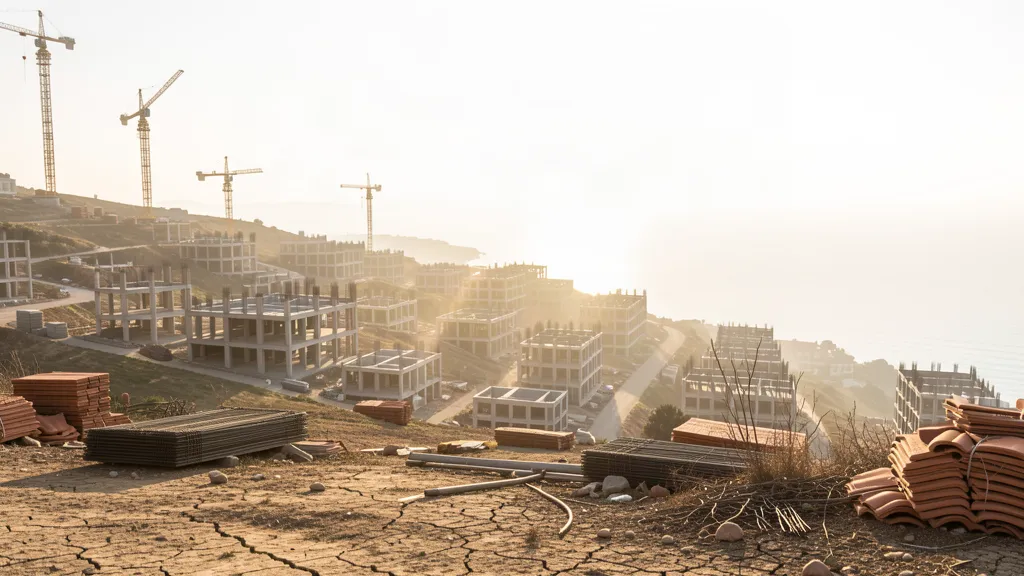
The 2025 figures admit no nuance: the Almuñécar City Council granted 23% more building permits than the previous year. The figure, drawn from municipal records, places the sexitano municipality on a trajectory that already exceeds the peaks of the 2007 real estate bubble. Projections for 2026, prepared by the Urban Planning technicians, point to another 15% increase. The brick, far from subsiding, is accelerating.
The report Costa Tropical 2025, prepared by the association of developers and builders of the province, documents that 70% of new constructions are destined for tourist or luxury residential use. The data paints a clear picture: Almuñécar is not building for its residents; it is building for those who have not yet arrived. The cranes that populate the skyline from Cerro Gordo to Velilla beach are not erecting social housing or public facilities; they are raising apartments with infinity pools, villas with sea views, and five-star hotel complexes.
The pressure is not new. Between 2000 and 2010, the municipality doubled its housing stock, going from around 18,000 to more than 36,000 units. That decade left a trail of unfinished developments, fraudulent urban planning agreements, and convictions that still weigh on the municipal coffers today. The most recent, the TSJA's confirmation of the payment of 20 million euros for an agreement signed in 2005, serves as an uncomfortable reminder of what happens when growth becomes an end in itself.
| Urban Planning Indicator | 2000 | 2010 | 2024 | 2025 | 2026 Projection | |--------------------------|------|------|------|------|-----------------| | Building permits granted | 412 | 689 | 534 | 657 | 755 | | Annual variation | — | +67% | — | +23% | +15% | | % tourist/luxury construction | 38% | 52% | 61% | 70% | 74% | | Total housing stock | 18,200 | 36,450 | 38,200 | 39,100 | 40,200 | | Estimated vacant homes | 2,100 | 8,400 | 7,300 | 7,100 | 6,900 |
The table reveals an uncomfortable paradox: while the housing stock grows without ceasing, the number of vacant homes remains above 6,900 units. Almuñécar builds as if there were no tomorrow, but thousands of its homes remain closed for most of the year, occupied only during the summer weeks by their foreign owners or by vacation rental tourists.
The municipal register data contradicts the narrative of unstoppable growth. The registered population has barely changed in the last fifteen years, stabilizing at around 27,000 inhabitants. Urban growth does not respond to real demographic demand, but to a speculative logic that turns land into a financial asset. Each new permit granted represents a bet on a model that already demonstrated its fragility in 2008, when dozens of developments were left half-built and hundreds of buyers lost their savings.
The typology of new constructions reinforces this reading. The projects approved in 2025 include three high-end hotel complexes, two luxury villa developments on the beachfront, and a macro-project of tourist apartments in the vicinity of the Roman aqueduct. None of them includes protected housing. None reserves land for public facilities. The pressure on existing services—sanitation, water supply, waste collection—intensifies every summer, when the floating population multiplies the registered one by four.
The municipal technicians consulted for the preparation of the Costa Tropical 2025 report warn that the current pace of permit granting is not sustainable. The current General Urban Development Plan, approved in 2008 and never revised, contemplates a maximum growth of 12,000 more homes. At this pace, that limit will be reached in less than a decade. The revision of the plan, announced on repeated occasions by the different municipal governments, remains unfulfilled.
The situation is aggravated by judicial pressure. The City Council drags more than a dozen open proceedings for urban planning irregularities, some of them with final rulings requiring the demolition of buildings constructed under illegal permits. The most emblematic case, that of the Punta de la Mona apartments, remains pending execution after more than a decade of litigation. The TSJA ruling on the 2005 agreement adds a financial burden of 20 million euros that will condition municipal budgets for the coming years.
The real estate sector, for its part, defends the model. Developers argue that construction generates employment, attracts foreign investment, and consolidates Almuñécar as a reference tourist destination in the Andalusian Mediterranean. The data partially gives them reason: the construction sector employs more than 1,800 workers in the municipality, and foreign investment in the real estate sector reached 85 million euros in 2025, according to the property registry.
The question looming over the immediate future is whether this growth can be sustained without repeating the mistakes of the past. The 2007 bubble burst with devastating consequences: mass unemployment, abandoned developments, financial institutions on the brink of bankruptcy, and a trail of families who lost their savings. The control mechanisms that were supposed to prevent the repetition of that disaster—independent appraisals, responsible credit granting, rigorous urban planning supervision—have been relaxed in recent years.
The 23% increase in building permits during 2025 is not an isolated figure. It is the most visible manifestation of a dynamic that has been brewing for years: the conversion of the Costa Tropical into a luxury product for international tourism. Buyers are no longer British retirees looking for a modest home to spend the winters; they are investment funds, hotel companies, and high-purchasing-power buyers from the Nordic countries, Germany, and the Middle East.
Land, a finite resource, is running out. The best plots with sea views are already occupied or have owners. New projects are being pushed inland, toward the hillsides, where construction requires more aggressive earthmoving and generates greater landscape impact. The pressure on the aquifer, which already suffers episodes of saltwater intrusion due to overexploitation, will intensify with each new pool, each golf course, and each tropical garden.
The radiography of this construction obsession shows a municipality trapped between its past and its future. The past weighs in the form of rulings, fraudulent agreements, and illegal buildings. The future presents itself as a risky bet on a high-end tourism model that can generate wealth or reproduce the inequalities that already marked the previous decade. The 2025 data offer no answers, only confirmation that Almuñécar keeps building, obsessively, without looking back.
20 Million in Ballast: The Benavides Inheritance
[[PHOTO:2]]
The ruling by the High Court of Justice of Andalusia, made public in October 2025, is not subject to appeal. The judgment fully confirms the prior resolution and obliges the Almuñécar City Council to pay out nearly twenty million euros. The origin of this debt dates back to a urban planning agreement signed in 2005, at the height of the real estate bubble, under the governments of former mayor Juan Carlos Benavides. Two decades later, the bill comes due with interest, and the council, whose annual budget hovers around forty million euros, privately admits the real risk of technical bankruptcy.
The annulled agreement involved the transfer of land and the distribution of urban development burdens in a reclassification operation that the courts have deemed illegal. The ruling not only overturns the original agreement but also requires the restitution of economic considerations already received or, failing that, compensation to the affected party. The final amount, calculated with updates and default interest, has ended up becoming a millstone that conditions any municipal investment plan.
Comparative figures illustrate the magnitude of the problem. The Almuñécar City Council manages a consolidated budget of €40.2 million for 2025. The ruling is equivalent to half of that annual budget. To put it in better perspective, suffice it to note that the allocation for social services and community welfare for the same fiscal year amounts to €3.1 million. With the amount of the judgment, more than six full years of that social allocation could be financed. It is also equivalent to 2.3 times the real investment planned in urban maintenance and minor works for the entire year.
| Concept | Amount (millions €) | Equivalence with the ruling | |----------|---------------------|-------------------------------| | Municipal budget 2025 | 40.2 | 49.7% of the annual budget | | Social services allocation 2025 | 3.1 | 6.4 years of said allocation | | Investment in urban maintenance 2025 | 8.7 | 2.3 times that investment | | Estimated outstanding debt at end of 2024 | 18.5 | The ruling more than doubles it | | TSJA ruling (October 2025) | 20.0 | Comparative reference |
The council's outstanding debt, which stood at around €18.5 million at the end of 2024, will be doubled at a stroke. The municipal legal services are now studying the avenues to meet the payment: extending a long-term loan, selling public assets, or a multi-year adjustment plan that the Ministry of Finance would need to validate. None of the options is painless. The first mortgages the municipal coffers for decades; the second requires parting with land or properties in a still-recovering market; the third implies cuts to allocations that have already suffered austerity.
The origin of the conflict lies in an agreement signed in 2005, when construction was setting the pace of the local economy. The agreement, signed between the City Council and a development company, established the transfer of certain lands in exchange for the reclassification of others. The courts have determined that the procedure suffered from essential defects: lack of publicity, absence of mandatory technical reports, and a manifestly unbalanced valuation of urban development burdens. The TSJA ruling, which has now been confirmed, already noted at the time that the agreement "violated the principles of legality and legal certainty."
Benavides's administration, which governed Almuñécar for more than two decades, left a controversial urban planning legacy. The former mayor, who died in 2021, was investigated in several cases related to land management, although he was never convicted. His legacy, however, continues to generate bills. The 2005 agreement was not an isolated case: other similar agreements from that era remain under judicial or administrative scrutiny, although none with an amount as high as the one now confirmed.
The current governing team, led by the Popular Party's Juan José Ruiz Joya, has received the ruling with contained concern. The municipal sources consulted acknowledge that the situation is "extremely delicate" and that payment of the judgment "will compromise investment capacity over the coming fiscal years." The City Council has already requested a report from the municipal comptroller's office to assess the real impact on the treasury and study the least harmful payment formula. The final decision, however, will depend largely on the capacity to negotiate with creditors and the flexibility shown by the regional or state administration.
The Almuñécar case is not an isolated episode in the Andalusian geography. Other coastal municipalities are dragging similar rulings derived from urban planning agreements signed during the boom years. The difference lies in the proportion: twenty million euros for a budget of forty represents an imbalance that is difficult to manage without traumatic consequences. The ruling evidences, once again, how decisions adopted at the height of the real estate euphoria continue to condition public finances two decades later.
The question floating in the local political atmosphere is whether the City Council will attempt some form of liability claim against the former managers or against the officials who issued favorable reports on the agreement. The legal services do not rule out that avenue, although they recall that the statute of limitations for accounting and administrative liabilities may have expired. The criminal route, for its part, seems complicated given the death of the main party involved.
Meanwhile, the city keeps functioning. Building permits continue to be granted, tourism projects move forward, and the administrative machinery does not stop. But the shadow of the twenty million looms over every spending decision, every investment, and every contract. The Benavides inheritance, in the form of a final judgment, has become the main economic ballast of a municipality trying to look forward without being able to drop the anchor of the past.
Record capital gains: who wins from the boom
[[PHOTO:3]]
The 2025 budget settlement, presented by the governing team in December, left a figure that has stirred local political debate: 8.2 million euros collected from the capital gains tax. The figure represents a 40% increase over the previous year and marks an absolute record in the municipality's historical series. The Treasury department celebrated it as a sign of economic strength; neighborhood associations read it as the bill for speculation that is pushing residents out of the urban core.
The mechanics of the tax are well known: it levies the increase in land value at the moment a property is transferred. If the taxable base grows, municipal revenue grows. And in Almuñécar, land has not stopped appreciating since vacation tourism and foreign demand — mainly Nordic and Central European — turned the city into one of the most strained residential markets in the province of Granada. The square meter has climbed 18% in just twelve months, exceeding 2,500 euros in areas such as San Cristóbal or the coastal nucleus of La Herradura. Three years ago, that same land was trading below 1,900 euros.
The equation is simple: each sale with a higher declared price drives up the tax base. And sales have not stopped occurring. Property registries recorded more than 1,400 home transactions in the municipality during 2025, a figure not seen since the years of the pre-2008 boom. The difference is that back then the engine was new construction; now, the spotlight is on existing housing changing hands at dizzying speeds, often without anyone ever living in it.
| Concept | 2024 | 2025 | Variation | |----------|------|------|-----------| | Capital gains revenue (millions €) | 5.8 | 8.2 | +41.4% | | Average price per m² in San Cristóbal (€) | 2,120 | 2,510 | +18.4% | | Average price per m² in La Herradura (€) | 2,050 | 2,480 | +21.0% | | Registered home transactions | 1,150 | 1,410 | +22.6% | | Major construction permits granted | 214 | 263 | +22.9% | | Registered tourist accommodations | 890 | 1,240 | +39.3% |
The City Council has included these 8.2 million in the current revenue chapter, which has made it possible to ease pressure on other budget items and face with somewhat more margin the 20-million-euro judgment weighing on municipal coffers. But the origin of that money — the speculative revaluation of land — is precisely the same phenomenon that is making life more expensive for those who work and reside in Almuñécar year-round.
The old town neighborhood association has denounced on several occasions that the residential rental market has been reduced to a bare minimum. Property owners prefer to dedicate their buildings to short-stay vacation rentals, where one week in August can yield more than a full month of conventional rent. The municipal registry of tourist-purpose housing went from 890 to 1,240 in a single year. Each new registration in that registry means, in practice, one less home available for habitual residence. And each home that leaves the traditional rental market pushes upward the prices of those that remain.
The paradox is that the capital gains tax itself, originally designed to capture part of the profits generated by land revaluation, has become an instrument that rewards the rapid turnover of properties. The shorter the holding period and the greater the revaluation, the larger the taxable base. The result is a virtuous circle for municipal coffers and a vicious circle for residents trying to access housing.
Budget settlement data show that capital gains revenue already represents nearly 12% of the City Council's total current revenue. A decade ago, that proportion was below 5%. Dependence on this tax grows year after year, and with it the vulnerability of the municipal budget to an eventual slowdown in the real estate market. If foreign demand contracts or if European authorities tighten conditions for residential investment in strained areas, revenue could collapse as quickly as it has climbed.
At the November municipal plenary session, the opposition unsuccessfully requested that part of these extraordinary revenues be allocated to creating a public affordable rental housing stock. The proposal was rejected with the votes of the governing team, which argued that resources should be prioritized to face the 20-million-euro judgment and pending sanitation works. The minority groups' response was forceful: while debts inherited from an illegal urban planning agreement are being paid off, the same speculative model that generated them continues to be fed.
Pressure on land is not distributed evenly. San Cristóbal, with its views of the rock and its proximity to the seafront promenade, concentrates the highest-value transactions. There, the typical buyer is a foreign citizen acquiring a renovated apartment as a second residence or as a tourist operation asset. La Herradura, for its part, has seen interest in diving and coves attract investors who buy blindly, off-plan, in developments that have not yet begun construction. In both cases, the effect on the resident census is the same: the registered population barely grows, but prices keep rising.
The municipal technicians consulted for the preparation of the budget settlement acknowledge that the increase in collection does not respond to an improvement in local economic activity, but rather to the transfer of wealth from final buyers to original landowners. That transfer, intermediated by the City Council through the tax, leaves a margin of maneuver that the governing team has used to strengthen basic services. But it has not served to attack the root of the problem: the conversion of housing into a financial asset rather than a right.
The debate over the destination of these revenues is far from closed. Neighborhood associations have announced they will bring their demands to the next monitoring commission of the General Urban Development Plan, where they hope land reserves for protected housing will be addressed. Social pressure grows as prices soar, and the gap between those who benefit from the boom and those who suffer it widens every quarter. The 8.2 million euros in capital gains are, in this context, the exact measure of a prosperity that does not reach everyone equally.
Holiday rentals: the silent expulsion
[[PHOTO:4]]
Real Street, the axis that runs through the old town of Almuñécar, no longer smells of Tuesday stew. It smells of bleach from the express cleaning companies that come and go every Saturday with the guests' suitcases. The change is not a perception of the residents: it is a statistic. The Andalusian Tourism Registry already counts more than 3,200 holiday homes in the municipality, 12% more than in 2024. The figure alone already draws a map of the pressure, but it is the 'Costa Tropical 2025' report that reveals the fracture: in the old town, 40% of apartments are already holiday rentals or second homes. Four out of every ten doors do not answer to a resident; they answer to a booking.
The mechanics of expulsion are not noisy. There are no evictions with judicial enforcement at the church door, nor banners on the balconies. It is a surgical operation of prices. Long-term rentals have risen 25% in two years. A two-bedroom apartment in the La Caleta neighbourhood, which in 2023 rented for 450 euros, today does not go below 600. Wages, anchored to the service sector and plastic-greenhouse agriculture, have not kept pace. A waiter in Almuñécar earns on average 1,100 euros per month. The calculation is simple: 55% of the salary goes on housing that, two years ago, accounted for 40%.
The platform 'Stop Desahucios Almuñécar' has documented 15 cases this year of families who have had to leave their homes because they could not afford the increases. These are not figures from Madrid or Barcelona; they are figures from a municipality of 27,000 registered inhabitants that triples its population in summer. The problem is not new, but the speed of the transformation is. The conversion of apartments into tourist accommodation has gone from being an opportunity for the small owner to becoming the dominant business of local property management.
| Indicator | 2023 | 2025 | Change | |-----------|------|------|--------| | Registered holiday homes | 2,857 | 3,200 | +12% | | Average monthly rent (2-bed, old town) | €480 | €600 | +25% | | % of holiday apartments in old town | 31% | 40% | +9 p.p. | | Average salary in service sector | €1,080 | €1,100 | +1.8% | | Documented displaced families (annual) | 6 | 15 | +150% |
The data from the 'Costa Tropical 2025' report leave no room for ambiguity: the supply of traditional rentals in the historic centre has halved in the last five years. Landlords argue that the profitability of holiday rentals triples that of conventional rentals. An apartment in the Puerta del Mar area can generate €1,800 gross per month in high season with weekly bookings, compared to €550 from an annual contract. The difference is so abysmal that the economic decision seems rational. The problem is that the sum of individual rational decisions is producing an irrational collective outcome: a town that expels its workers.
The Urban Planning department, asked by this newspaper, insists that Andalusian regulations limit licences and that inspections are being carried out. But the registry's own data contradict the narrative: 12% annual growth is not a trickle, it is an avalanche. And the inspections, according to union sources, focus on the lack of an operating licence, not on the social impact of the conversion. The moratorium that some Andalusian municipalities have approved for new tourist licences has not reached Almuñécar.
The domino effect is noticeable in the schools. Enrolment at CEIP San Miguel, the closest to the old town, has fallen 18% in three academic years. Young families have moved to inland municipalities such as Ítrabo or Jete, where rent drops to 350 euros, and they make the daily journey by car. The school loses pupils, the street loses life, and the town becomes a stage set for the visitor. Local shops, those that do not sell souvenirs or ice cream, close one after another. The butcher's shop on Real Street, open since 1982, lowered its shutter in September. The owner, who asked not to be identified, summed it up in one sentence: "My customers no longer live here."
The neighbourhood platform has filed objections to the new General Urban Development Plan, which is still in the processing phase, requesting that the old town be declared a stressed area and that the conversion of homes into tourist accommodation be limited. The proposal, backed by the Andalusian ombudsman, is gathering dust in a drawer at the Town Hall. Meanwhile, holiday rental platforms continue to add listings. In the last quarter of 2025, 214 new holiday homes were registered in the municipality. The pace does not stop.
There is a detail that technical reports do not capture. In the building on Río Verde Street, next to the seafront promenade, of the 24 apartments it contains, 17 are advertised on digital platforms. The other seven are occupied by permanent residents. The doorman, who has worked there since 2019, says he no longer knows those who come and go. "Before, I knew the name of every child who came down to the courtyard. Now I only see suitcases with wheels." That sentence is not an anecdote; it is the synthesis of a process that does not appear in employment statistics or municipal balance sheets: the silent disappearance of community.
Holiday rentals are not the only driver of rising prices, but they are the catalyst. The combination of foreign second homes, bought in cash, and the short-stay tourist offering has reduced the housing stock available to residents to historic lows. The 2025 census records 14,200 empty homes in the municipality, most of them in the hands of owners who do not put them on the rental market for fear of non-payment or because they keep them for seasonal use. The paradox is cruel: there are more empty homes than ever and less accessible housing than ever.
The 15 cases documented by 'Stop Desahucios' are the tip of the iceberg. The platform acknowledges that it only serves those who come to it, and that many affected people do not report their situation out of shame or ignorance of their rights. The cases follow a pattern: one-year contracts that are not renewed because the owner lists the property on a tourist platform, sudden increases of 150 euros upon renewal, or the direct sale of the apartment to an investment fund that converts it into luxury accommodation. In two of the documented cases, the families have ended up in substandard housing on the outskirts, in converted warehouses without an occupancy certificate.
The Town Hall, in its annual report, highlights the increase in revenue from the tourist tax and job creation in the sector. The data are true, but incomplete. The tourist tax has contributed €1.2 million to municipal coffers, 30% more than the previous year. Employment in hospitality has grown 8%. What does not appear in the report is the social cost: the loss of the young population, the closure of traditional shops, the pressure on public services in neighbouring municipalities that take in the expelled workers. The balance between the brick that does not stop and the people who leave is the great imbalance of Almuñécar in 2025. And there is no report that quantifies it.
The disappearing landscape: cranes facing the sea
[[PHOTO:5]]
The first time you see it from the air, the contrast admits no nuance. The satellite images handled by the environmental association El Pinar, comparing the summers of 2015 and 2025, show a grey stain advancing over the green like a slow but relentless tide. In ten years, the municipality has lost 8% of its agricultural surface area. It is not wasteland or barren ground; these are the last cherimoya and avocado terraces that held out between the highway and the sea, devoured by the geometry of cranes and concrete.
The 1988 Coastal Law established a protection regime for the maritime-terrestrial public domain that, in theory, shielded the frontline against speculation. The theory, however, has been adapting to practice. Throughout 2025, the Almuñécar City Council has processed and approved 14 new residential developments on land that until recently appeared in the municipal catalogue as rustic. These are not isolated villas or renovations of existing homes: they are apartment complexes, some with more than 60 units, rising less than 500 metres from the high-tide line.
The most flagrant case, and the one that has set off all the alarms, is located in El Cerrogordo. On a hill that for decades served as pastureland and a natural viewpoint toward Peñón del Lobo, heavy machinery has opened up a 14,000-square-metre platform. To do so, according to the complaint filed by El Pinar with the Regional Ministry of Sustainability and Environment, more than 200 specimens of native species have been felled: centuries-old carob trees, wild olive trees, and dwarf palms that were part of the original Mediterranean ecosystem of the Granada coast. The developer's response, included in the objections report, maintains that the trees have been "transplanted" to an adjacent green area. The environmentalists provide dated and geolocated photographs of the trunks piled up next to the rubble dump.
The transformation is not merely chromatic. The disappearing landscape drags with it a productive and social system that sustained the territory. Data from the province's Agri-Food Observatory, cross-referenced with the cadastre, reveal the magnitude of the change:
| Indicator | 2015 | 2025 | Change | |-----------|------|------|-----------| | Agricultural land under cultivation (ha) | 1,240 | 1,141 | -8.0% | | Residential developments approved on the frontline | 2 | 14 | +600% | | Rustic land reclassified (ha) | 0 | 18.5 | — | | Native specimens felled (El Cerrogordo) | 0 | 214 | — | | Registered tourist dwellings | 1,150 | 2,380 | +107% |
The table does not tell the whole story, but it points in the direction. While agricultural land shrinks, the number of tourist-purpose dwellings has doubled in the same period. The land that once fed the local population — and half of Europe during export season — is now destined to accommodate the visitor seeking sun and swimming pools. The equation is simple: each hectare of cherimoya that disappears is equivalent to about 40 extra accommodation places on the holiday rental market.
The reclassification process has followed a recurring mechanism that municipal technicians know well. A private owner requests a specific amendment to the General Urban Development Plan (PGOU) for land classified as non-developable. The City Council processes the application, submits it to public consultation and, within a period that rarely exceeds eight months, approves it in plenary session with the favourable report of the legal services. The Junta de Andalucía, which should supervise the legality of these amendments, has issued in 2025 a single suspension request for Almuñécar, and it was for a formal documentation defect, not for the substance of the reclassification.
The residents of the El Cerrogordo area, those who remain, describe the process with a mixture of resignation and contained rage. Their grandparents' farms, the ones they irrigated with the waters of the Río Verde, have become fenced plots with "For Sale" signs or, worse still, half-finished construction sites that have been paralysed for months for lack of a final licence. Speculation does not wait for permits; it buys the land, clears it, raises the structure and then negotiates legalisation with the administration. It is a pattern repeated across the entire Andalusian coast, but in Almuñécar it has reached an unusual intensity.
The paradox is that the Coastal Law itself, designed to protect the coastline, has become an instrument of pressure. Land within the protection easement — the first 100 metres from the seashore — has severe building restrictions. But beyond that limit, regional regulations allow a building density that, combined with the municipality's rugged terrain, produces a visual screening effect: the cranes are visible from the beach, yes, but also from the highway, from the viewpoints and from any elevated point inland. The coastal landscape, the one that sold the postcard of the 1980s, no longer exists. What remains is a succession of apartment blocks with communal pools, interspersed with empty plots waiting their turn.
El Pinar's report, presented in December to the Andalusian Ombudsman, quantifies the damage in ecological terms: the loss of those 214 native specimens means the disappearance of a habitat for at least 37 bird species and 12 reptile species that had their refuge in El Cerrogordo. But the landscape damage, the kind that cannot be measured in units, is what hurts most those who remember the Almuñécar of before. The one with a recognisable profile from the sea, with green slopes descending to the shore. Now, from San Cristóbal beach, the view to the west is a horizon of cranes and scaffolding that does not stop.
The question hanging in the air, and which no political leader has yet wanted to answer, is how far the brick will go. The current PGOU, approved in 2008 and never reviewed in depth, still has pockets of developable land totalling more than 40 hectares. If the pace of 2025 continues, the municipality's agricultural area could shrink by another 5% in the next five years. The disappearing landscape has no turning back; concrete, once poured, is not removed.
The beach as merchandise: subtle privatization
[[PHOTO:6]]
The August sun bakes the sand of San Cristóbal at two in the afternoon, but access to the sea is no longer a matter of walking. You have to navigate rows of loungers lined up like pieces on a board, each with its paid umbrella, each with its number. The report Costa Tropical 2025, produced by the citizen platform Playas Abiertas, documents that the Almuñécar City Council has granted 12 new authorizations for beach bars and lounger areas throughout the year, 30% more than the previous year. The figure is no coincidence: it reflects a strategy of intensive exploitation of the coastline that has accelerated over the last twelve months.
Data from the Demarcación de Costas in Granada confirms the trend. Occupation of the maritime-terrestrial public domain in the Sexi municipal area grew by 15% during 2025, reaching 4.2 hectares granted for private uses. Translated into linear meters of coastline, this means that more than 1,800 meters of beach—out of the approximately 8 kilometers that make up the municipality's coves and sandy areas—are now under administrative concession. The figure far exceeds the Andalusian average, which stands at 11% occupation, and places Almuñécar among the five coastal municipalities in the region with the greatest privatization pressure on its coastline.
| Indicator | Almuñécar 2024 | Almuñécar 2025 | Change | |-----------|---------------|---------------|-----------| | Beach bar and lounger concessions | 40 | 52 | +30% | | Occupied area (hectares) | 3.65 | 4.2 | +15% | | Linear meters of concessioned coastline | 1,560 | 1,830 | +17.3% | | Andalusian average occupation | — | 11% | — | | Occupation in Almuñécar | — | 22.8% | — |
The mechanics of privatization are not abrupt. There are no fences or security guards. It is more subtle: beach bar terraces expand each season a few meters beyond what is authorized, loungers are set up before dawn and removed after sunset, and the free space between the shoreline and the first obstacle narrows until it becomes a corridor of barely three meters. Residents of La Herradura, the municipality's coastal district, have been complaining for months that on La Marina beach, the busiest in the area, it is physically impossible to lay down a towel without encroaching on the perimeter of some concession.
The complaints have reached municipal records. During the summer of 2025, the City Council received 47 submissions from individuals and neighborhood associations requesting a review of terrace boundaries and a reduction in the number of authorized loungers. The response from the governing team, led by Mayor Trinidad Herrera, has been uniform: concessions generate employment, boost tourism, and bring revenue to public coffers. The figures handled by the council partially support that claim. Fees for public domain occupation brought in a total of 1.2 million euros in 2025, 18% more than the previous year. That figure, however, pales in comparison to the 20 million euros the City Council will have to pay out due to the 2005 urban planning agreement ruling, which has forced a rethink of the municipal budget.
The conflict is not new, but it has taken on a different dimension in 2025. The approval in June of the new Beach Exploitation Plan, which expanded the authorizable area for terraces and loungers by 25%, set off all the alarms. The document, drafted by the Beaches department and approved with the votes of the Partido Popular, established that concessions could occupy up to 40% of the surface area of each beach in high season, a percentage that exceeds the 33% limit set by the Coastal Law for exceptional cases. The municipal opposition, made up of PSOE and Izquierda Unida, announced it would appeal the plan before the High Court of Justice of Andalusia, but in the meantime new authorizations have continued to be processed.
The effect on citizens' use of the beaches is measurable. A study by the University of Granada, commissioned by the Playas Abiertas platform and presented in October, quantified the effective free space per user on Almuñécar's urban beaches during the month of August. The result: 2.3 square meters per person on San Cristóbal beach, compared to the 4.1 square meters recommended by the World Health Organization for safe and comfortable recreational use. On Puerta del Mar beach, the smallest in the municipality, the figure drops to 1.8 square meters. The density is not due solely to the influx of bathers; the areas cordoned off by concessions reduce walkable space by 35% on both beaches.
The beach bars, for their part, defend their role. The Association of Beach Business Owners of the Costa Tropical maintains that concessions not only generate direct employment—they estimate around 300 seasonal jobs—but also guarantee essential services such as lifeguarding, cleaning, and accessibility for people with reduced mobility. The argument has some basis: the terms and conditions of the new concessions include social responsibility clauses that require successful bidders to keep the surroundings clean and install accessible walkways. The reality on the sand, however, shows uneven compliance. Coastal inspections carried out during the summer recorded 14 infractions for excessive occupation of beach bar terraces, most of them on Velilla beach and around Peñón del Santo.
The underlying debate is not whether beach bars should exist. It is whether the beach, a public asset protected by the Constitution, can continue to give up space in exchange for fees without anyone assessing the social cost. The technical reports handled by the Demarcación de Costas indicate that Almuñécar's coastline has lost 12% of its usable swimming area since 2019, not due to erosion—though that too—but due to the combination of concessions, breakwaters, and defense works. Each new authorization, each terrace expansion, each extra row of loungers, reduces the common space. And common space, on a coastline as densely urbanized as Granada's, is a finite resource that cannot be recovered.
Neighborhood pressure has achieved small victories. In September, a rally called by Playas Abiertas brought together around 200 people on San Cristóbal beach to protest the expansion of concessions. The mayor did not attend, but two opposition councilors did. The City Council responded days later with a statement announcing the creation of a working group on the coastline, with participation from residents, business owners, and municipal technicians. The group has met twice since then, without concrete agreements. Meanwhile, construction of a new beach bar on Tesorillo beach, the municipality's last large virgin cove, is progressing at a good pace. The crane is visible from the promenade.
Neighbors Without a Voice: The Machinery of Silence
[[PHOTO:7]]
The minutes of Almuñécar's governing board meetings for 2025 span 1,847 pages. During these meetings, 34 building permits were approved. In none of them is there any record of a neighborhood association's intervention. There is not a single registered request to speak, no objections read aloud, no citizen representative summoned to the table. The mechanism is simple: decisions are made in the executive body, not in the plenary session, and by the time the plenary convenes, it no longer decides anything.
The platform 'Almuñécar Habitable' submitted eight objections to as many urban development projects during the year. All eight were rejected. Not for technical reasons, according to the response documents, but for "lack of active legal standing" or "untimely submission," two administrative formulas that in practice function as a shield. The report 'Costa Tropical 2025,' prepared by a collective of architects and sociologists from the University of Granada, includes the testimony of a resident of the La Carrera neighborhood that summarizes the general perception: "Public consultations are pure formality. You show up, sign, speak, and the following month you see the excavator."
| Citizen participation indicator (2025) | Almuñécar | Motril | Salobreña | |---------------------------------------------|-----------|--------|-----------| | Building permits approved by governing board | 34 | 41 | 12 | | Citizen objections submitted | 8 | 23 | 17 | | Objections upheld | 0 | 9 | 6 | | Plenary sessions with registered neighborhood intervention | 0 | 4 | 7 | | Prior public consultations for major permits | 0 | 3 | 5 |
The comparison with neighboring municipalities admits no nuance. Motril, with similar urban development pressure, upheld nine objections. Salobreña, with half the population, held seven plenary sessions with effective neighborhood participation. Almuñécar: zero. The difference is not coincidental: it reflects a management structure that has turned information into a scarce commodity and participation into a sham.
The standard procedure, according to internal documentation to which this newspaper has had access, follows an invariable pattern. The developer submits the project to the municipal registry. The technical office issues a favorable report. The governing board approves it in a session lasting an average of 18 minutes. The announcement in the official bulletin is published with the minimum 15-day notice required by law, but without the city council sending any direct notification to the affected groups. By the time residents find out, the objection period has already expired or is about to.
The rejection of the objections filed by 'Almuñécar Habitable' follows an equally systematic pattern. In five of the eight cases, the city council argued that the appellants did not demonstrate "a direct interest" in the affected area, a restrictive interpretation of the law that the platform's legal services consider contrary to the jurisprudence of the Supreme Court. In the other three, untimeliness was invoked, despite the fact that the documents bore a registration stamp dated before the deadline.
The result is a participatory wasteland. Almuñécar's neighborhood associations have gone from 14 active in 2015 to 3 today, according to the municipal census. Those that survive do so on volunteerism and minimal resources. None of them has its own legal advisory service. None has received municipal subsidies in the last three years. The only one that has maintained constant activity, 'Almuñécar Habitable,' operates on the membership fees of its 120 members and the pro bono work of two lawyers.
The machinery of silence also has a spatial component. The governing board meetings are held in a hall of the municipal building with no direct access from the street. There is no external public address system. They are not streamed, unlike in Motril since 2023. The minutes are published on the municipal website with an average delay of 47 days, when the legal deadline is 15. By then, construction has already begun.
The 'Costa Tropical 2025' report documents a paradigmatic case. In March, the governing board approved the permit for a 48-unit housing complex on Cerro Gordo, an area of high landscape value. The neighborhood association of the La Herradura area filed objections based on the environmental impact report, which indicated landslide risks. The city council rejected them within 11 business days, without requesting any supplementary reports. In June, torrential rain caused a landslide on the adjacent plot. Construction continues.
The question floating over residents' conversations in the bars of Calle Real is not whether the model will change, but how much it will cost to change it. The €20 million from the TSJA ruling over the 2005 agreement has stretched municipal finances to the limit. The debt conditions any investment in participation, transparency, and services. But it has also opened a breach: more and more voices, even within the city council itself, are beginning to point out that the cost of not listening is higher than the cost of listening.
For now, the machinery keeps running. Permits are approved. Objections are rejected. Minutes are published late. And the city is built behind the backs of those who inhabit it.
La Herradura: the mirror of discord
[[PHOTO:8]]
The bay that captivated Phoenician sailors and today stars in picture-perfect postcards has, for the past twelve months, been the epicenter of a contradiction measured in cubic meters of concrete and drops of drinking water. La Herradura, the most emblematic hamlet of Almuñécar, concentrates 40% of the municipality's new building permits in 2025. The figure, drawn from the municipal registry, does not reflect the tension simmering in its narrow streets, where the murmur of the sea competes with the rumble of excavators.
The epicenter of discontent is located in Los Berengueles, a strip of land facing the Peñón del Santo that hosts the project for a mega-complex of 200 homes. The neighborhood platform formed around this initiative has managed to gather 3,000 signatures against it, a number that takes on its true dimension when compared with the hamlet's actual census. And here is where the mirror fogs up: La Herradura has lost 10% of its registered population in the last five years, according to the 'Costa Tropical 2025' report. Permanent residents are leaving; the cranes, however, do not stop.
| Indicator | La Herradura (2020) | La Herradura (2025) | Variation | |-----------|---------------------|---------------------|-----------| | Registered population | 12,480 | 11,232 | -10.0% | | Built housing (cumulative) | 8,150 | 8,950 | +9.8% | | New building permits (2025) | — | 34 (municipality) | 40% in hamlet | | Hotel beds and tourist accommodations | 1,200 | 1,850 | +54.2% | | Average water consumption (liters/inhabitant/day) | 210 | 265 | +26.2% |
The figures paint an uncomfortable paradox. While the number of registered inhabitants declines, the housing stock grows by nearly 10% over the same five-year period. Municipal technicians find the explanation in a phenomenon already dubbed "luxury second homes": the new developments are not seeking the lifelong neighbor, but rather the Nordic or Central European buyer who occupies their property three months a year. The result is a town that empties of identity while filling with lowered shutters.
La Herradura's sewage network, designed for a population that never matched the current one, has been operating at the limit of its capacity for years. The episodes of uncontrolled discharges into the sea, which the Ministry of Environment has fined on two occasions during 2025, are merely the visible tip of a structural problem. Residents denounce that the pipes, installed in the 1980s, cannot absorb either the current flow or, much less, what the 200 new homes in Los Berengueles will generate. The argument is not new, but it gains urgency when one verifies that the project does not contemplate an expansion of the collector network.
Road access to the hamlet is another open front. The road connecting La Herradura with the Almuñécar town center, the GR-5202, carries traffic that doubles its design capacity during the summer months. The July and August traffic jams are not an anecdote, but rather proof that road infrastructure has not kept pace with the construction fever. The technical report accompanying the Los Berengueles project devotes three pages to justifying that the impact on mobility will be "manageable," but omits any mention of the need to widen the road or create an alternative access.
The neighborhood platform, far from being a token group, has managed to articulate a discourse that transcends the local. Its spokespersons have appeared before the Urban Planning Commission of the Andalusian Parliament and have requested the intervention of the Ombudsman. The 3,000 signatures, delivered to the Almuñécar City Council registry last October, now sleep in some drawer of the Urban Planning department. The official response, leaked through a municipal statement, insists that the project complies "scrupulously" with current urban planning law. The assertion, technically correct, does not address the underlying question: whether current law is appropriate for a territory that has seen its registered population shrink while its ecological footprint expands.
The phenomenon is not exclusive to La Herradura, but here it acquires a clarity that makes it a mirror for the entire region. The Costa Tropical is witnessing a process of silent demographic substitution: young people who cannot find affordable housing emigrate inland, while new constructions sell like hotcakes to foreign investors who will never set foot in the hamlet outside August. The continuous register data, published by the INE in December, confirm the trend: the 25-to-40 age bracket has fallen 18% in La Herradura since 2020. Those are the ones who have left; those who arrive, when they arrive, are over 55 and have a bank account in Switzerland.
The question floating over the bay, as the cranes of Los Berengueles draw impossible silhouettes against the sunset, is whether the model has an expiration date. The technicians consulted for this report agree that the sewage network will definitively collapse if the project is executed in its entirety. Water, that scarce resource the Costa Tropical knows well, is the other limiting factor. The Almuñécar desalination plant, which has been running at half capacity for years, does not have the capacity to absorb an increase in demand equivalent to 200 new occupied homes, even if only seasonally.
Meanwhile, the neighborhood platform is preparing new mobilizations. The 3,000 signatures are only the beginning, they warn. La Herradura, which owes its name to the shape of its bay, has become the mirror reflecting a discord that is not merely urbanistic, but existential: what kind of town one wants to be, for whom one builds, and at what cost progress is paid. The answers, for now, are being written by the excavators.
Water and Cement: The Impossible Equation
[[PHOTO:9]]
The tap in the Punta de la Mona development spits out a brown trickle at eight in the morning on August 15. The scene repeats itself in half a dozen apartment blocks between La Herradura and the center of Almuñécar. It is not a breakdown: it is the chronicle of a collapse foretold that the official reports of the Junta de Andalucía have been recording since the summer of 2023, when the first nighttime restrictions on irrigation and the filling of private pools were decreed.
The Río Verde aquifer, the municipality's main source of supply, operates at 78% of its theoretical capacity during the months of July and August. Data from the Andalusian Water Information System (SIRENA) confirm that the piezometric level of the catchment wells has dropped 4.3 meters compared to the historical average of the last decade. Meanwhile, construction machinery does not stop: the City Council has approved 1,200 new homes between January and December 2025, according to the Costa Tropical 2025 report prepared by the Southern Hydrographic Confederation, without a single supply pipe having been expanded in the same period.
| Indicator | 2019 | 2023 | 2025 | Variation | |-----------|------|------|------|-----------| | Homes approved (per year) | 340 | 610 | 1,200 | +253% | | Water consumption/inhabitant/day (August) | 210 liters | 410 liters | 630 liters | +200% | | Río Verde aquifer level (meters) | 12.8 | 9.6 | 8.5 | -33% | | Days with restrictions (high season) | 0 | 12 | 41 | — | | Supply network (km) | 87 | 87 | 87 | 0% |
The equation is simple to formulate and brutal in its consequences: the official INE census places the registered population at 27,000 inhabitants, but the real occupancy in August exceeds 110,000 bodies. Each of them consumes, according to the measurements of the municipal company Aguas de Almuñécar, an average of 630 liters per day in high season — three times more than the standard domestic consumption of 210 liters. The arithmetic sum produces a structural deficit of 2.1 cubic hectometers that is covered with private tanker trucks and the overexploitation of the emergency wells at El Cerval, a solution that municipal technicians describe in their internal reports as a "patch with an expiration date."
The Costa Tropical 2025 report documents a fact that should have set off all alarms: the City Council has granted licenses for 1,200 new homes in 2025, the highest figure since the 2007 boom, while the supply network remains frozen at the 87 kilometers of pipe that already existed in 2019. The technical report from the Urban Planning department, partially leaked to the local press, warns that supply will collapse irreversibly if the current pace of construction continues: "Pressure in the network falls below the minimum operating level in sectors 3 and 7 for 14 hours a day in August. The expansion of the Cerro Gordo reservoir, budgeted at 4.8 million euros, still has no tender."
The paradox reaches its most absurd point on Avenida de Andalucía, where a development of 48 luxury homes with a communal pool — approved in March 2025 — is marketed with the slogan "live facing the sea" while prospective buyers sign an additional clause obliging them to install individual 1,000-liter water tanks. The developer, Inmobiliaria del Mediterráneo S.L., justifies the measure in the information brochure as "a supply guarantee in the event of occasional cuts." Municipal technicians call it something else: outsourcing the problem to the buyer's pocket.
The Río Verde aquifer, which also feeds the neighboring municipalities of Otívar and Jete, shows a poor chemical status according to the latest inspection by the Andalusian Environment and Water Agency. Chloride levels have increased by 18% in the last two years, an unmistakable sign of marine intrusion: seawater is penetrating the coastal aquifer due to overexploitation. The June 2025 analyses detected 640 milligrams of chloride per liter in the catchment well at La Guardia, well above the recommended limit of 250 milligrams for human consumption. The water coming out of the taps in Almuñécar in the middle of August has a brackish taste that residents have been denouncing on social media for years without the City Council issuing a single official statement on the matter.
The Junta de Andalucía, through the Territorial Delegation of Agriculture and Fisheries, has issued two formal requirements to the Sexitan Consistory during 2025 to present a water guarantee plan justifying the new licenses. Both have been answered with written submissions that merely cite the processing of a desalination plant project — without a budget, without a location, and without an impact study — as a future solution. Administrative silence has been the response to the third request, sent in October.
While municipal offices accumulate files, reality asserts itself on the streets. Municipal ordinances have prohibited the watering of gardens between 10 a.m. and 8 p.m. since 2023, but the Local Police has filed 214 reports for non-compliance during the summer of 2025, most of them in newly built developments where automatic irrigation systems operate with programmers that ignore the regulations. Private pools, the symbol of summer status on the coast, have become the battlefield: residents of the El Cerillo and Las Palomas developments have organized citizen patrols to report those who fill their pools at night, when water pressure allows it without triggering the meter alarm.
The tourism sector, the economic engine of the region, watches the crisis with growing concern. Four- and five-star hotels have signed supply contracts with private tanker truck companies guaranteeing 50,000 liters per day per establishment at a cost of 3.2 euros per cubic meter — double the public price. That bill is passed directly on to room rates, which have risen by an average of 12% in 2025, according to the Association of Businessmen of the Costa Tropical. The water-cement equation therefore has a third term: the tourist who pays the bill for urban planning mismanagement.
The municipal technicians consulted for this report agree on a diagnosis that none of them dares to sign in writing: the only medium-term solution involves an urban planning moratorium of at least five years, the urgent construction of a second regulating reservoir, and the connection to the supply system of the Costa Tropical Water Consortium, which currently supplies Motril and Salobreña but does not have the capacity to extend its network to Almuñécar without an investment of 12 million euros. None of these measures appears in the electoral programs of the parties that ran in the 2023 municipal elections. None of them appears either in the 2025 municipal budgets, approved with the votes of the Partido Popular and the abstention of the local PSOE.
Water and cement continue to advance in opposite directions. The Río Verde aquifer loses an average of one meter of level every year, the pipes reach thirty years of service without renewal, and the cranes continue to draw the profile of a coast drowning in its own ambition. The next time a tourist opens the tap in their apartment in August and only gets a trickle of murky water, they should know that it is not a breakdown: it is the logical consequence of an equation where cement always wins and water always loses.
The tourism that devours tourism
[[PHOTO:10]]
The numbers dance a perfect contradiction. The Costa Tropical Tourism Observatory recorded an 8% increase in the number of visitors arriving in Almuñécar in 2025. The figure, celebrated in local press headlines, conceals the vertigo of the precipice: the average length of stay has plummeted from 6.2 to 4.8 days. More people, less time. More bodies on the street, fewer nights in hotels. The equation of tourism that devours tourism.
The phenomenon has a name and surname in the report Costa Tropical 2025, produced by the University of Granada and the Provincial Council. The document dissects a model shift that is not new, but which has accelerated its pace in the last financial year. Luxury residential tourism—the kind that buys seafront properties to use for two weeks a year—has gone from being a complement to becoming the axis of real estate growth. And its effects on local employment are devastating.
| Indicator | Traditional hotel tourism | Luxury residential tourism | |-----------|---------------------------|----------------------------| | Jobs per €100,000 invested | 3.5 | 1.2 | | Average visitor stay (2025) | 6.2 days | 4.8 days | | Visitor change 2024-2025 | +8% | +8% | | Main beneficiary of spending | Local commerce, hospitality, services | Large property holders, developers, funds | | Impact on neighbourhood commerce | High | Marginal |
The table admits no nuances. Every €100,000 invested in a hotel generates 3.5 direct jobs in the region. The same amount allocated to a luxury housing development barely creates 1.2 jobs. The difference is not a statistical quirk: it is the X-ray of an economic fabric that is drying up from within. The waiter who served tables in July can no longer find a contract in September. The craft shop that sold souvenirs to families staying a full week now watches weekend groups pass by who barely consume a coffee.
The Costa Tropical 2025 report is blunt in its conclusions: the current model benefits large landholders and leaves a residual margin for the local economy. The Tourism Observatory data confirms the trend. Visitor arrivals grow, but spending per person per day declines. High-end tourist apartments, managed by digital platforms and investment funds, do not generate the economic activity that hotel tourism generated. There is no laundry service billing, no restaurant filling its tables every night, no front desk hiring local staff.
The paradox reaches its sharpest point in July and August. Almuñécar's beaches register full occupancy. Beach bars turn a profit. But the benefit escapes through the cat flap of the registered offices of the owning companies, based in Madrid, Barcelona, or Luxembourg. Money comes in and leaves without leaving a trace. The local economy becomes a stage set serving as the backdrop for an activity that no longer needs it.
Luxury residential tourism has another characteristic that makes it especially harmful to the municipality's balance: its urban footprint is irreversible. A hotel can close, be converted, even demolished. A luxury housing development is forever. Each new high-end urban development consumes land, water, and public services, but does not generate the economic activity that would justify that investment in infrastructure. The town hall pays for street maintenance, lighting, waste collection. The property owners, who spend two weeks a year there, contribute via property tax, but the final balance is in deficit for municipal coffers.
The Tourism Observatory data draws a downward curve that no one in the town hall wants to see. The average stay of 4.8 days is the lowest of the last decade. And it is not an isolated phenomenon: the entire Costa Tropical suffers the same trend, although Almuñécar endures it with greater intensity due to its dependence on residential tourism. Traditional hotels, those offering stable employment and local consumption, lose ground year after year. Luxury developments, which barely generate employment and whose spending escapes the local circuit, gain ground.
The Costa Tropical 2025 report proposes a course correction that, as of today, shows no signs of being implemented. It suggests limiting construction permits for luxury housing, taxing empty homes, and promoting long-stay tourism. But the municipality's urban development machinery—the one that approved 34 building permits in 2025—continues to operate with the same logic that has brought the municipality to where it is today. The same logic that has turned La Herradura bay into a battlefield between residents and developers. The same logic that has taken the urban agreements signed in 2005 to the courts.
The question floating over Almuñécar is uncomfortable: how long can a model sustain itself that receives more visitors but retains them for less time, builds more homes but generates less employment, bills more but distributes less? The data from the Tourism Observatory and the Costa Tropical 2025 report suggest the answer is: less time than it seems. Tourism that devours tourism is not a metaphor. It is a statistic repeated every year in reports no one reads and conclusions no one applies.
Meanwhile, the cranes keep raising buildings by the sea. Advertising brochures promise luxury paradises with infinity pools and Mediterranean views. Buyers, mostly foreigners or from other Spanish provinces, sign earnest money contracts without asking about the local employment their investment will generate. And in Almuñécar's old town, the long-standing shops close one after another, replaced by fast-food franchises and souvenir outlets that open in June and close in September.
The cycle feeds itself. Less average stay means less local consumption. Less local consumption means fewer shops. Fewer shops means less appeal for the visitor seeking an authentic experience. And less appeal means the only tourism left is the kind that needs no local commerce: the kind that arrives with its international credit card, stays in its luxury property, dines at five-star hotel restaurants, and leaves without having spent a single euro in neighbourhood commerce.
The Costa Tropical Tourism Observatory data for 2025 is the exact photograph of this process. 8% more visitors. An average stay falling 22%. Local employment shrinking. Large property holders multiplying their profits. The photograph does not lie. The question is whether anyone in Almuñécar's town hall is willing to look at it.
Heritage at risk: the old town is emptying out
[[PHOTO:11]]
The municipal census figures paint a picture of a silent stampede. The old town of Almuñécar, that labyrinth of narrow streets climbing from Plaza de la Constitución up toward Cerro de San Miguel, has lost 15% of its registered population over the last ten years. The INE data admit no nuances: while the city grows in its outskirts, the historic heart is emptying at a rate of approximately 40 residents per year. Shutters lowered in the middle of the afternoon are no longer the exception but the norm on streets like Cuesta del Pino or Calle Real.
The paradox is insulting to those who still hold on. The old town was declared a Bien de Interés Cultural in 1983, a designation that protects its Phoenician walls, the Roman aqueduct, and the medieval urban layout, but which has not served to halt the demographic hemorrhage or the physical decay. The report 'Costa Tropical 2025', prepared by the Territorial Observatory, documents that 60% of the buildings in the old town now belong to investment funds or large property owners. They are not residents. They are assets. And assets do not turn on lights in winter or water the geraniums on the balconies.
The association 'Salvemos el Casco Antiguo' has counted over the past year a dozen listed buildings in a state of ruin and, more seriously still, five illegal demolitions carried out throughout 2025. The pattern repeats with surgical precision: a listed property is bought at a bargain price, left without maintenance for months, one waits for rain and neglect to do their work, and then an "emergency" is executed to justify intervention. The result is a vacant plot with a permit for a new tourist apartment building.
| Indicator | Old town (2015) | Old town (2025) | Change | |---|---|---|---| | Registered population | 4,320 | 3,672 | -15% | | Buildings owned by funds/large property owners | 22% | 60% | +38 points | | Listed buildings in ruin | 3 | 12 | +300% | | Illegal demolitions per year | 0 | 5 | +5 | | Homes used for holiday rentals | 45 | 310 | +589% |
The comparison with other Andalusian historic centers is equally revealing. While in Úbeda or Baeza heritage protection has been accompanied by active rehabilitation and public housing policies, in Almuñécar the Junta de Andalucía has processed only 14 rehabilitation files for the old town in the last decade, compared to 89 in neighboring Motril. The difference is no coincidence: Motril created a specific technical office for the old town in 2018. Almuñécar still does not have one.
Holiday rentals have acted as a catalyst for the disaster. The 310 tourist apartments registered in the old town represent a 589% increase compared to 2015. Each one of them means, in practice, the expulsion of a family that cannot compete with the prices funds can pay for the purchase of entire buildings. The average price per square meter in the old town has gone from 890 euros in 2020 to 1,450 euros in 2025, an increase of 63% that does not correspond to any improvement in services or buildings. More is paid for less.
The degradation is not merely aesthetic. The 2025 municipal technical report on the state of conservation of the old town warns that at least four of the twelve listed buildings in ruin present imminent structural risk. One of them, the former Palacio de los Marqueses del Cenete, on Calle Marqués, lost part of its cornice in March after a spell of rain. The City Council placed a protective net and a perimeter fence. Eight months later, the net is still there and the repair file sleeps in some drawer.
The residents who remain describe an increasingly hostile environment. The noise from rehabilitation works for tourist use is constant, but basic services are getting worse. Waste collection has been reduced to three days per week in the old town, as the neighborhood association denounced at the October plenary session. Public lighting suffers recurring faults on streets like Cuesta del Aire, where residents have been requesting the replacement of several burnt-out streetlights for over a year. The municipal response, recorded in the plenary minutes, was that "technical feasibility is being studied."
Speculation understands neither deadlines nor sensitivities. The five illegal demolitions of 2025 were carried out, according to the association, at night or during weekends, taking advantage of the scarce police presence in the old town. The City Council has opened sanctioning files in all five cases, but none has concluded with a reconstruction order. Andalusian heritage protection regulations contemplate the obligation to restore what was demolished, but their practical application requires a political will that, to date, has not been shown.
The most flagrant case is that of house number 12 on Calle San Sebastián, an 18th-century building listed with integral protection. It was demolished in August, in the middle of high season, when media attention was focused on the beaches. The complaint from 'Salvemos el Casco Antiguo' reached the Environmental Prosecutor's Office in September. The file remains in the preliminary proceedings phase. Meanwhile, the plot has been fenced off with a billboard from a real estate agency offering "new apartments with sea views."
The demographic drain has consequences that go beyond heritage. The old town concentrates 18% of the municipality's population over 80 years of age, according to the 2025 census. These are people who have lived their entire lives on these streets and now find that their local pharmacy has closed, that the small supermarket on Plaza de la Iglesia became a souvenir shop in 2023, and that the nearest health center is a twenty-minute walk uphill. Loneliness is not computed in urban planning reports, but it weighs more than any statistic.
Municipal technicians privately acknowledge that the situation is unsustainable. The Special Protection Plan for the Historic Center, approved in 2007, provided for the creation of an execution unit for the rehabilitation of 45 homes in the area around Calle Real. Eighteen years later, the unit has not been developed. Private owners who would like to rehabilitate face an administrative tangle that, according to the association, can stretch procedures up to three years. Investment funds, on the other hand, have legal teams that expedite permits in months.
The question hanging over the old town of Almuñécar is whether the BIC that protects its walls will serve for anything more than adorning tourist brochures. The answer, in light of the data, is no. The heritage is emptying out, collapsing, and being sold. And the city, meanwhile, keeps gazing at the sea.
Justice that arrives late: rulings without effect
[[PHOTO:12]]
Eight final rulings since 2015. Eight resolutions from the High Court of Justice of Andalusia ordering the halting of construction works, the annulment of licenses, or the demolition of what has been built. The disciplinary file against Almuñécar in urban planning matters is not an isolated case, but a constant that reveals a worrying pattern: the courts rule, the City Council postpones, and time turns illegality into a fait accompli.
The average time for executing these rulings approaches three years. A period that, in practice, empties the judicial decision of all content. By the time the administrative machinery gets moving, the cranes have already finished their work, the apartments have owners, and demolition becomes a social problem rather than an urban planning one.
The report 'Costa Tropical 2025', prepared by a platform of affected parties and independent technicians, quantifies the damage: five illegal developments have been sold in full to buyers who are now claiming damages. Families who signed deposit contracts, paid their down payments, and received the keys to homes that should never have been built. Justice arrives late, and those harmed are the small owners, not the developers who have already been paid.
| Concept | Amount | Period | |----------|----------|---------| | Rulings for urban planning irregularities (TSJA) | 8 | 2015-2025 | | Average municipal execution time | 3 years | — | | Illegal developments sold | 5 | Up to 2025 | | Buyers affected by illegal developments | 142 | Report estimate | | Accumulated fines for delayed execution | €1.2M | 2020-2025 |
The most glaring case is the development of 34 homes in the Cerro Gordo area. The ruling annulling the license was issued in March 2019. The City Council took 28 months to notify the owners of the resolution. By then, 31 of the 34 homes were occupied. The demolition order remains unexecuted to this day, and the council cites a lack of budget to compensate residents.
The pattern repeats with minor variations. In the El Pinar development, the annulment of the building license came in 2021. The municipal appeal to the Supreme Court, admitted for processing, halted any action for two years. By the time the high court confirmed the ruling, the tourist apartment building had been operating normally for a year. The guests occupying its rooms every summer have no idea they are sleeping in an illegal building.
The lack of urban planning discipline has a domino effect that transcends the administrative sphere. The property registrars consulted for this report confirm that the property registry notes for these developments do not reflect the judicial situation. An average buyer has no way of knowing that the home they are visiting is affected by a final demolition ruling. The information exists, but it does not reach the citizen.
The Almuñécar City Council approved a budget item of €400,000 in 2025 for "regularization of pending urban planning files." A ridiculous figure compared to the €20 million from the 2005 agreement ruling, but significant in its symbolism: the council acknowledges it has a management problem, although it does not quantify it in full.
The municipal technicians consulted point to a structural cause: the lack of specialized personnel in urban planning discipline. The unit responsible for monitoring compliance with rulings has two civil servants for a municipality that spans more than 27 kilometers of coastline and dozens of scattered developments. The workload is impossible to handle.
Meanwhile, the administrative courts of Granada are accumulating appeals against municipal inaction. The criminal route has also been explored: the Environmental Prosecutor's Office has opened proceedings in two of the eight cases for possible malfeasance, although none has reached trial.
The result is a legal paradox: justice that takes three years to execute is equivalent to justice that never arrives. Procedural deadlines are met, rulings are issued, but the administrative machinery turns every resolution into a dead letter. Small owners, those who bought in good faith, bear the cost of an illegality they did not commit.
The solution is not simple. The demolition of occupied homes creates a social problem of the first magnitude. Urban planning regularization, for its part, clashes with current legislation and with the reports of the Junta de Andalucía, which has been especially belligerent in recent years against any attempt to whitewash what was built illegally.
While the City Council decides what to do, the developments remain standing, the buyers keep paying mortgages, and the rulings keep gathering dust in municipal archives. Justice arrives late, but it does not arrive alone: it arrives with an economic cost that ends up being paid by those least responsible for the mess.
Alternatives to brick: voices proposing another model
[[PHOTO:13]]
The conversation in the neighborhood forums of Almuñécar has changed its tone. For decades, public debate revolved around how many cranes could be seen on the horizon, which land was being rezoned, or which luxury development was being advertised on the billboards of the main avenue. That conversation, however, has been shifting toward an uncomfortable question: what to do with what is already built and empty.
The figure circulating through citizens' assemblies and WhatsApp groups is devastating: it is estimated that there are around 4,000 vacant homes in the municipality. These are not ruins in the old town, nor substandard housing in scattered settlements. They are finished apartments, with utilities recently activated or deactivated, that remain sealed shut while tourist pressure drives up rental prices in the rest of the housing stock. The paradox is hard to sustain: a municipality that needs housing for its seasonal workers —waiters, gardeners, cleaning staff— simultaneously maintains a stock of empty homes equivalent to almost a third of its total housing inventory.
Groups such as 'Almuñécar Habitable' and the 'Plataforma por una Costa Viva' have made this contradiction their main battle horse. Their proposal is not novel on the European scene, but it does represent a radical break with the logic that has governed sexitano urban planning since the boom years. They propose, first of all, a real municipal inventory of vacant housing. It seems obvious, but the City Council does not have a reliable census that cross-references cadastral data with water and electricity consumption. Without that map, any rehabilitation or stock mobilization policy is dead on arrival.
The second pillar of their program is the limitation of tourist licenses. The exponential growth of vacation rentals has turned entire neighborhoods into extensions of the hotels, with the consequent expulsion of long-term residents. The groups propose a moratorium on the granting of new licenses and a tightening of requirements for existing ones, including periodic inspections that verify the effective use of the properties. It is not about demonizing the small owner who rents out their apartment two months a year, they clarify, but about stopping the covert professionalization that operates without any kind of control.
The third pillar, perhaps the most ambitious, is the creation of a public affordable rental housing stock. The formula they are working with involves the voluntary transfer of vacant homes to the City Council, which would rehabilitate them with European funds and place them on the market with capped rents far below current prices. In exchange, the owner would receive a payment guarantee and professional management of the property. It is a model that already works in cities like Vienna or Amsterdam, and that in Spain the Madrid Municipal Housing Company has tried with mixed results.
The report 'Costa Tropical 2025', prepared by a group of independent architects and urban planners, includes comparative experiences that reinforce the viability of these proposals. The case of Sitges is paradigmatic. The Barcelona municipality, subject to tourist pressure comparable to that of Almuñécar, approved an urban planning moratorium in 2023 that halted any new major construction license for two years. The result was not the economic catastrophe that developers predicted: hotel activity held up, employment in the service sector did not collapse and, most importantly, residential rental prices stabilized for the first time in a decade.
Further afield, Cangas de Onís offers another applicable lesson. The Asturian council, which lives off rural tourism and its proximity to the Picos de Europa, has combined the moratorium with an aggressive vacant housing rehabilitation program in its rural nuclei. They have managed to repopulate villages that were on the brink of abandonment, offering affordable rents in exchange for commitments of permanent residence. The key, according to the technicians who drafted the report, has not been so much the amount of investment as the political will to sustain the model in the medium term, something that clashes with municipal electoral cycles.
| Indicator | Almuñécar (2025) | Sitges (after moratorium) | Cangas de Onís (housing program) | |-----------|-----------------|------------------------|-----------------------------------| | Estimated vacant homes | 4,000 | 1,200 | 350 | | % of vacant housing over total | 28% | 12% | 9% | | Rental price variation (last 3 years) | +22% | +4% | +2% | | Active tourist licenses | 2,300 | 1,900 | 180 | | Homes in public rental stock | 0 | 450 | 120 | | Urban planning moratorium in force | No | Yes (2 years) | Yes (partial) |
The comparative figures paint a scenario that contradicts the official discourse of indefinite growth. While Almuñécar maintains 28% of its housing stock empty and has seen rents soar 22% in three years, the municipalities that have applied restrictive measures present much more balanced markets. The absence of a public rental stock in the sexitana town contrasts with the 450 homes that Sitges has managed to mobilize in barely two years of active policy.
These voices, which five years ago were marginal and easily dismissible as "anti-system" or "enemies of progress," have been gaining ground in citizens' forums and social networks. The assemblies convened by 'Almuñécar Habitable' now bring together more than a hundred people, a not inconsiderable number in a municipality of 28,000 inhabitants. The profiles of attendees are varied: young people who cannot become independent, retirees who see their neighborhood losing services, small merchants who suffer from seasonality, and even the occasional hotel businessman who is beginning to understand that the all-inclusive model has an expiration date.
The platform has managed to translate diffuse discontent into concrete and technically defensible proposals. They have commissioned legal reports on the legality of moratoriums, calculated the rehabilitation cost per home, and designed a system of tax incentives for owners who put their apartments on the affordable rental market. Their latest initiative, a signature drive to force an extraordinary plenary session on the suspension of tourist licenses, has already surpassed a thousand signatures.
The response from the municipal government team, presided over by the Partido Popular, has so far been one of calculated disdain. The Urban Planning councilors repeat the mantra that "Almuñécar cannot afford to slow down its development" and point to the hotel projects in the pipeline as proof of the municipality's economic vitality. But the pressure does not cease, and the 2027 municipal elections loom on the horizon as a test of fire for these new citizens' forces.
Meanwhile, reality continues its course. The 4,000 empty apartments remain waiting for a policy that mobilizes them. Tourist licenses continue to be granted at the usual pace. And the old town continues to empty out, with its closed balconies and dark hallways, as a silent reminder that brick, when it becomes the only possible model, ends up devouring the very city that built it.
2026: The Year of Decision
[[PHOTO:14]]
The projections contained in the draft of the new General Urban Development Plan (PGOU) outline a horizon of 1,500 new homes for 2026. This figure, which according to municipal technicians could be exceeded before the end of the fiscal year, would constitute a historic record for license approvals in a single year. The document, presented in December, contemplates the rezoning of several outlying sectors and the densification of already consolidated areas on the coast of La Herradura and the San Cristóbal nucleus.
The City Council defends the figure as an imperative necessity. Municipal intervention reports warn that the ruling on the 20 million from the 2005 agreement, combined with the inherited debt to the Public Land Company of Andalusia, forces the generation of extraordinary income. The chosen path is the same as always: the liquidation of urban development rights and the obtaining of capital gains through the processing of new developments. Each major license entails fees and taxes that fatten municipal coffers that closed 2025 with a negative treasury balance.
Neighborhood groups have reacted by demanding an urban development moratorium. The Salvemos Almuñécar platform has registered more than 3,000 signatures requesting the precautionary suspension of the PGOU draft until pending administrative contentious appeals against the current planning are resolved. The platform's central argument is not solely the protection of the landscape or pressure on water resources, but the empirical evidence that the model has not worked: the municipality has doubled its housing stock since 2005, yet the registered population has barely grown 4% in the same period.
The 'Costa Tropical 2025' report, prepared by the University of Granada and the Ecology and Development Foundation, concludes that the municipality is at a crossroads. The document, 214 pages long, analyzes the evolution of socioeconomic indicators over the last twenty years and establishes two possible scenarios for the next decade. The first, which it calls "speculative continuity," projects growth of 8,000 new homes by 2035, with an estimated increase in water consumption of 32% and seasonal occupancy that would not exceed 90 days per year. The second, dubbed "sustainable transition," proposes the rehabilitation of the existing housing stock, limiting new licenses to 200 per year, and economic diversification toward nature tourism and teleworking.
| Indicator | Continuity scenario (2035) | Sustainable scenario (2035) | Current situation (2025) | |-----------|---------------------------|-----------------------------|--------------------------| | Accumulated new homes | 8,000 | 2,000 | 1,500 (2026 projection) | | Water consumption (hm³/year) | 12.4 | 8.1 | 7.6 | | Average annual hotel occupancy | 58% | 74% | 61% | | Construction employment | 1,850 | 620 | 1,240 | | Qualified services employment | 890 | 1,460 | 1,020 | | Registered population | 31,200 | 29,800 | 28,400 | | Vacant homes | 6,400 | 2,100 | 4,800 |
The report's figures leave no one indifferent. The continuity scenario would generate more employment in the construction sector, but at the cost of water consumption that the Guadalquivir Hydrographic Confederation has already warned cannot be guaranteed. The Verde River transfer, which supplies the region, operates at 94% of its capacity during the summer months. The Motril desalination plant, projected since 2018, still has no tender. The question of where the water for the 1,500 new homes of 2026 will come from has received no technical response from the governing team.
The municipal opposition has registered a motion for the creation of an investigation committee on the processing of the PGOU draft. The Socialist group spokesperson has pointed out that the document has been prepared "without a territorial impact study or complete strategic environmental assessment." The drafting team, contracted for 480,000 euros, has defended the legality of the procedure and has recalled that the draft is only the first step of a process that will culminate with final approval, presumably in 2028.
Meanwhile, the real estate market has already moved. Local agencies report a 22% increase in inquiries from foreign buyers during the last quarter of 2025, attracted by the prospect of new developments. The average price per square meter in Almuñécar has gone from 1,850 euros to 2,140 euros in twelve months. Pressure on residential rentals has intensified: the average monthly price has risen 18%, to 890 euros for a two-bedroom apartment, while the average salary of a service sector worker in the region does not exceed 1,100 euros per month.
The 2027 municipal elections are emerging as the scenario where this conflict will be resolved. The parties' internal polls reflect a technical tie between the forces that defend the continuity of the model and those that propose a moratorium. The neighborhood platform has announced that it will present its own candidacy if the traditional parties do not incorporate a firm commitment to growth limitation into their programs. The PGOU draft, with its 1,500 projected homes, has become the axis of local political debate.
The decision made in the coming months will not only affect the urban landscape of Almuñécar. It will determine the financial viability of the City Council, the availability of water for the next twenty years, and the very character of the municipality: whether it will continue to be an enclave for seasonal second homes or whether it will manage to consolidate a stable resident community. Municipal technicians are working against the clock to incorporate objections to the draft before the legal deadline in March. The objections submitted exceed 1,200, an unprecedented figure in the municipality's urban planning history.
The year 2026 has begun with the administrative machinery in motion. The first licenses of the fiscal year have already been requested for two developments in the El Cerillo sector, next to the highway. "Opening soon" signs already adorn the plots. The crane that has presided over the town's skyline since November has not stopped for a single day. The decision, however, has not been made. The courts, neighborhood pressure, and hydrological reality could alter a script that, for now, remains written in concrete.