
Club Costa Tropical · The Journal
Avocado: the green gold dividing the Coast
In Vélez-Málaga, agricultural land prices have tripled since 2015, while aquifers drop 2 meters yearly: who wins and who loses with 'green gold'? ## The avocado boom: from exotic crop to monoculture The transformation began quietly, almost experimentally, in the late 1980s. The first farmers who
In Vélez-Málaga, agricultural land prices have tripled since 2015, while aquifers drop 2 meters yearly: who wins and who loses with 'green gold'?
[[PHOTO:0]]
The avocado boom: from exotic crop to monoculture
[[PHOTO:1]]
The transformation began quietly, almost experimentally, in the late 1980s. The first farmers who planted avocados in the coastal strip running from
The Rise of Avocado: From Exotic Crop to Monoculture
[[PHOTO:2]]
The transformation began quietly, almost experimentally, in the late 1980s. The first farmers who planted avocados in the coastal strip running from Vélez-Málaga to Motril were seen as adventurers. The loquat and the cherimoya, undisputed kings of the subtropical orchard, occupied the most fertile terraces. The avocado, however, behaved like a tolerated intruder, an exotic crop that required patience and, above all, water in abundance. Three decades later, patience has given way to haste and tolerance to absolute domination.
The numbers trace a curve that admits no argument. In 2008, the area dedicated to avocado in the provinces of Málaga and Granada barely exceeded 2,000 hectares. The economic crisis, which emptied bank accounts and pushed thousands of unemployed people toward the countryside, acted as a catalyst. The avocado offered something the loquat could not match: a stable price in the European market and an international demand in constant expansion. By 2024, the area has soared to 9,400 hectares, an increase of 370% in sixteen years that has completely reshaped the agricultural geography of the Costa Tropical.
| Indicator | 2008 | 2024 | Change | |-----------|------|------|--------| | Avocado area (ha) | 2,000 | 9,400 | +370% | | Andalusian production (tonnes) | 25,000* | 75,000 | +200% | | Share of national production | 60%* | 75% | +15 pp | | Traditional crops displaced | — | Loquat, cherimoya | — |
*Estimates based on data from the Spanish Association of Tropical Fruits (AET) for previous campaigns.
The Spanish Association of Tropical Fruits confirms that Andalusia now produces 75% of the national avocado, and the 2024/2025 campaign closed with 20% growth compared to the previous year, exceeding 75,000 tonnes. These figures make the region the main supplier to the European continent, ahead of Israel and South Africa, whose exports are weighed down by logistics costs. Andalusian avocado travels by truck to the markets of Paris, Berlin, and Amsterdam in less than 48 hours, a competitive advantage that no other global producer can replicate.
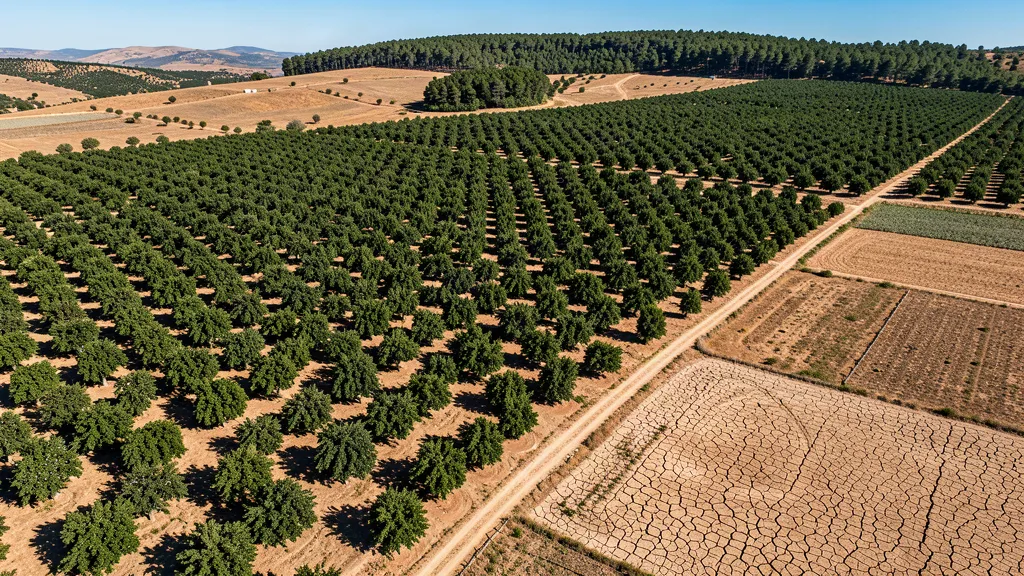
The landscape has mutated accordingly. The slopes that for centuries supported rain-fed olive and almond trees now show perfect rows of evergreen trees, with drip irrigation systems snaking between the roots. The valleys that once hosted century-old cherimoya trees have been uprooted to make way for more profitable avocado varieties such as Hass and Bacon. The greenhouses of neighboring Almería have exported their intensive agriculture model eastward, adapting it to a crop that requires between 1,000 and 1,500 liters of water per kilo of fruit produced.
The substitution has not been neutral. The loquat, which occupied around 4,000 hectares in the Axarquía region at the turn of the century, has seen its presence reduced to less than half. The cherimoya, once the emblem of the Granada coast, survives on about 2,500 hectares, many of them aging and without generational renewal. Farmers who maintain these traditional crops watch with resignation as avocado prices justify the conversion of their farms, although they know that the water the new trees need is not always available.
The monoculture advances without finding a brake. Regional administrations have approved dozens of irrigation conversion files in recent years, relying on the economic profitability of the crop. Environmentalists denounce that the expansion is taking place without serious hydrological planning, and that the groundwater bodies of the Costa Tropical already show signs of overexploitation. The aquifers of the Vélez River and the Verde River, which supply most of the farms, are recording level declines that technicians describe as "concerning" in internal reports from the Southern Hydrographic Confederation.
The paradox is uncomfortable to sustain. The avocado, a fruit that in its natural habitat of Michoacán grows in humid tropical climates with rainfall exceeding 1,500 millimeters per year, is now cultivated in a region that barely receives 300 millimeters of rain annually. The difference is compensated with well extractions and water transfers, an equation that works as long as the aquifer holds out. The most veteran farmers recall that during the 1995 drought, when the wells ran dry, many avocado trees died standing. The question hanging over the current 9,400 hectares is whether the next severe drought will find the crop better prepared or simply more exposed.
The 20% growth in the 2024/2025 campaign has not been accompanied by a proportional increase in water storage capacity. The reservoirs of the province of Málaga, which total a capacity of 364 cubic hectometres, stood at 42% of capacity at the close of the hydrological year. The figures paint a scenario of structural vulnerability that official reports acknowledge with caution, while new plantations continue to occupy land on slopes where the gradient exceeds 30%, forcing earthworks that increase the risk of erosion and landslides.
The economic transformation has been, nevertheless, undeniable. The value of avocado production in Andalusia exceeds 300 million euros annually, generating direct employment for more than 8,000 workers in harvesting, sorting, and packaging tasks. The coastal towns, which lost population during the decades from 1960 to 1990, have recovered inhabitants thanks to intensive agriculture. Immigration, mostly Moroccan and sub-Saharan, has found in the avocado fields a source of seasonal income that sustains entire family economies.
The dilemma is not minor. The profitability of the crop has lifted many family farms out of poverty that previously barely survived with rain-fed farming. But the logic of monoculture, which pushes farmers to plant avocado on any available plot, has created a dangerous dependence on a single product and a single market. If the international price of avocado were to fall persistently, or if a pest affected the dominant varieties, the Costa Tropical would face a collapse similar to that suffered by other Spanish regions when their star crop ceased to be profitable.
AET technicians argue that the expansion has natural limits and that the sector is aware of the need to modernize irrigation systems and improve water efficiency. The data, however, show that the area continues to grow at a rate of 400 hectares per year over the last five years, without any moratorium or deep review of water concessions. The gap between official discourse and on-the-ground reality widens every campaign, while the green gold continues to dye the slopes that were once gray and arid in an intense green.
The Price of Land: Speculation That Drives Out the Traditional Farmer
[[PHOTO:3]]
The numbers dance in the notary offices of Motril and Almuñécar with a disarming coldness. The hectare of agricultural land on the Costa Tropical has tripled in less than a decade. The records of the Andalusian Ministry of Agriculture are stubborn: from the 20,000 euros per hectare seen in 2015, the figure has risen to the current 60,000. The figure, however, is an average that hides much higher peaks on farms with their own wells or access to water from the Rules irrigation canal, where prices can climb to 90,000 euros. The avocado, that fruit with creamy flesh that Europe devours ceaselessly, has turned the soil into a financial asset.
The mechanics are always the same. An investor, often with capital from European investment funds or fortunes from the north of the continent, locates a plot of loquat or cherimoya. The owner, a farmer who has worked that land for generations, receives an offer that multiplies the real value of his holding by three or four. The deal is closed within weeks. The new owner tears out the fruit trees that have provided shade and sustenance to the region for decades, plants Hass variety avocados, and waits. The capital gain is guaranteed: the fruit sells for prices ranging between 2.5 and 4 euros per kilo at origin, far above the 0.80 euros that loquat fetches in its best seasons.
The University of Granada report, prepared by the Department of Human Geography, documents the phenomenon with surgical precision. Between 2015 and 2023, the area dedicated to avocado in the province has grown by 40%, while that of loquat has fallen by 25% and cherimoya by 18%. The correlation is evident: what avocado gains, traditional crops lose. But the most revealing figure in the study is another: 60% of the new avocado plantations belong to owners who do not reside in the region and who have no previous connection to agriculture. They are investors who buy land like buying shares, with the difference that here the dividend is harvested and exported.
The pressure on family farms is unbearable. A farmer who grows cherimoya in the Otívar plain obtains an average return of 3,000 euros per hectare per year. His neighbor, who has sold and now works as a day laborer on the same farm that was once his, watches as the new owner makes profits of 12,000 euros per hectare with avocado. The difference is not the result of effort or innovation: it is the result of a crop that demands twice as much water and benefits from voracious international demand. The traditional farmer cannot compete. It is not a matter of technique or dedication; it is a matter of scale and capital.
Land concentration advances without meeting resistance. The large agricultural companies, many of them based in Almería or Murcia, have seen in the Costa Tropical an opportunity for expansion. They buy contiguous plots, unify them, and create holdings of 50 or 100 hectares that operate like vegetable factories. The landscape changes: the stepped terraces that for centuries hosted diversified agriculture become monotonous rows of avocados under plastic and shade netting. Agricultural biodiversity, that heritage that agronomists value as much as environmentalists, erodes at the same speed that land prices rise.
The comparative data illustrate the magnitude of the phenomenon:
| Concept | 2015 | 2023 | Change | |----------|------|------|-----------| | Average price per hectare (€) | 20,000 | 60,000 | +200% | | Avocado area in Granada (ha) | 6,700 | 9,400 | +40% | | Loquat area (ha) | 2,100 | 1,575 | -25% | | Cherimoya area (ha) | 1,800 | 1,476 | -18% | | Average avocado return (€/ha/year) | 8,000 | 12,000 | +50% | | Average cherimoya return (€/ha/year) | 3,500 | 3,000 | -14% |
The table reveals an uncomfortable reality: while avocado appreciates in value, traditional crops lose profitability even in absolute terms. The loquat, which was the king of the Granada coast in the 1990s, also suffers the effects of climate change: late frosts, increasingly frequent, decimate entire harvests. The farmer who clings to his trees watches his assets depreciate year after year, while the price of the land he stands on soars. The paradox is cruel: his soil is worth more than ever, but only if he sells it. If he wants to keep cultivating it, he is condemned to diminishing returns.
The social consequences are felt in the inland villages, those that hang from the foothills of Sierra Nevada. In Cádiar, in Murtas, in Albondón, the younger generations have stopped considering agriculture as a viable future. The children of traditional farmers study or emigrate to the city; the lands that are not sold to investors are abandoned. The sale, when it comes, is presented as a liberation: the money allows paying off debts, renovating the house, or simply living with dignity. But the transaction has a collective cost that no one accounts for: the loss of a social fabric that has defined the identity of the region.
Speculation makes no distinction between small and large owners. The retiree who owns two hectares of loquat receives the same offer as the medium-sized farmer with ten. The difference lies in the capacity to resist. The smallholder, without generational succession and with a meager pension, almost always accepts. The medium-sized farmer, with more resources, can hold out a few more years, but the pressure is constant. The intermediaries, often linked to the exporting companies themselves, know the situation of each plot and each owner inside out. They know when there is an inheritance pending settlement, when there is a mortgage tightening the screws, when there is an illness that forces a sale. Information is power, and on the Costa Tropical power translates into land.
The Andalusian administration observes the phenomenon with a mixture of complacency and concern. Complacency because the appreciation of land increases tax revenue and projects an image of economic dynamism. Concern because the concentration of land in the hands of large companies reduces social cohesion and generates tensions in a territory that already suffers extreme water stress. The urban planning schemes, drafted in the 1990s, did not contemplate this transformation. The regulations governing crop changes are ambiguous and are applied with disparate criteria depending on the municipality. The result is a legal vacuum that favors the strongest.
Meanwhile, the price of land continues to rise. The farmers who resist, those who still cultivate loquat or cherimoya on their plots, watch their world shrink. It is not just an economic matter: it is a matter of identity. The Costa Tropical has been for centuries a mosaic of crops adapted to the conditions of each valley, each hillside. That mosaic is becoming an avocado monoculture, and with it is lost a know-how, a way of life, a way of understanding the relationship with the land. The green gold has a price, and it is not paid only in euros.
Water consumption: one avocado, 200 liters, and an aquifer under threat
[[PHOTO:4]]
The figure hits like a sledgehammer: 200 liters per kilo. The Food and Agriculture Organization of the United Nations (FAO) calculates it that way, and on the Costa Tropical that equation translates into unsustainable pressure on a resource that cannot be seen but is being depleted beneath the feet of the greenhouses and terraced plantations. It is not the fruit itself that devours the water, but the biological machinery that sustains it: a mature avocado tree in full production can require more than 60 liters per day during the months of highest water demand. Multiply that by the 9,400 hectares stretching between Málaga and Granada, and the result is a deficit that no longer allows for half measures.
The aquifers of the Bajo Guadalhorce and the Vélez River, the two great underground reserves that feed the coastal strip, are under threat. Data from the report Costa Tropical: Crisis del agua, prepared by environmental groups, indicate that 80% of the water extracted from these systems goes to subtropical crops. The remaining 20% must be shared between urban supply, irrigation of other traditional crops, and maintaining the ecological flows of the rivers. The balance is so skewed that water table levels are dropping at a rate of two meters per year. Two meters. Every twelve months. With nothing and no one stopping that silent hemorrhage.
Overexploitation is not a future hypothesis but a reality that has already claimed victims. During the summer of 2023, farmers in the region went up to 100 days without being able to irrigate. It was not a voluntary decision or a strike: it was the direct consequence of wells simply giving out. When the groundwater level drops below the intake elevation, pumps suck air instead of liquid, and irrigation becomes impossible. That technical drought—not a meteorological one—left thousands of hectares of avocado and mango on the brink of collapse, with trees losing leaves and fruit due to water stress.
Ecologistas en Acción has been warning about this dynamic for years. Their measurements, carried out in collaboration with neighborhood associations and citizen platforms, paint a picture that public administrations are slow to acknowledge. Coastal aquifers also suffer an added problem: marine intrusion. When too much freshwater is extracted, the sea takes advantage of the empty spaces to seep inland, salinizing the wells and making the water useless for irrigation. It is a vicious cycle: the more water that is taken out, the saltier what remains becomes, and the more water is needed to wash the salt accumulated in the soil. A labyrinth from which it is difficult to escape without serious hydrological planning.
| Indicator | Data | Source | |-----------|------|--------| | Water needed per kilo of avocado | 200 liters | FAO | | Annual decline in aquifer levels | 2 meters | Ecologistas en Acción | | Days without irrigation in summer 2023 | Up to 100 days | Report Costa Tropical: Crisis del agua | | Extracted water destined for subtropical crops | 80% | Report Costa Tropical: Crisis del agua | | Avocado surface area in the region | 9,400 hectares | Junta de Andalucía |
The paradox is that this production model, which generates wealth and employment in a region traditionally plagued by unemployment, rests on a resource that is not billed at its real cost. Groundwater is extracted with barely any control, with legal and illegal wells competing for the same aquifer. The Confederación Hidrográfica del Guadalquivir, the competent body for the basin, acknowledges that the number of irregular extractions far exceeds authorized ones, but on-the-ground inspection is insufficient. Meanwhile, farmers who comply with the law watch their non-compliant neighbors extract more water, at lower cost, and with greater profit. Unfair competition thus becomes a perverse incentive for overexploitation.
The debate is not new, but it has acquired unusual urgency in recent years. The expansion of avocado has been so rapid that water infrastructure has not been able to keep pace. Irrigation ponds, designed to store water during periods of abundance, are insufficient to cover summer demand. Transfers from other basins, such as the Guadiaro-Majaceite, have limited capacity and depend on rainfall in other areas. And desalination, sometimes presented as the definitive solution, remains an expensive and energy-intensive option that few farmers can afford.
The result is a crop that, in economic terms, is extraordinarily profitable—a kilo of avocado can fetch prices of up to 4 euros at origin—but that, in environmental terms, leaves a bill no one wants to pay. Environmentalists insist that the solution lies in a moratorium on new plantings, regularization of illegal wells, and the implementation of more efficient irrigation systems. Farmers, for their part, demand investment in infrastructure and water management that does not leave them in the lurch. Between the two sides, the aquifer keeps dropping two meters every year, and the Costa Tropical is teetering on the edge of a precipice from which there is no turning back.
The 2024/2025 campaign: rains that save the harvest but ruin the mango
[[PHOTO:5]]
The winter of 2024 will go down in the memory of Costa Tropical farmers as the winter of contradictions. The torrential rains that fell between November and February on the provinces of Málaga and Granada refilled reservoirs that had been pitifully low for years and brought back to life aquifers that engineers had written off. The State Meteorological Agency (AET) estimates that avocado production grew by 20% in this 2024/2025 campaign. In absolute terms, the figure is a relief for a sector that had come off two years of severe drought. But water, when it arrives, does not understand calendars or commercial needs.
The problem was not the quantity, but the distribution. The rainfall was concentrated in violent episodes, the kind that saturate the soil within hours and force tractors to stay in the shed. The mango, more delicate than the avocado and with a much narrower harvest window, has been the collateral victim. The Association of Mango and Avocado Producers of the Costa Tropical puts losses at up to 15% on some farms. It is not that the fruit has been lost entirely, but that quality has dropped: blemishes on the skin, pulp with less firmness, and irregular ripening that complicates its placement in European markets, where the aesthetic standard is unforgiving.
| Indicator | 2023/2024 Campaign | 2024/2025 Campaign (estimate) | Variation | |-----------|-------------------|-------------------------------|-----------| | Avocado production (tonnes) | 42,500 | 51,000 | +20% | | Quality losses in mango (% of harvest) | 4% | 15% | +11 p.p. | | Accumulated winter precipitation (litres/m²) | 98 | 412 | +324% | | Reservoir levels in the basin (capacity) | 31% | 68% | +37 p.p. | | Average delay in avocado harvest (days) | 5 | 18 | +13 days |
The numbers in the table paint an uncomfortable paradox. While the reservoirs of the Andalusian Mediterranean basin have gone from 31% of capacity to nearly 68%, the farmers who depend on those same resources to irrigate their trees now face a logistics and market problem. The average delay in avocado harvesting has soared to 18 days. The farms, waterlogged for weeks, did not allow machinery or laborers through. And when they finally could get in, the fruit had reached a ripeness point that does not always match what the buyer demands.
The phrase circulating through the warehouses of Motril and Almuñécar is vivid: "it never rains to everyone's liking." Farmers repeat it with a mix of resignation and dark humor, aware that just twelve months ago they were begging for every drop. The 2023 drought left images of trees with wilted leaves and wells that brought up sand instead of water. Now, with the aquifers recharged, the problem is different: excess moisture has favored the appearance of fungi on the mango, especially anthracnose, which attacks the fruit's skin and leaves it unusable for export.
The avocado, more resistant, has weathered the onslaught better. But it has not come out unscathed. Excess water in the soil during flowering has caused flower drop in some varieties, which could affect next year's production. Cooperative technicians speak of a "rebound effect": this campaign's record harvest could be mortgaging part of the next one. The trees, subjected to a water stress opposite to the usual one, have prioritized vegetative growth over reproductive growth.
The situation has sparked an internal debate within the sector. Some argue that torrential rains are a one-off phenomenon and that the priority remains guaranteeing water for irrigation in summer. Others, more critical, point out that dependence on a crop as sensitive to humidity as the mango is a risky bet in a context of climate change where extreme events will become increasingly frequent. AET data suggest that winters in the Andalusian Mediterranean basin will be drier on average, but with more intense precipitation peaks. In other words, more water in less time, exactly what fruit tolerates worst.
Meanwhile, agricultural insurance companies have begun receiving the first claims. The assessments are dragging on because the damage is not uniform: some farms have negligible losses, while on others the mango has been left practically unusable. The difference is determined by altitude, plot orientation, and above all, soil drainage. The most modern plantations, with drainage systems installed, have held up better. The older ones, those put in hastily during the boom, have suffered more.
The 2024/2025 campaign will, in any case, leave an uncomfortable lesson for the Costa Tropical. Water, that resource that for years was the center of all demands, has shown that it can also be a problem when it arrives in excess. Farmers know this and accept it with the philosophy of those who work at the mercy of the sky. But technicians warn: if the pattern of torrential rains becomes established, plantations will need to be redesigned, investments made in drainage, and a rethink of which mango and avocado varieties are truly viable on this land. The green gold, in the end, also comes with a price in the form of uncertainty.
The New Investors: Who Is Behind the 'Green Gold'
[[PHOTO:6]]
The commercial registries of Granada and Málaga hold the trace of a silent but relentless change of ownership. Between 2015 and 2023, the number of limited companies dedicated to the cultivation of tropical fruits skyrocketed on the Costa Tropical, and not precisely at the initiative of lifelong farmers. The El Salto report, published in 2023, quantifies the phenomenon with a figure that stings in the bars of Motril: 30% of new avocado plantations belong to companies created after 2015 with non-agricultural capital. That is, money that does not come from the countryside, but from offices, investment funds, and real estate developments.
The profile of the new owner has nothing to do with the grandfather who planted cherimoya trees in the 1970s. They are British and German investment funds, attracted by a profitability that they cannot find in Northern Europe either in real estate or in government debt. There are also real estate entrepreneurs from the Málaga and Granada coast who have seen in the avocado a natural extension of their business: buy cheap land, transform it into a high-yield plantation, and sell or lease it to large European distributors. The circuit is always the same: acquisition of dry-farm estates or declining traditional crops, conversion to avocado with its corresponding drip irrigation infrastructure, and subsequent placement on the market as a financial asset.
The operations have names and surnames in public registries. Companies such as Tropical Green Investments SL, incorporated in 2017 with a share capital of €3,000 and a corporate purpose ranging from the purchase and sale of estates to investment portfolio management, today control dozens of hectares between Almuñécar and Salobreña. Or Costa Avocado Capital, registered in 2019, whose sole director also appears as a board member of a real estate developer in Marbella. These are not isolated cases: the pattern repeats in at least twenty companies identified by the report's researchers, all with registered offices in offices in Málaga city or Madrid, none in the towns where the plantations are located.
The effect on land prices has been immediate and devastating for the traditional farmer. A hectare of avocado in production, which in 2015 was trading at around €60,000, has reached as much as €180,000 in the most sought-after areas of the Granada coast. The farmer who wants to expand his holding, or the young person who aspires to take over the family farm from his father, finds that the land is worth three times more than a decade ago, and that the one bidding for it is not the neighbor of the adjacent plot, but an investment fund that calculates returns in years, not generations.
The speculative bubble also has a geographic component. Investors do not buy just any land: they seek plots with guaranteed access to water, preferably those located in the lower elevations of the Motril-Salobreña aquifer or near the canalizations of the Guadalfeo River. That selectivity has created a two-speed market: farms with consolidated irrigation rights are paid at a premium, while dry-farm plots, which a decade ago had some value for olive or almond cultivation, have been practically excluded from the market. The result is additional pressure on water resources, because the new investor does not buy land: he buys water.
European distributors play a key role in this machinery. German and British supermarket chains, under pressure from their consumers regarding carbon footprint and traceability, have established long-term supply contracts with these investment companies. The typical agreement guarantees the purchase of production for ten to fifteen years at a fixed price, turning the plantation into a financial asset with predictable cash flow. That contract, in turn, serves as collateral to obtain bank financing to cover the initial investment. The circle closes: the fund buys the land, plants it, signs the contract with the distributor, obtains the loan, and repeats the operation on the next farm.
| Indicator | 2015 | 2023 | Change | |-----------|------|------|--------| | Hectares of avocado in Granada | 4,200 | 6,800 | +61.9% | | Average price per hectare (€) | 60,000 | 180,000 | +200% | | % of new plantations in non-agricultural companies | 8% | 30% | +22 points | | Registered tropical limited companies | 14 | 47 | +235% | | Aquifer water consumption (hm³/year) | 18 | 27 | +50% |
Source: Own elaboration based on data from the Junta de Andalucía, the El Salto report (2023), and commercial registries.
The question floating around the assemblies of irrigation communities is whether this model has a future or whether, as happened with real estate in 2008, the house of cards will eventually collapse. The most optimistic point out that global demand for avocado continues to grow and that the Costa Tropical has an undeniable competitive advantage: it produces in a time window in which Mexico and Peru, the world's largest exporters, have no supply. The most pessimistic recall that water is not an infinite resource and that the Motril-Salobreña aquifer already shows signs of overexploitation, with marine intrusion detected in the wells closest to the coast.
Meanwhile, the investment companies keep buying. In the last twelve months, at least six purchase transactions of farms larger than ten hectares have been registered in the region, all with foreign capital. Local notaries confirm that the pace has not slowed, although some are beginning to warn their clients of the risks of paying such high prices for a crop that depends on an increasingly scarce resource. But the warning usually falls on deaf ears: as long as the kilo of avocado is paid at three euros on the European market, the green gold will continue to attract those seeking quick returns without caring about the landscape they leave behind.
The traditional farmer: between profitability and loss of identity
[[PHOTO:7]]
The afternoon falls over the Motril plain, and Antonio, 67 years old, scans with his gaze a plot he no longer recognizes as his own. A decade ago, this piece of land supported loquat trees his father planted in the sixties and a row of cherimoya trees he himself grafted when he came of age. Today, the gray, twisted trunks of avocado trees line up in regular grids, like soldiers in formation, and the drip irrigation hisses at regular intervals. Antonio is not an isolated case: he is statistics made flesh.
The data handled by the Association of Farmers of the Costa Tropical paints a transformation that admits no half measures. Between 2010 and 2023, the area dedicated to avocado in the provinces of Granada and Málaga tripled, while that of loquat, the region's flagship crop, was cut in half. Mango, which seemed destined to be the generational replacement, has been relegated to a secondary role: its profitability per hectare, around 6,000 euros, pales in comparison to the 10,000 euros a well-managed hectare of avocado can generate.
| Crop | Average profitability (€/ha) | Water needed (m³/ha/year) | Area in 2010 (ha) | Area in 2023 (ha) | Change | |---------|---------------------------|---------------------------|------------------------|------------------------|-----------| | Avocado | 10,000 | 7,500 | 3,100 | 9,400 | +203% | | Mango | 6,000 | 4,200 | 1,800 | 2,100 | +16% | | Loquat | 4,500 | 3,800 | 2,400 | 1,200 | -50% | | Cherimoya | 3,800 | 3,500 | 1,600 | 700 | -56% |
The table does not lie: avocado has devoured the agricultural landscape of the Costa Tropical. But what the figures do not capture is the human cost of this transition. The testimonies collected by the association reveal a generational fracture that threatens to empty the countryside of its last guardians. Young people, the report says, abandon family farms because they see no future in crops that do not reach the profitability threshold that modern life demands. The older generation, for their part, watch how their farms become avocado monocultures, losing the variety that for generations defined the agricultural identity of the region.
There are those who resist. In the upper part of the plain, where water is scarcer and the slope complicates mechanization, plots of cherimoya remain like islands in a sea of avocados. Their owners, mostly farmers over 60, argue that diversity is a form of insurance: if the avocado market collapses or environmental regulations restrict irrigation, traditional crops will still be there, waiting for their moment. But this resistance comes at a price. Income is lower, labor is scarce, and local cooperatives, which once marketed a dozen different products, now depend on a single fruit to fill their warehouses.
The pressure is not only economic. Farmers who have chosen avocado face a moral dilemma that few acknowledge in public: they have torn out the trees their grandparents planted to sow a variety they did not know twenty years ago. Some justify it by necessity: without avocado profitability, the family farm would not have survived the 2008 crisis or the 2022 drought. Others lament it in private, aware that they have contributed to a process they themselves describe as "the slow death of our agricultural culture."
The Association of Farmers of the Costa Tropical has tried to mediate in this internal conflict without success. Its proposals to create a designation of origin for loquat or to subsidize the conservation of native varieties have collided with market reality: European supermarkets pay more for avocado than for any traditional fruit of the region. And the banks, which finance the conversion of farms, demand guarantees that only avocado can offer.
The result is a region that looks in the mirror and does not recognize itself. The terraces that once showed a mosaic of different greens — the silvery green of loquat, the intense green of cherimoya, the light green of mango — are now a monochrome of avocados. The towns, which lived by the agricultural calendar marked by each harvest, have lost their harvest festivals and their local produce markets. Identity, that word farmers repeat with a mixture of nostalgia and resignation, has become a luxury few can afford.
Meanwhile, those who resist know their battle is unequal. Avocado profitability, which in boom years has reached 3.5 euros per kilo at origin, is too powerful a magnet. And the pressure of new investors, who buy entire farms to turn them into intensive plantations, pushes traditional farmers into an impossible dilemma: sell or tear out. In both cases, the result is the same: the loss of a heritage measured not in euros, but in memory.
The question hanging over the Costa Tropical is not whether avocado will continue to expand — the data says it will — but what will remain when the boom stabilizes. The older farmers, those who still remember the taste of a loquat freshly picked from the tree, are a dying breed. And with them will go a knowledge that is not learned in agronomy manuals: knowing when to irrigate without looking at the rain gauge, how to prune a cherimoya tree so it bears fruit in a drought year, which soil is good for mango and which is not. That knowledge, passed from parents to children for generations, has no place in the logic of monoculture. And its loss, the most clear-sighted warn, will be irreversible.
Ecologists in Action: the avocado as an ecological threat
[[PHOTO:8]]
The report by Ecologists in Action titled 'Costa Tropical Málaga and Granada: Water crisis: intensive avocado and mango crops' is not a minor document. Its 47 pages condense years of ignored warnings and turn into data what residents of the region have been observing from their windows for a decade: the landscape has been dyed emerald green, but the subsoil is cracking.
The document, presented last autumn, dismantles the narrative of the "subtropical miracle." The ecologists do not dispute the economic profitability of the avocado; they dispute its ecological bill. And that bill, according to their measurements, is paid in three currencies: water, soil, and biodiversity.
The invisible drain: aquifers at critical lows
The first complaint is the most serious and the least visible. The expansion of avocado farming has turned the Costa Tropical into a giant sponge sucking up underground resources. The water bodies of the Río Verde hydrogeological unit, the most exploited in the area, show a "poor" quantitative status according to the latest reports from the Junta de Andalucía. The ecologists go further: they claim that extraction exceeds the aquifer's natural recharge by 40% in dry years.
The figure is devastating when compared to the situation two decades ago. In 2004, the piezometric level of the Vélez-Málaga aquifer stood at an average depth of 12 meters. Today, the deepest boreholes in the area — some drilled illegally — reach 60 meters without finding fresh water. Saltwater intrusion, that silent phenomenon by which the sea penetrates overexploited aquifers, has already contaminated several wells in the coastal strip between Nerja and Almuñécar.
| Indicator | 2004 | 2024 | Change | |-----------|------|------|-----------| | Average aquifer level Vélez-Málaga | 12 m | 38 m | -216% | | Irrigable area with groundwater | 4,200 ha | 2,100 ha | -50% | | Wells with detected saltwater intrusion | 3 | 27 | +800% | | Hectares of avocado in Málaga and Granada | 3,800 | 9,400 | +147% | | Estimated avocado water consumption (hm³/year) | 38 | 94 | +147% |
The table reflects a perverse equation: while the avocado surface area has multiplied by two and a half, the aquifers' real capacity to sustain that growth has been reduced by half. The result is a structural water deficit that not even the torrential rains of winter 2024 have been able to alleviate, because runoff water does not infiltrate soil sealed by plastic and compaction.
The slope that slips: erosion and landslides
The second complaint in the report has a physical dimension that can be touched. The felling of riparian forests and the clearing of slopes with gradients exceeding 30% — something prohibited by Andalusian regulations — have triggered erosion processes. The ecologists document at least 14 significant landslides between 2019 and 2024 in the basins of the Verde, Seco, and Guadalmanza rivers.
The mechanism is well known: the roots of native trees — carob trees, wild olive trees, holm oaks — acted as a natural armor for the terrain. When replaced by avocado trees, whose root system is shallow and does not exceed 60 centimeters in depth, the slopes lose their anchorage. When torrential rains arrive, the water saturates soil that no longer has anything holding it in place. The result was seen in December 2024 in Ítrabo: 200,000 cubic meters of earth and stones buried a county road and two avocado farms.
Erosion does not only affect the upper areas. The sediment carried downstream silts up the Rules and La Viñuela reservoirs, reducing their storage capacity. The Rules reservoir, built in 2004 with a capacity of 113 hm³, has already lost 12% of its useful volume due to siltation. Every ton of soil lost on the slopes is a ton that will never be productive again and that, moreover, steals space from the water the region needs.
The chemical cocktail: fertilizers that poison the aquifer
The third pillar of the report addresses diffuse pollution. Avocado is a nutrient-demanding crop, and the pursuit of maximum yields has led to intensive use of nitrogen fertilizers and pesticides. Groundwater analyses conducted by the ecologists in collaboration with independent laboratories detect nitrate concentrations exceeding 50 mg/l — the legal limit for human consumption — at 11 of the 23 sampling points in the region.
The problem is not only nitrate. The ecologists have identified residues of chlorpyrifos and metalaxyl, two fungicides banned in the European Union since 2020, in three coastal aquifers. Their presence suggests that part of the crop is maintained with illegal products, stored from previous years or introduced through parallel channels. The contamination affects aquatic biodiversity — native amphibians have disappeared from two coastal wetlands — and compromises the health of marine ecosystems, which receive the leachates through aquifers connected to the sea.
The institutional response has so far been insufficient. The Junta de Andalucía declared the area a "water body at risk" in 2022 but has not yet approved the action plan required by the Water Framework Directive. Meanwhile, the ecologists demand a moratorium on new plantings, the closure of illegal wells — they estimate there are more than 300 unregulated ones — and the restoration of the felled riverbanks.
The conflict is not between agriculture and the environment, the report's authors clarify. It is between a model of intensive agriculture that externalizes its environmental costs and the capacity of a territory to sustain its own future. The Costa Tropical today produces the cheapest avocado in Europe, but that price does not include the bill for erosion, salinization, and biodiversity loss. That bill, they warn, will arrive with interest.
The water footprint of avocado: a comparison with other crops
[[PHOTO:9]]
One thousand liters per kilo of fruit. That is the amount of water that the Water Footprint Network attributes to avocado grown under water-deficit conditions. The figure, cold and stark, takes on its true dimension when placed alongside that of its neighbors in the field. The loquat, that spring fruit that for decades was a hallmark of the Granada coast, makes do with 300 liters per kilo. The mango, the other major tropical fruit sharing the spotlight in the area, needs 400. The difference is not a nuance: it is an abyss.
| Crop | Water footprint (liters per kilo) | Irrigation needs on the Tropical Coast | |---------|----------------------------------|----------------------------------------| | Avocado | 1,000 | Intensive, year-round | | Mango | 400 | Seasonal, with peaks in summer | | Loquat | 300 | Moderate, supplementary to rainfall | | Cherimoya | 350 | Moderate, adapted to partial dry farming |
The average annual rainfall on the Tropical Coast is around 300 millimeters. To put that in perspective: it is less than half of what falls in Seville and a third of what Santiago de Compostela receives. On land that receives such scarce rainfall, each hectare of avocado requires approximately 5,000 cubic meters of water per year. That means that, in practice, the crop depends almost entirely on artificial irrigation. There is no margin for rain: avocado needs constant water, month after month, without the tree experiencing water stress.
The comparison with traditional crops is beyond dispute. The University of Almería study on adapting crops to semi-arid zones notes that native species or those acclimatized over centuries have developed mechanisms to survive on the bare minimum. The loquat, for example, concentrates its water demand during the fruit-fattening months and withstands the rest of the year with supplementary irrigation. The olive tree, although not a leading crop in this area, survives on less than half the water an avocado needs. The structural difference is that traditional crops adapted to the climate; avocado demands that the climate adapt to it, and when the climate does not give in, aquifers are tapped.
The Water Footprint Network data does not distinguish between water that falls from the sky and water extracted from the subsoil. But in practice, the distinction is crucial. In an area where rainfall barely reaches 300 liters per square meter per year, the 5,000 cubic meters per hectare that avocado demands come, in the vast majority, from wells and boreholes. It is fossil water, accumulated over centuries, extracted at a rate far exceeding its natural recharge.
The consequence is measured in the overexploitation of groundwater bodies. The aquifers of the Granada and Málaga coasts show declining levels year after year. This is not a perception: it is a trend reflected in the reports of the Guadalquivir Hydrographic Confederation and the Junta de Andalucía. Meanwhile, the area dedicated to avocado continues to grow, replacing crops that needed less water and that, paradoxically, generated more evenly distributed employment throughout the year.
The sustainability of avocado on the Tropical Coast is not a problem of irrigation technology. Drip systems are widespread and water application efficiency is high. The problem is fundamental: the crop requires a volume of water that the area cannot naturally provide. Efficiency can be improved, but water cannot be manufactured where there is none. The 1,000 liters per kilo of avocado is an average that could be reduced with more precise techniques, but never to the levels of loquat or mango.
The debate is not new. Already in the 1980s, when the first farmers bet on avocado on the Granada coast, there were voices that warned of the problem. But the price of the fruit on the European market, which has at times tripled that of traditional crops, silenced the warnings. Today, with aquifers in critical condition and irrigation restrictions increasingly frequent, the question hanging over the fields is whether the green gold will remain profitable when water truly begins to be rationed.
The answer is not simple. Avocado generates wealth, employment, and an economic fabric that has lifted many families out of crisis. But it does so on an unsustainable water basis. Traditional crops, with their lower water footprint, represent a more environmentally respectful alternative, but also a less lucrative one. The dilemma between profitability and sustainability has no easy solution, and in the meantime, the water level in the aquifers keeps dropping.
The data from the University of Almería suggests that the solution lies in diversifying and limiting avocado acreage to areas where water is more abundant or where reclaimed water can be reused. But that is a political decision that, so far, no one has made with the necessary resolve. In the meantime, the avocado's water footprint remains the highest of all crops on the Tropical Coast, and the gap with traditional crops only continues to widen.
The impact on the landscape: terraces, slopes, and biodiversity loss
[[PHOTO:10]]
The change is noticeable before reaching the road. Where the slope used to be terraced with dry stone walls to hold olive or almond trees, now the hillside is stripped bare into vertical cuts of reddish earth, crossed by black drips that snake between rows of low, shiny trees. The aerial photograph of the Costa Tropical from 1995, compared with that of 2024, shows a mosaic that has shifted from grayish green to an intense, uniform green that climbs up the ravines as far as the terrain allows. It is not natural vegetation: it is avocado.
Data from the Physical Geography research group at the University of Malaga quantifies what the eye already perceives. The area dedicated to this crop in the provinces of Malaga and Granada has grown by 300% since 2000. The growth has not occurred in the fertile plains, already occupied, but on mid-mountain slopes, on land historically used for dry farming or pasture. The average slope of the new plantations exceeds 25%, a threshold that agricultural engineering manuals advise against for herbaceous crops and which, in the case of avocado, requires a radical transformation of the terrain profile.
The problem is not merely aesthetic. The traditional terracing technique, which for centuries made it possible to cultivate on slopes in the Mediterranean, has been abandoned in much of the new operations. The avocado, a tree with shallow roots and a dense canopy, is now planted on slopes without terraces, with the land simply cleared and leveled with heavy machinery. The consequence is predictable: without the containment of stone walls, torrential rain, typical of the Mediterranean climate, washes the bare soil down into the ravines. The cold drop episodes of 2018 and 2021 left eloquent images: roads cut off by mudslides coming directly down from newly planted avocado plots.
Erosion is not the only cost. Clearing native vegetation to prepare the land has fragmented habitats that were already under pressure. The University of Malaga study documents the disappearance of ecological corridors that connected the coastal mountain ranges with the interior. Species such as the Iberian lynx, which in recent years had recolonized areas of the Sierra de Almijara, and the Bonelli's eagle, which nests on rocky cliffs, have seen their hunting territory reduced. Avocado plantations, with their dense canopy and constant irrigation, offer neither refuge nor food to native fauna. From an ecological point of view, they are a green desert.
| Indicator | 2000 | 2024 | Change | |---|---|---|---| | Avocado area in Malaga and Granada (ha) | 2,350 | 9,400 | +300% | | Average slope of new plantations | <10% | >25% | +15 points | | Iberian lynx habitat area affected (ha) | 0 | 1,200 | New impact | | Bonelli's eagle hunting territory (km²) | 45 | 28 | -38% | | Dry stone walls in use (linear km) | 1,800 | 650 | -64% |
The comparison with other subtropical crops in the region, such as mango, reveals that avocado requires the greatest transformation. Mango tolerates slopes better and requires less earthmoving. Avocado, on the other hand, needs nearly flat terrain to facilitate drip irrigation and harvesting. The practical difference is that one hectare of avocado on a slope involves moving between 3,000 and 5,000 cubic meters of earth, while one hectare of mango barely requires 500. That is the geomorphological footprint visible from the sea: slopes that look like recent scars, with the color of the disturbed earth still visible.
Environmentalists have conveyed their concerns to the authorities. The specific proposal is a moratorium on new plantations on land with slopes greater than 15% and the obligation to restore dry stone terraces in existing operations. The institutional response has been uneven. The Junta de Andalucía has approved regulations limiting new wells, but has not addressed the landscape issue. The coastal municipalities, pressured by the employment the sector generates, look the other way. Meanwhile, the machinery continues working on the slopes of Ítrabo, Otívar, or Jete, where avocado advances uphill, consuming the scrubland and the remaining holm oak groves.
Biodiversity loss is not limited to large species. Field studies conducted in avocado plots in the Axarquía region show a drastic reduction in wild pollinators, insectivorous birds, and reptiles. The intensive use of phytosanitary products and the uniformity of the crop create an impoverished ecosystem. Compared to an avocado slope, biodiversity is reduced to a handful of tolerant species: some grasses, ants, and, at best, rabbits that slip through the perimeter fences.
The question floating around neighborhood assemblies and technical offices is whether this model of transformation is reversible. Dry stone terraces, once destroyed, are difficult to rebuild. Fertile soil, washed out to sea, does not recover in decades. And the avocado, once planted, has a productive life of 30 to 40 years. Whoever decides to plant today is committing the coastal landscape for an entire generation. Data from the University of Malaga suggests that, at the current rate of conversion, by 2035 there will be no uncultivated slopes left in the coastal strip from 0 to 300 meters in altitude. The moratorium environmentalists are calling for is not a conservationist whim: it is a pause to assess whether the green gold is worth the price being paid in soil, water, and biodiversity.
The global market: European demand and export dependence
[[PHOTO:11]]
The port of Algeciras never sleeps. Among its cranes, containers full of Andalusian avocado wait for the next tide toward northern markets. The crossing takes less than 48 hours to Rotterdam, and from there, the fruit is distributed to the German, French, and British supermarket chains that have turned breakfast with avocado toast into a status symbol of the European middle class.
80% of the Costa Tropical's production crosses the border. That is what the records of the province's Exporters Association show. Germany, France, and the United Kingdom absorb most of that flow, with an appetite that seems to have no ceiling. European demand for avocado has tripled in the last decade, and Spain, with its climatic advantage and geographic proximity, has managed to occupy a privileged position in that logistics chain.
But that position comes at a price. Dependence on the foreign market turns the coast's farmers into secondary players on a global board they do not control. When the international price of avocado falls at the Amsterdam auction, the news is felt in the cooperatives of Motril before the week is out. When the European Commission negotiates a trade agreement with Mercosur, local producers hold their breath: they know that South American avocado entering with reduced tariffs could reshape the market within months.
| Indicator | Costa Tropical (Spain) | Mexico | Peru | Chile | |-----------|------------------------|--------|------|------| | Production cost per kg (approx.) | €1.20 – €1.50 | €0.60 – €0.80 | €0.70 – €0.90 | €0.80 – €1.00 | | Average distance to European market | 1,500 km | 9,000 km | 10,500 km | 11,500 km | | Maritime transit time | 2 days | 12-15 days | 18-20 days | 20-25 days | | EU market share (2023) | 12% | 38% | 22% | 15% | | Water consumption per kg produced | 1,000 liters | 1,500 liters | 1,200 liters | 1,100 liters |
The table above paints an uncomfortable reality. Mexico produces avocado at nearly half the Andalusian cost, with higher yields per hectare and a scale that Spain cannot match. Peru has multiplied its exports over the last decade thanks to massive investments in irrigation infrastructure on the desert coast. Chile, with a more mature industry, competes in the southern hemisphere market window, when Spanish production is scarce.
The Costa Tropical's competitive advantage does not lie, therefore, in price. It lies in freshness. An avocado picked in Vélez-Málaga can be on a shelf in Munich in less than a week. The Mexican fruit, by contrast, needs nearly a month of maritime transit, which forces it to be harvested at an earlier stage of ripeness and subjected to cold treatments that, according to importers, affect the final organoleptic quality.
That logistics advantage, however, does not automatically translate into better prices for the farmer. The pressure of global supply keeps farm-gate prices at levels that barely cover production costs in years of abundant harvests. Local producers thus find themselves trapped in a perverse dynamic: to maintain their margins, they need to produce more, and producing more means intensifying cultivation, increasing planting density, and above all, irrigating more.
Intensification is not a choice but an imposition of the market. The varieties most in demand by European consumers, such as Hass, require a constant water supply throughout the year. Unlike the olive grove, which can withstand long periods of drought, avocado is a crop that allows no respite: if the tree does not receive water at the critical moment of flowering, the following year's harvest suffers. That physiological rigidity clashes head-on with the climatic reality of a region that has recorded the driest summers in its recent history.
European trade policy adds another layer of uncertainty. The free trade agreements that the EU has signed with Latin American countries include growing quotas of avocado at zero tariff. The agreement with Mercosur, currently in the ratification process, contemplates the entry of 100,000 additional tons of avocado from Brazil and Argentina. That figure is equivalent to more than double the annual production of the Costa Tropical. If the agreement materializes, farm-gate prices could fall between 15% and 20%, according to estimates from agricultural organizations.
Andalusian exporters are trying to diversify. The emerging markets of northern Europe, such as the Nordic countries, show sustained consumption growth. Value-added niches are also being explored: certified organic avocado, premium varieties with designation of origin, or processed formats such as refrigerated guacamole that allow capturing greater margins. But these strategies have a limit: the European consumer remains price-sensitive, and the difference between an Andalusian avocado and a Peruvian one on the supermarket shelf rarely exceeds 30 cents.
Export dependence also conditions the capacity to respond to health or geopolitical crises. Brexit, for example, introduced phytosanitary and customs barriers that made exporting to the United Kingdom more expensive, one of the three main destinations for Spanish avocado. Producers had to absorb that extra cost in their margins to avoid losing a market that represents around 20% of foreign sales.
In the cooperatives on the coast, there is talk of the need for a change of model. Some propose creating a collective brand that differentiates Andalusian avocado by its origin and its lower carbon footprint. Others advocate creating a reference market that provides more transparency in price formation. But all these initiatives collide with a structural reality: Andalusian production represents barely 12% of the European market, a volume insufficient to exert influence over international prices.
Meanwhile, the avocado keeps leaving every morning from the farms of the Costa Tropical toward the ports of Motril, Málaga, and Almería. The trucks load the day's harvest bound for the sorting warehouses, where the fruit is selected, calibrated, and packed according to the standards demanded by European distribution chains. That logistics machinery operates with millimeter precision, but it depends on a fragile balance: the international price, European trade policy, South American competition, and above all, the water that comes from the region's wells.
The question hanging over the avocado plots is not whether the European market will continue to demand this fruit. Demand seems assured in the medium term. The question is whether the Costa Tropical can sustain that export pace without exhausting the resource that makes it possible. Because the water that irrigates the avocados exported to Germany does not stay in Germany: it evaporates into the dry coastal air, it seeps into the overexploited subsoil, it is lost to the sea. And that is a bill that no trade agreement can pay.
The structural water crisis: reservoirs, aquifers, and lack of planning
[[PHOTO:12]]
The latest report from the Automatic Hydrological Information System of the Guadalquivir Basin paints a picture of half-empty reservoirs. The reservoirs that irrigate part of the Costa Tropical stand at 30% of their capacity. This is not an isolated anomaly, but rather the snapshot of a drought that is no longer cyclical but structural. The Sierra Boyera reservoir, in the north of the province of Córdoba, appears almost dry, with its sludge exposed and a usable capacity hovering near technical zero. The image of its cracks, circulated in monitoring reports, has become the symbol of a management response that came too late.
The paradox is that while reservoirs lose their reserves, the area dedicated to avocado cultivation continues to grow. The Andalusian Regional Government has not implemented a specific water management plan for subtropical crops. There is no document establishing maximum quotas for irrigable hectares, nor a zoning system that distinguishes between lowlands with access to surface water and hillsides that depend exclusively on groundwater. The lack of planning translates into a race to drill before the administration reacts.
The aquifers of the Lower Guadalhorce and the Vélez River show declines of up to two meters per year. These are water bodies that supply both agriculture and coastal urban centers, and their piezometric levels are falling without any official alert being activated. Ecologists in Action has repeatedly denounced that the administration has prioritized economic development over sustainability, allowing new plantings without assessing the cumulative impact. The last irrigation authorization for an avocado farm in the Axarquía region was signed when the Vélez aquifer had already been suffering overexploitation for a decade.
The situation is not homogeneous. There is a substantial difference between irrigation that depends on public infrastructure and that which is supplied by private wells. The former are subject to reservoir releases and restrictions imposed by the Hydrographic Confederation. The latter operate in a gray area where oversight is scarce and extraction is difficult to measure. Data from the Guadalquivir Basin indicate that 40% of subtropical farms in Granada are irrigated with groundwater, a percentage that rises to 60% in the province of Málaga. These are figures that the administration itself handles but which do not translate into a moratorium on new water extractions.
| Water indicator | Recorded data | Alert threshold | Status | |---|---|---|---| | Guadalquivir Basin reservoirs | 30% of capacity | 40% | Alert | | Sierra Boyera reservoir | Almost dry (minimum usable capacity) | 20% | Emergency | | Annual decline of the Lower Guadalhorce aquifer | Up to 2 meters | 0.5 meters | Overexploitation | | Annual decline of the Vélez River aquifer | Up to 2 meters | 0.5 meters | Overexploitation | | Subtropical farms in Málaga with groundwater irrigation | 60% | Undefined | High risk | | Subtropical farms in Granada with groundwater irrigation | 40% | Undefined | Medium risk |
The lack of a specific plan is not an administrative oversight. It is a political decision that has been maintained for two decades, under governments of different stripes, and that responds to the pressure of a sector that generates employment and foreign currency in one of the areas with the highest structural unemployment in Andalusia. Avocado has become the crop that sustains local economies, but also the one that depletes the resource that makes it possible. Technicians from the Guadalquivir Hydrographic Confederation have spent years warning in their internal reports that the demand for water for subtropical crops exceeds actual availability in dry years. Those reports have not translated into preventive restrictions.
The current hydrological plan, approved in 2022, contemplates a climate change scenario with reductions in water contributions of 15% for the next decade. But it does not include a specific variable for tropical crops, which are the ones that consume the most water per hectare in the entire basin. The result is a mismatch between the reality on the ground and the regulatory instruments. Meanwhile, farmers who have been in the sector for decades watch with concern how new plantings are established in areas without supply guarantees. The price of water in the informal market of the Axarquía has tripled during the summer months, an indicator that scarcity is already being managed through cost rather than through planning.
The overexploitation of aquifers not only affects the quantity of available water. The decline in levels causes marine intrusion into coastal aquifers, a phenomenon already detected in the Lower Guadalhorce. Seawater penetrates the subsoil and contaminates wells, forcing farmers to drill deeper to find fresh water, in a vicious cycle that accelerates the depletion of the resource. Analyses from the Geological and Mining Institute of Spain confirm that salinization of Málaga's coastal aquifers has increased by 30% in the last five years. Avocado crops are especially sensitive to salinity, and fruit quality suffers when irrigation water exceeds certain levels of electrical conductivity.
The lack of planning is also manifested in the absence of regulation infrastructure. While other basins have built ponds and lateral reservoirs to capture rainwater, the Costa Tropical depends on a system of canals and irrigation ditches inherited from the last century. Losses from evaporation and leaks in the distribution network are estimated at 25% of the water transported. Every summer, farmers watch the water they need be lost along the way, without any significant public investment to modernize the network.
The regional administration has opted for a patchwork strategy. Aid for irrigation modernization is announced, agreements are signed with irrigation communities, but the underlying problem is not addressed: the carrying capacity of the territory. Environmentalists insist that the question is not how much water there is, but how many avocados this land can sustain without exhausting it. The answer, according to aquifer data, is that the limit has already been exceeded.
Sustainable alternatives: can avocado coexist with dry farming?
[[PHOTO:13]]
The March sun beats down on the experimental plot that the University of Granada maintains in the Valle de Lecrín. There, a high-efficiency drip irrigation system distributes reclaimed water from the nearby treatment plant. The avocado trees, Hass variety, grow with 30% less water than on neighboring farms. Technicians measure every drop, every electrolyte, every physiological response of the tree. The first results, still preliminary, suggest that the crop can survive with fewer resources if managed with millimeter precision. But the question hanging in the air of the Costa Tropical is not technical, but structural: can a tropical crop coexist with the logic of dry farming in a region that looks toward the desert?
The agronomists' proposal is divided into three fronts. The first is irrigation modernization. The second is diversification toward woody dry-farming crops such as almond or pistachio. The third is the recovery of native mango and cherimoya varieties, genetically adapted to irregular water cycles. Each of these paths has its defenders and detractors, its numbers and its uncertainties.
| Alternative | Initial investment (€/ha) | Water consumption (m³/ha/year) | Estimated profitability (€/ha/year) | Payback period | |---|---|---|---|---| | Avocado with efficient drip irrigation | 18,000 - 25,000 | 4,500 - 5,500 | 12,000 - 15,000 | 5 - 7 years | | Avocado with reclaimed water | 22,000 - 30,000 | 4,000 - 5,000 | 11,000 - 14,000 | 6 - 8 years | | Almond in dry farming | 3,500 - 5,000 | 0 - 500 (occasional support) | 2,500 - 4,000 | 8 - 12 years | | Pistachio in dry farming | 6,000 - 8,000 | 0 - 600 | 3,000 - 5,500 | 10 - 14 years | | Native mango (local varieties) | 15,000 - 20,000 | 3,500 - 4,500 | 8,000 - 10,000 | 6 - 9 years | | Traditional cherimoya | 12,000 - 16,000 | 3,000 - 4,000 | 7,000 - 9,000 | 5 - 8 years |
The table paints an uncomfortable reality. Avocado, even with water-saving technologies, remains the crop that demands the most water and offers the highest economic return. The gap between almond and avocado is not just one of consumption, but of perception. A farmer who has watched his neighbor pay off the mortgage on his farm in five years with green gold will hardly settle for pistachio margins, which take more than a decade to recoup the investment.
The pilot project at the University of Granada, funded with European funds, has managed to reduce aquifer extraction on the plots where reclaimed water is applied. But researchers acknowledge that the scale of the problem far exceeds the capacity of current treatment plants. The Costa Tropical generates a volume of treated wastewater that would barely cover 15% of avocado water demand. The rest inevitably comes from underground.
Farmers consulted in the Vega de Motril and in the Axarquía region of Málaga show a skepticism that stems not from ignorance, but from experience. Several tried almond in the 1990s, when olive oil prices collapsed. They abandoned it. Others tried pistachio, but late March frosts, increasingly frequent due to climate change, ruined three consecutive harvests. Agricultural memory weighs more than any feasibility study.
The recovery of native mango and cherimoya varieties presents an intermediate scenario. These species, cultivated in the area since the 1970s, have developed a natural tolerance to summer drought periods that imported commercial varieties lack. However, their productivity is lower and their size does not always meet the standards required by European supermarket chains. A producer from Almuñécar sums it up bluntly: "The market pays for the big, perfect avocado, not the small, wrinkled mango that withstands thirst better."
The Andalusian administration has announced aid lines for conversion to dry-farming crops, but funds are limited and timelines are slow. Technicians at the Oficina Comarcal Agraria de Motril note that applications for almond have doubled in two years, although most interested parties are owners of marginal farms, not the large avocado producers. Conversion, for now, affects the periphery of the business, not its core.
The underlying debate is not agronomic, but political. The Confederación Hidrográfica del Guadalquivir, the competent authority for the basin, has announced a review of irrigation water concessions, but the files are piling up on desks. Meanwhile, the aquifers of the Bajo Guadalhorce and the Valle de Lecrín are losing level at a rate of two meters per year. Data from the Instituto Geológico y Minero confirm that marine intrusion has already salinized wells along the coastal strip between Nerja and La Herradura.
Coexistence between avocado and dry farming is not impossible, but it requires planning that does not exist today. It requires, on the one hand, that avocado be confined to areas with guaranteed access to reclaimed water or irrigation surplus. On the other, that dry farming cease to be seen as a refuge for losers and become a strategic bet with fair prices and stable marketing channels. Both conditions depend on decisions that transcend the individual farmer.
The pilot project at the University of Granada has shown that technology can reduce consumption, but not eliminate it. Avocado will always need water, much more than almond or pistachio. The question is not whether it can coexist with dry farming in the same territory, but whether society is willing to pay the price of that coexistence: fewer hectares of avocado, more controls, more public investment in water treatment, and a collective acceptance that unlimited growth has a physical limit.
The technicians consulted agree that the window of opportunity is narrowing. Every year that passes without an effective moratorium on new plantings, every well drilled without authorization, every hectare of olive grove torn up to plant Hass, reduces the options for an orderly transition. The alternative is not binary: it is not about choosing between avocado or dry farming, but about defining what percentage of the territory is devoted to each, with what resources, and under what rules. That decision, today, is not being made. It is being made by inertia, by the market, by greed. And the result, warn the hydrogeologists, will be an exhausted aquifer and a coast that can no longer call itself tropical.
The Future of the Costa Tropical: Between Bubble and Sustainability
The University of Malaga report does not speculate: it charts a mathematical trajectory. If the planting rate of the last five years is maintained, the avocado surface area on the Costa Tropical will reach 15,000 hectares by 2030. The figure, cold on paper, means in practice the collapse of the water system that feeds 300,000 inhabitants and a tourism industry that does not understand droughts. The region's aquifers, already declared in poor condition by the Junta de Andalucía, cannot sustain that growth without overexploitation that would deplete them irreversibly.
The dilemma is not new for a region that has lived with its back to its own geography. The Costa Tropical is, in essence, a privileged microclimate within a semi-arid environment. Average rainfall is around 300 liters per square meter per year, but the avocado needs between 1,500 and 2,000 liters per tree to produce with commercial quality. That difference is covered with groundwater, with occasional water transfers, and with a network of desalination plants that, today, only covers 15% of agricultural demand.
| Indicator | 2015 | 2024 | 2030 Projection (if current pace is maintained) | |-----------|------|------|-------------------------------------------| | Avocado surface area (ha) | 6,200 | 9,400 | 15,000 | | Estimated water demand (hm³/year) | 45 | 68 | 108 | | Reservoir capacity in the area (%) | 62% | 28% | — | | Aquifers in poor condition | 3 | 7 | 11 | | Average avocado price (€/kg) | 1.80 | 3.20 | ? |
The table above hides an uncomfortable paradox. While water demand grows 60% in a decade, the region's water storage capacity has not varied a single cubic hectometer. No new dam has been built since 1998. The desalination plants in Almería and Malaga operate at half capacity due to energy costs, and regenerated water for agricultural use remains a pending issue in most coastal municipalities.
Land speculation adds another layer of fragility. The price of land suitable for avocado has multiplied by five in ten years. Farms that sold for 12,000 euros per hectare in 2014 now reach 60,000. That increase does not respond to productive improvement, but to the expectation that the crop will remain profitable. But profitability depends on a factor no one controls: water. If the drought persists and restrictions tighten, the value of those same farms could collapse as quickly as it rose.
Farmers who have been in the sector for three decades recall the precedent of bananas in the Canary Islands or tomatoes in Almería. In both cases, the initial boom attracted massive investment, land prices soared, and when the market became saturated or water grew scarce, small farms were trapped with impossible debts. The current avocado structure on the Costa Tropical reproduces that pattern: 70% of farms are smaller than two hectares, managed by families who have mortgaged their future to plant a crop that takes four years to produce its first harvest.
Sustainability, in this context, is not an ideological option but a condition of survival. Proven technical alternatives exist: high-frequency drip irrigation, the implementation of cover crops to reduce evaporation, the selection of rootstocks more resistant to salinity, or the combination of avocado with rain-fed crops such as almond or olive trees. The University of Granada has demonstrated on its experimental plots that it is possible to reduce water consumption by 30% without significant production losses. But the adoption of these techniques is slow: only 12% of farms in the area apply precision irrigation systems.
The other major question mark is the market. European demand for avocado continues to grow, but competition from countries such as Peru, Chile, or Mexico, with lower production costs and no comparable water restrictions, pressures prices downward. If Andalusian avocado loses the quality or proximity differential that today justifies its premium price, the bubble could burst before the aquifers run dry. The recent history of Spanish agriculture offers enough examples of crops that went from being the economic engine of a region to becoming a burden in less than a decade.
The question hanging over the Costa Tropical is not whether avocado will continue to be cultivated, but at what price and for how long. The region has two paths: that of serious hydrological planning, with investment in regenerated water infrastructure and desalination, or that of speculative inertia that has marked the last fifteen years. The first requires unpopular political decisions, such as limiting new plantings or raising the price of water for agricultural uses. The second simply waits for nature to impose its bill.